
Boomer! University of Oklahoma joins Los Alamos in Work on Carbon Storage Hub
Published by Todd Bush on November 29, 2024
The project will investigate three separate sites in Osage and Kay Counties as potential locations for the injection of approximately 54 million metric tons of CO2 over 20 years.
A team of researchers from across the University of Oklahoma Mewbourne College of Earth and Energy and Los Alamos National Laboratory have secured an $18.7 million grant from the U.S. Department of Energy to investigate commercial subsurface storage of CO2. This project aims to advance carbon storage solutions as part of a broader effort to combat climate change.
The university and national lab will work with industry partners, including oil and gas firms, on the Oklahoma Carbon Hub project. The sites under development could involve partner companies operating just outside the Sooner state.
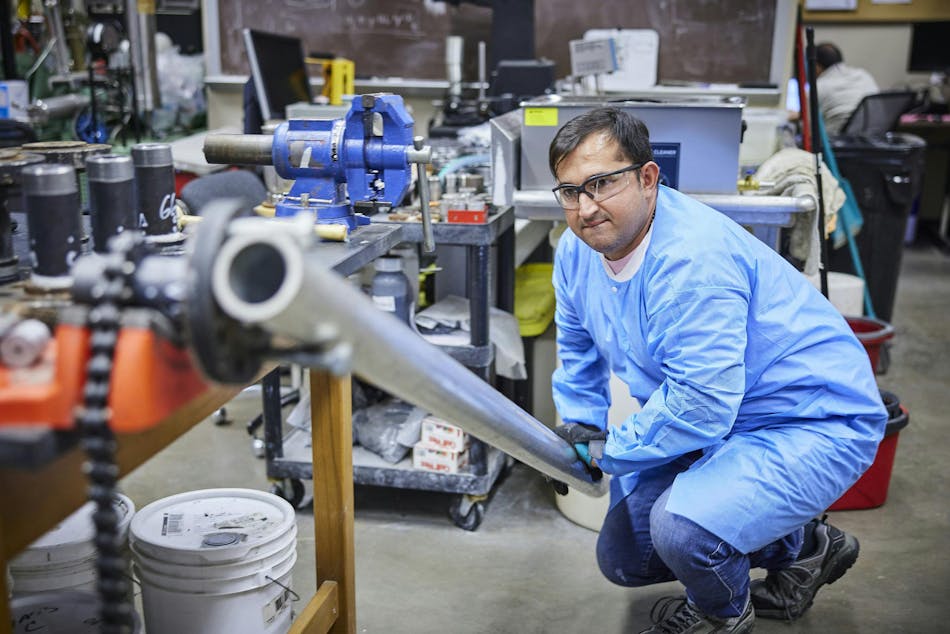
University of Oklahoma Mewbourne College of Earth and Energy researcher working in a lab. OU is leading the Oklahoma Carbon Hub, an initiative to research potential carbon storage sites.
>> In Other News: New Discovery Reveals How Diatoms Capture Carbon Dioxide So Effectively
Oklahoma Carbon Hub and the CarbonSAFE Initiative
The Oklahoma Carbon Hub is part of the U.S. Department of Energy's Carbon Storage Assurance Facility Enterprise (CarbonSAFE) initiative and a $518 million effort by the DOE's Office of Fossil Energy and Carbon Management to fund a third round of projects focused on carbon storage site characterization and permitting.
"We're emitting more and more carbon dioxide into the atmosphere over time. If we could capture that carbon dioxide at certain point sources, we could use these types of facilities to store it long-term," said Matthew Pranter, director of the OU School of Geosciences and the lead principal investigator on the grant. "With this grant and the Mewbourne College of Earth and Energy's history of expertise in the subsurface, OU will be able to directly impact and participate in reducing CO2 emissions into our atmosphere. We're trying to help with the global issue of climate change and mitigate or reduce the amount of CO2 that's going into the atmosphere."
Investigating Carbon Storage Potential in Oklahoma
The project will investigate three separate sites in Osage and Kay Counties as potential locations for the injection of approximately 54 million metric tons of CO2 over 20 years. For reference, the average car in the U.S. will produce one metric ton of CO2 over a three-month period.
The CVR fertilizer plant near Coffeyville, KS, the Azure sustainable aviation fuel production facility near Cherryvale, KS, and the Heimdal direct air capture units on the Osage Reservation in Oklahoma will store CO2 emissions through the Hub.
According to Matthew Pranter, Ph.D., director of the OU School of Geosciences and Eberly Family Chair, the lead principal investigator on the grant, subsurface geological storage is a potentially favorable option as oil and natural gas under the surface have been trapped for years and have not migrated to the surface.
Optimizing Subsurface Carbon Storage
For these potential sites, researchers contend it is important to characterize and quantify the spatial distribution of pore space and minerals in the subsurface and determine the optimal locations to drill injection wells. Drilling wells to acquire thick cores provides researchers direct observation of the rock, a crucial aspect of the project.
The target rock layer is the Arbuckle Group, a primarily limestone and dolomite formation. Pranter added that the Arbuckle Group in the study area has high porosity, while the rock formations above have low porosity and permeability, predicted to act as a seal to keep the stored CO2 in the Arbuckle Group. Porosity is the percentage of void space within a rock, allowing for potential storage within the rock formation. Permeability defines how easily material can flow through the pores of the rock.
About EnergyTech
EnergyTech is focused on mission-critical and large-scale energy users and their sustainability and resiliency goals. These include the commercial and industrial sectors, as well as the military, universities, data centers, and microgrids.
Many large-scale energy users, such as Fortune 500 companies, and mission-critical users, including military bases, universities, healthcare facilities, public safety, and data centers, are shifting their energy priorities to reach net-zero carbon goals within the coming decades. These efforts include plans for renewable energy power purchase agreements, on-site resiliency projects such as microgrids, combined heat and power, rooftop solar, energy storage, digitalization, and building efficiency upgrades.
Subscribe to the newsletter
Daily decarbonization data and news delivered to your inbox
Follow the money flow of climate, technology, and energy investments to uncover new opportunities and jobs.
Latest issues
-
One Company Bought 93% of All Carbon Removals on Earth
Inside This Issue 📊 Microsoft Bought 93% of Carbon Removals. Now What? 🌱 Symbiosis Announces New Carbon Offtake Agreements With Living Carbon 🛢️ Canada and Alberta Reach Agreement-in-Principle on ...
-
They're Burying Carbon Under the Sea. With Sewage.
Inside This Issue 🌿 Inherit Enters Operation With World's First Carbon Removal Project From Biogas in Norway 🏭 First Ammonia Bets on 2026 FID After Topsoe Exit 🧪 Hydrogen Filling With 90 Tonnes at...
-
Why Microsoft is Paying for 1 Million Tons of... Charcoal?
Inside This Issue 🌱 Liferaft Announces a 10-Year, 1 Million Carbon Removal Units Offtake Agreement with Microsoft 🏭 ExxonMobil Fires Up Second CCS Hub in Louisiana with NG3 🚢 Powering Global Marit...
Company Announcements
-
Cespira’s Hydrogen HPDI™ Fuel System Now in On-Road Testing
VANCOUVER, British Columbia, April 01, 2026 (GLOBE NEWSWIRE) -- Westport Fuel Systems Inc. ("Westport" or the “Company”) (TSX:WPRT / Nasdaq:WPRT), a leading supplier of advanced alternative fuel sy...
-
SuMo And Velocys Commission Fischer-Tropsch System, Advance UK Waste-to-SAF Demonstration
Key early milestone strengthens the technical and commercial case for the UK's emerging waste-to-SAF industry Sustainable Molecules Ltd (SuMo) and Velocys have successfully commissioned a UK-first...
-
Gevo, Inc. (NASDAQ: GEVO), a leader in sustainable fuels and carbon management, today announced that it is developing plans for a potential expansion at the site of its Gevo North Dakota facility (...
-
Volvo Group, Daimler Truck, cellcentric and Toyota Motor Corporation signed a non-binding Memorandum of Understanding to collaborate on fuel cell technology. Toyota Motor Corporation aims to inves...