
The carbon capture plant at Imperial College London has more than 250 pieces of operating equipment. From transmitters to storage terminals, the industry standard facility spans four floors of the Department of Chemical Engineering and is the breeding ground for more than 160 in-house and international students at the university.
Since 2012, the facility has provided hands-on experience in maintaining and operating a plant, with Imperial working with international engineering firm ABB to develop an AI tool, My Measurement Assistant+ (MMA+), which students can use to troubleshoot problems.
“For the future working lives of these students, AI, machine learning, and data analytics is going to be the key to what they do,” says Colin Hale, a senior teaching fellow for the department.
Omar Matar, the department head of chemical engineering at Imperial, adds: “AI and its use in process maintenance is now essential for climate energy engineering, and students must have access to AI as it is part of the future of in-demand skills.”
Recently, ABB has taken this capability a step further with generative AI (GenAI) – marrying MMA+ with Microsoft’s CoPilot – enabling the technology to assist with a wide range of maintenance issues and queries.
>> In Other News: Seer Launches Carbon Focused Division to Produce Licensed Biochar, Monetize and Tokenize Assets and Carbon Credits and Develop Turbine Blade Treatment Technology
Old problems, new tricks
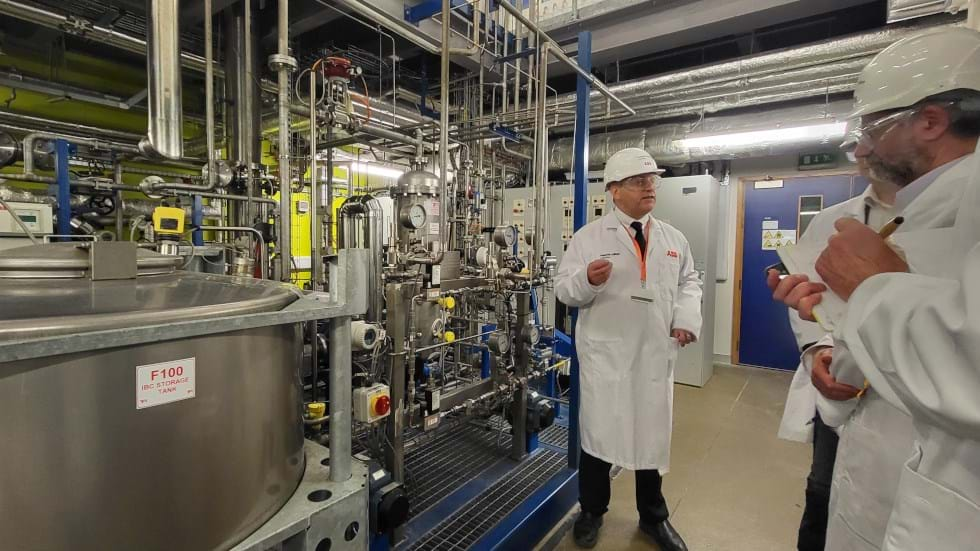
David Bowers walks us through the ground floor of the carbon capture pilot plant.
>> In Other News: Seer Launches Carbon Focused Division to Produce Licensed Biochar, Monetize and Tokenize Assets and Carbon Credits and Develop Turbine Blade Treatment Technology
“We have found in ABB, that roughly 80% of our customer issues can be solved by reading the equipment manual,” says David Bowers over the clanging of heavy machinery.
We are on the ground floor of the carbon capture pilot plant, where CO₂ capture and storage take place. This area houses key equipment, including two CO₂ absorption columns and an active steam line running through the room. Each piece of equipment features a dynamic QR code for easy access to information.
Bowers, product manager, process & DP flow for ABB, explains: “You are able to scan these codes and via the MMA+ application on our tablet device, you have all the information you need about that instrument.
“With CoPilot, the customer can use a chat box to ask MMA+ a question – say they need to fit a new product with terminals in, and they don’t know how to wire it correctly.”
Tablet in hand, Bowers asks CoPilot what terminals the facility already has in operation. In seconds, paragraphs of design specifications and instructions appear.
“CoPilot can immediately tell you what to do, and MMA+ has a series of videos which can show you what to do,” he says.
“Using the old support system, where customers would have to contact ABB for queries, it would take 14 hours to resolve. With the AI, it takes seconds.”
For this plant specifically, common issues can include unstable equipment temperatures or sorbent fluid in the wrong phase. Information about these issues is collected and fed back to the control room. Using the CoPilot feature, MMA+ can provide information on how to fix the problems, with video aids to show operators the process.
Learning agility
We climb a spiral staircase and enter the control room, a bustling space equipped with multiple screens monitoring the carbon capture systems.
As part of their second-year coursework, chemical engineering undergraduates use the facility to get hands-on experience of what working in a plant is like, and how dangerous it can be.
Every student must complete a “line walk,” which is a piping and instrumentation diagram (P&ID) test, a common exercise in the process industry used by engineers to understand how different equipment interact with each other.
Adam, a third-year undergraduate at Imperial, says: “There are often a dozen students in each class when teaching at the pilot plant. This technology can give immediate and direct attention to each student rather than them having to rely on one professor.
“Before this tech, we actually had to rely on walkie-talkies for audio, but now we have audio and visual aids that can help us.”
Measured progress
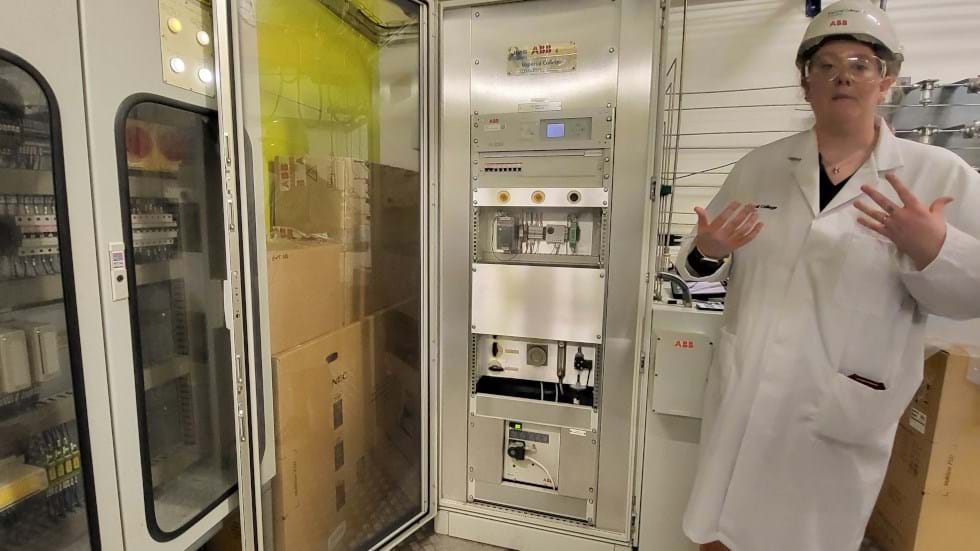
Ellie Sinyard-Jones demonstrates how MMA+ is used for diagnosing a gas analyser.
We get to the top floor of the plant, and the end of our tour, and are met by several metal units with flashing transmitters. These machines are gas analysers, used in emissions monitoring.
“I call them the product that nobody wants, but everyone needs to have,” says Sinyard-Jones, one of ABB’s product marketing managers.
Sinyard-Jones explains how the analysers are essential in understanding the environmental output of a plant – if they shut down, it’s an engineer’s job to make sure they are back up and running as fast as possible.
“That’s where this technology comes in. It can reduce a 30-minute task of looking through diagnostic documents to about two minutes, and in a format where both the team on site and in ABB’s support will have access to.”
Jaace, another undergraduate, adds: “The QR codes have been the most helpful addition to the course. When we do the line walk, we need to identify each piece of equipment. With wear and tear common in plants, the tags can be worn out.
“But with the codes we can identify more effectively what a piece of equipment is and get the necessary parameters, which is useful when we need to differentiate types of flow meters, for example.”
Jaace holds a tablet showing her call to an ABB operator.
Jaace shows us how the visual support function of MMA+ works in the control room. Holding the tablet, she guides an ABB support operator – who is on the video call – through a theoretical fault issue. The information from the call, which includes video and PDF notes of the resolution, is fed back to MMA+, which CoPilot can use to help operators if the issue happens again.
Sinyard-Jones adds: “I like to think of MMA+ as an enabler. It enables engineers to do their job in a time-effective way.”
Subscribe to the newsletter
Daily decarbonization data and news delivered to your inbox
Follow the money flow of climate, technology, and energy investments to uncover new opportunities and jobs.
Latest issues
-
Honeywell's Methanol-to-Jet Pathway Just Cleared Its Biggest Gate
Inside This Issue 🛫 Methanol-to-Jet Clears the ASTM Gate. What Changes Now? 🌿 InPlanet Selected as the Brazilian Supplier in Whirlpool Corporation's Durable Carbon Removal Portfolio 🧲 Climeworks A...
-
How Montana Renewables Cut $1B Out of Its SAF Budget
Inside This Issue 🌿 How Montana Renewables Cut MaxSAF Capex 89% 📋 IRS Issues Notice on 45Z Clean Fuel Production Tax Credit to Support Domestic Biofuel Production and American Agriculture 🌊 Natura...
-
Can Carba Really Remove Carbon Under $100?
Inside This Issue 🌬️ U.S. Bank Makes First Carbon Removal Purchase with Carba's Minnesota Biochar Project 🏭 Michigan's CCS Primacy Bid Could Reshape Great Lakes Industry 🏗️ Europe's Largest Carbo...
Company Announcements
-
In the largest rice methane offtake to date, Mitti Labs will deliver one million high-integrity credits to Google by 2030 BENGALURU, India and SAN FRANCISCO, Sept. 10, 2026 /PRNewswire/ -- Deep-t...
-
Climeworks Announces Key Performance Improvements at Mammoth
Over the past 18 months, technology upgrades have more than doubled CO₂ capture performance in upgraded collector containers while reducing operating costs by more than 50%. Zurich, Switzerland | ...
-
A team member at one of InPlanet’s partner farms inspects freshly harvested citrus fruit to assess its quality Remineralizer integrated into the soil following field application, beginning the enh...
-
Methanol-to-Jet Clears ASTM Gate. What Changes Now?
Methanol-to-jet has crossed a critical technical gate for commercial aviation fuel. ASTM D7566-26a, the active specification updated July 30, 2026, incorporates methanol into the Annex A5 alcohol-t...