
The pressure to reduce carbon emissions is forcing a major shift in the oil industry. Australian oil company Santos is taking a bold step with its new Alaskan development, the Pikka oil field, which they claim will be "climate-friendly."

>> In Other News: ATCO EnPower, Shell Move Forward with Atlas Carbon Storage Hub Project
Santos in Alaska: A New Player on the North Slope
Santos, a well-established Australian oil and gas company, is entering the Alaskan scene with the Pikka project. This significant development on Alaska's North Slope holds the potential to reshape the state's oil industry.
Strategies for Decarbonization: Beyond Offsets
Santos' approach goes beyond the typical industry practice of carbon offsets, which involve investing in projects that reduce carbon elsewhere to compensate for emissions produced. Their plan incorporates two innovative strategies:
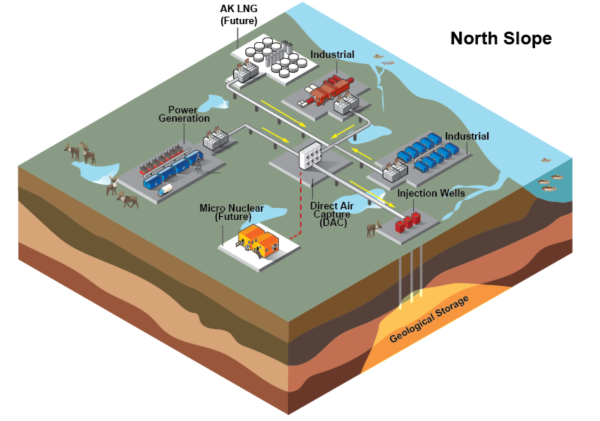
Carbon Capture and Storage (CCS): Santos aims to capture emissions directly from North Slope power plants and drill pads. They also plan to explore "direct air capture," a new technology that sucks carbon dioxide out of the air. The captured carbon would then be safely stored underground.
Offsets: Santos acknowledges the role of offsets in achieving net-zero emissions. They might invest in projects like reforestation or renewable energy initiatives to compensate for the emissions generated by burning the extracted oil.
Impact on Alaska's Oil Industry
Santos' commitment to decarbonization stands in contrast to the practices of established Alaskan oil companies like ConocoPhillips. This could influence future regulatory policies and public perception within the state. The potential economic benefits include job creation in new technology sectors and a more sustainable long-term future for Alaska's oil industry.
Broader Implications for Global Carbon Reduction
Santos' strategies align with the goals of the Paris Agreement, a landmark international treaty on climate change. Their success could inspire other oil companies to adopt similar practices. However, the scalability of CCS and offsets as solutions for large-scale carbon reduction remains a question.
Challenges and Skepticism
Concerns exist regarding the cost-effectiveness and technological feasibility of CCS and direct air capture. Environmental groups criticize these technologies as a potential delay tactic for transitioning away from fossil fuels altogether. Transparency and accountability are crucial to address concerns about "greenwashing," a tactic where companies create a misleading impression of environmental responsibility.
A Promising Step Towards a Sustainable Future
Santos' innovative approach to decarbonization in Alaska represents a significant step forward. While challenges remain, their efforts hold promise for positive impacts on both local and global scales. Continued investment in research and development of these technologies is crucial for a future where the oil industry can coexist with a healthy planet.
Subscribe to the newsletter
Daily decarbonization data and news delivered to your inbox
Follow the money flow of climate, technology, and energy investments to uncover new opportunities and jobs.
Latest issues
-
North America’s Carbon Removal Year in Review: Winners, Losers, Surprises
Inside This Issue 🌎 North America's Carbon Removal Year in Review: The Deals, Policies, and Milestones That Shaped 2025 🚢 Hapag-Lloyd And North Sea Container Line Win ZEMBA Second E-Fuel Tender 🪨 ...
-
CCS Just Got Cheaper Than Anyone Expected
Inside This Issue 🧪 Shrinking the CCS Energy Penalty: A Molten Borate Breakthrough Promises Viability for Hard-to-Abate Canadian Oil & Gas 👤 Syntholene Energy Corp Appoints Former CEO of Carbo...
-
The CO₂ Pipeline Everyone Said Couldn’t Happen
Inside This Issue 🛠️ Tallgrass Found the CO2 Pipeline Formula Others Missed 🚂 HyOrc & Zeltech Advance Practical Locomotive Retrofit Pathway as U.S. Rail Emissions Face Growing Scrutiny 💰 Secre...
Company Announcements
-
Gevo, Inc. (NASDAQ: GEVO) announced that BeZero Carbon Ltd., a global carbon rating agency, has upgraded its rating for the Gevo North Dakota (GND) facility, which has carbon capture and storage, t...
-
Electric Hydrogen Selected By Synergen Green Energy For 240MW U.S. Green Ammonia Project
Electric Hydrogen, U.S. manufacturer of advanced electrolyzer plants, announced it has been selected by Synergen Green Energy Inc., a leading commercial-scale developer of green hydrogen and ammoni...
-
Neste and the Cathay Group have agreed on the supply of Neste MY Sustainable Aviation Fuel™ for the group’s aviation operations across three major aviation regions: Europe, the United States, and A...
-
Wicomico County Selects Waga Energy To Upgrade Landfill Gas To RNG In Maryland
Wicomico County has selected Waga Energy to build, own, operate, and maintain an RNG production unit at the Newland Park Landfill in Salisbury, Maryland. When in operation, the plant will provide m...