
Researchers have developed an air filter capable of absorbing carbon emissions in building ventilation systems while decreasing energy consumption, according to research published this month in Science Advances.
Using distributed carbon nanofibers, the direct air capture (DAC) air filter can remove carbon dioxide without requiring additional energy supply. The electrical and optical properties of the carbon nanofibers also allow the adsorbent material to be regenerated by solar thermal or electrothermal methods with low carbon footprints, the researchers say.
Although direct air capture technologies that remove CO2 from the atmosphere show potential in carbon neutralization, the massive land use and capital required for centralized plants and energy required to run them has limited wide deployment, the paper says. For that reason, the technology might work best if it’s decentralized. “Inferring from the historical development from centralized solar farms to distributed rooftop solar panels, it is anticipated DAC should become distributed to fully use its potential to accelerate our efforts in combating global warming,” researchers wrote.
Similar to existing rooftops providing access to solar energy without additional land use, buildings can also support direct air capture through existing ventilation systems, the researchers said. Because of the high proportion of time people spend indoors, around 90% in industrialized countries, and the amount of ventilation required to ensure indoor air quality and occupancy comfort, integrating and retrofitting DAC units to air filters in building indoor ventilation systems also provides potential for its widespread distribution and abundant resources, according to the paper.
In addition, distributed DAC technologies can reduce energy consumption for HVAC systems by decreasing outdoor ventilation requirements, which account for 30% of global energy consumption and 10% of global greenhouse gas emissions, the researchers say, citing research by the National Science Foundation.
To test the potential of these technologies, researchers developed a carbon nanofiber (CNF)-based DAC air filter that can absorb CO2 within the ventilation system in buildings, which not only has a high DAC capacity but can reduce HVAC energy consumption.
>> In Other News: ICAO General Assembly 2025 Reaffirms Aviation’s Commitment to Net-Zero by 205
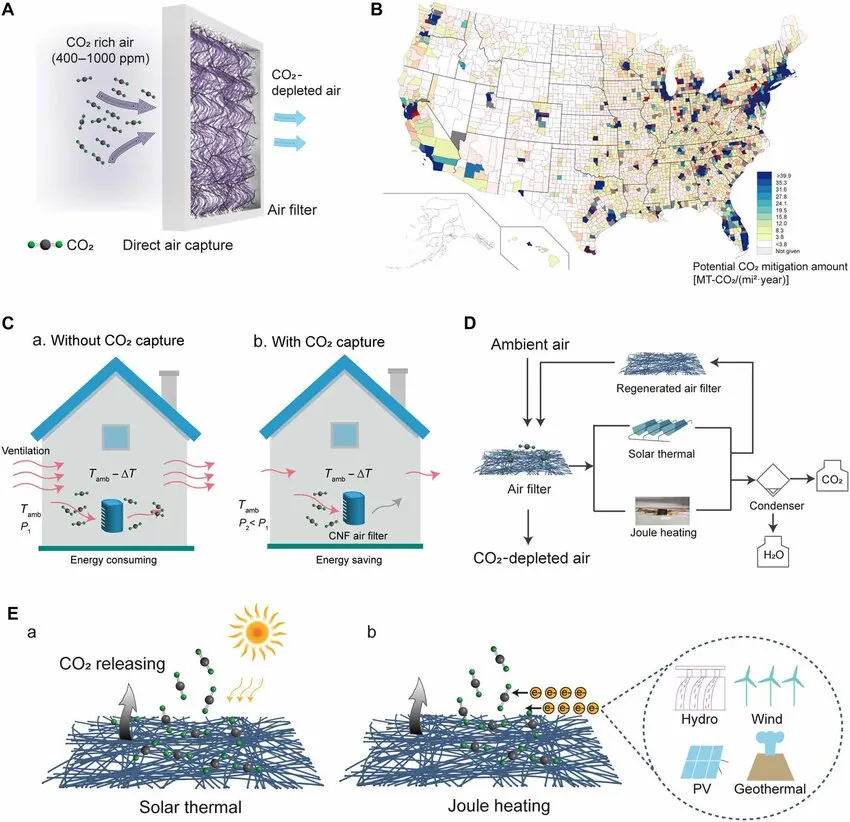
Graphic showing the concept and advantages of direct air capture, or DAC, air filter using carbon nanofiber-based adsordents. Retrieved from ResearchGate, Science Advances on October 29, 2025
“The large surface area and porous structure of the CNF enable a high PEI mass loading while maintaining fast adsorption and desorption kinetics, leading to a remarkable carbon capture capacity,” the researchers wrote. “CNF has excellent solar absorptivity, electrical conductivity, and low heat capacity, enabling the adsorbent to be regenerated by solar thermal and/or electrothermal methods, both with renewable energy sources.”
The study found four advantages to the distributed DAC air filter, including low capital needed for wide CO2 removal; improved building heating and cooling energy efficiency; the promotion of public health and productivity; and efficiency and low carbon footprint regeneration.
Particularly, if DAC air filters are retrofitted into buildings downstream after conventional air filters, then operators can supply CO2-lean air for indoor occupants without additional fans or pumps, the researchers say. Low indoor CO2 concentrations lower the demand for fresh air intake, in turn benefiting HVAC energy efficiency, the paper says.
Through life cycle assessment, the CNF air filter exhibited a carbon removal efficiency of 92.1% “from cradle to grave,” researchers wrote, estimating a cost of $209 to $668 in capturing and storing one ton of CO2 from direct air. Globally, the DAC air filter has the potential to remove up to 596 metric tons of CO2 per year, according to the paper.
Subscribe to the newsletter
Daily decarbonization data and news delivered to your inbox
Follow the money flow of climate, technology, and energy investments to uncover new opportunities and jobs.
Latest issues
-
Honda Repositions Hydrogen Strategy After Michigan Pivot
Inside This Issue 🚪 Honda Exits Fuel Cell Partnership as Hydrogen Pivots ♻️ A Breakthrough That Turns Exhaust CO2 Into Useful Materials ✈️ FedEx Takes Delivery of SAF at Dallas Fort Worth and New ...
-
QIMC Hits 5,558 ppm Hydrogen in Nova Scotia Discovery
Inside This Issue 🔍 QIMC Hits 5,558 ppm Hydrogen in Nova Scotia Discovery 🏗️ Haffner Energy Launches the C-iC Modular Units Line to Unlock Financing for Mid-Sized Biofuel Projects 🌱 CF Industries,...
-
$77.5B Carbon Pipeline Just Got Federal Backing
Inside This Issue 💰 Congress Preserves Carbon Management Funding in FY26 Bill Heading to Trump's Desk 🧪 HYCO1 Announces Three U.S. Patents Powering the Most Advanced Syngas Production Platform Thr...
Company Announcements
-
FedEx Takes Delivery of SAF at Dallas Fort Worth and New York–JFK International Airports
In 2025, FedEx deployed blended SAF for the first time at five major U.S. airports. MEMPHIS, Tenn., Jan. 29, 2026 – FedEx introduced sustainable aviation fuel (SAF) at two more U.S. airports towar...
-
Air Products (NYSE: APD), the world’s leading supplier of hydrogen, today announced that it was recently awarded supply contracts from the National Aeronautics and Space Administration (NASA) total...
-
Green Ammonia Demonstration Plant of JGC Begins Producing Ammonia Using Hydrogen From Asahi Kasei
Asahi Kasei Corp. is pleased to announce that a demonstration plant1 utilizing green ammonia production technology of JGC Holdings Corporation (JGC) began producing ammonia in January 2026, using h...
-
A Breakthrough That Turns Exhaust CO2 Into Useful Materials
Summary: Scientists have created a device that captures carbon dioxide and transforms it into a useful chemical in a single step. The new electrode works with realistic exhaust gases rather than re...