
EIA: US Biodiesel And Renewable Diesel Imports Fall Sharply In 2025 After Tax Credit Change
Published by Todd Bush on September 5, 2025
September 5, 2025BY U.S. Energy Information Administration
U.S. imports of biodiesel and renewable diesel significantly decreased in the first half of 2025 (1H25) compared with the same period in previous years. This decline is primarily due to the loss of tax credits for imported biofuels and generally lower domestic consumption of these fuels.
Renewable diesel and biodiesel are biomass-based diesel fuels that can replace petroleum-based distillate and be used to comply with the Renewable Fuel Standard blending requirements for refiners administered by the U.S. Environmental Protection Agency.
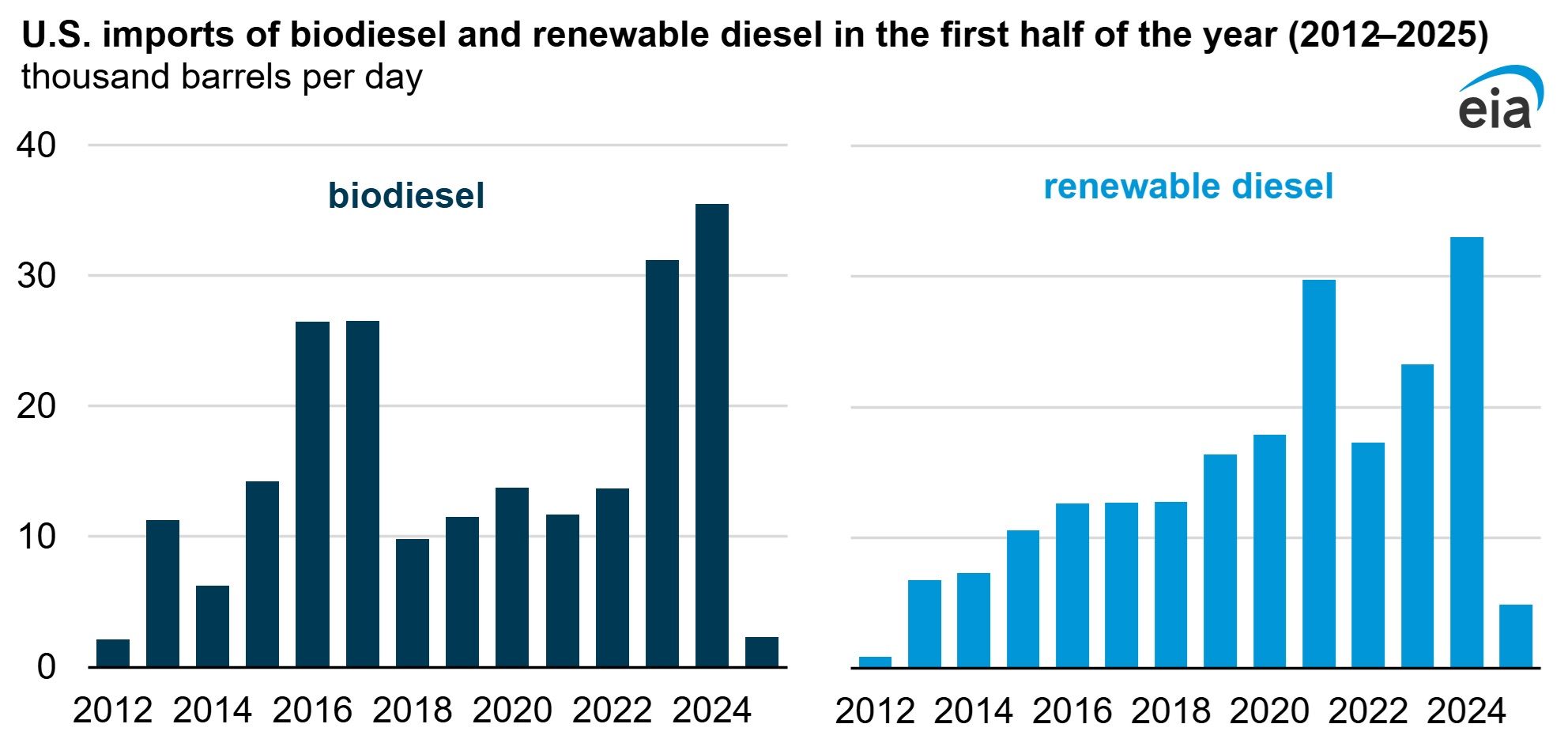
Data source: U.S. Energy Information Administration, Petroleum Supply Monthly Note: Consumption is defined as product supplied plus refinery and blender net inputs.
>> In Other News: US SAF Production Hits Critical 30,000 BPD Milestone
In 1H25, U.S. biodiesel imports averaged 2,000 barrels per day (b/d), a sharp drop from 35,000 b/d in 1H24. Renewable diesel imports averaged 5,000 b/d, down from 33,000 b/d in 1H24. These import levels were the lowest for the first half of any year since 2012, when U.S. biodiesel consumption was less than half of 2024 levels and renewable diesel consumption was negligible.
One key reason for the sharp drop in biodiesel and renewable diesel imports in early 2025 is the loss in tax credits for imported biofuels. Before 2025, both imported and domestically produced biodiesel and renewable diesel received a $1 per gallon blender’s tax credit (BTC). The Inflation Reduction Act replaced the BTC with the Section 45Z Clean Fuel Production Credit in 2025, which only applies to domestic production. This tax credit change placed imports at a relative economic disadvantage.
A second reason biodiesel and renewable diesel imports dropped in 1H25 was low U.S. consumption of these fuels because of uncertainty around blending requirements and negative profit margins for blending biofuels. Compared with 1H24, U.S. consumption of renewable diesel was down about 30% in 1H25, and biodiesel consumption was down about 40%. This lower consumption reduced demand for both imported and domestically produced biofuels.
The combination of poor blending margins and the relative economic disadvantage for imported biofuels led domestic blenders to rely on domestically produced biofuels for the smaller amounts they were blending. As a result, international biofuel producers found fewer profitable opportunities to send product to the United States. For example, Neste, the producer of all of the renewable diesel imported to the United States, reported a lower share of exports going to the United States in 1H25 than in 1H24. Looking ahead, we expect U.S. consumption of biodiesel and renewable diesel to increase as the year progresses to meet existing RFS mandates, but imports of the fuels will likely remain low because of the change in tax policy.
Although we do not explicitly forecast biodiesel and renewable diesel imports in the Short-Term Energy Outlook, we do forecast U.S. net imports. We assume low imports for both products in the forecast period and forecast U.S. biodiesel net imports in 2025 and 2026 to be their lowest since 2012.
About U.S. Energy Information Administration
The U.S. Energy Information Administration (EIA) collects, analyzes, and disseminates independent and impartial energy information to promote sound policymaking, efficient markets, and public understanding of energy and its interaction with the economy and the environment.
Subscribe to the newsletter
Daily decarbonization data and news delivered to your inbox
Follow the money flow of climate, technology, and energy investments to uncover new opportunities and jobs.
Latest issues
-
LNK Energies Targets $6.50 Hydrogen With No Federal Subsidies
Inside This Issue 🚛 MIT Startup Says It Can Turn Diesel Trucks Into Cheaper Hydrogen Haulers, See It at Disrupt 🏭 Baytown City Council Briefs: ExxonMobil Blue Hydrogen Agreement Approved 🌎 Colorad...
-
Why Gulf Coast CCS Teams Are Watching Liverpool Bay
Inside This Issue 💂 Eni’s Douglas Platform Sets the Offshore CCS Blueprint 🌲 Pacolet Milliken Expands Its Biomass Platform With the Acquisition of Georgia Renewable Power 🧪 Metacon Receives EU Fun...
-
Who Bought Gevo’s $50M in 45Z Credits?
Inside This Issue ⛽ Gevo Sells $70M in 45Z Credits to a New Kind of Buyer 🌱 South Pole, Gaïago, and Gold Standard Issue European Soil Carbon Credits, Unlocking Verified Regenerative Agriculture Re...
Company Announcements
-
MIT Startup Says It Can Turn Diesel Trucks Into Cheaper Hydrogen Haulers — See It at Disrupt
Diesel fuel powers everything from shipping to agriculture, and with prices hitting record highs in recent weeks, governments around the world are scrambling to contain the fallout. For now, that’...
-
Gevo Announces First Multi-Year Carbon Removal Credits Supply Agreement Through CEEZER
Three-Year Delivery of Durable Carbon Removals from Gevo North Dakota to a Leading Global Enterprise Software Company Gevo will supply durable carbon dioxide removal (CDR) credits from Gevo North...
-
Continental Refining to Double Biodiesel Capacity at Somerset Complex
SOMERSET, Ky. — Continental Refining Company is expanding its biodiesel production facility to double capacity at its Somerset industrial complex, while its soybean processing plant will remain idl...
-
Groundwork BioAg Secures 'BBB' BeZero Carbon Rating
The rating places Groundwork BioAg among the highest-rated agricultural soil carbon projects, opening a scalable pipeline of independently rated, high-integrity removals for corporate buyers. MAZO...