
With a newly developed nanofiber filter, air conditioners, heaters and other ventilation systems could remove airborne carbon dioxide while cutting energy costs

A carbon nanofiber-based direct air capture filter developed by the University of Chicago Pritzker School of Molecular Engineering could turn existing building ventilation systems into carbon-capture devices while cutting homeowners’ energy costs. Through life cycle assessment, the air filter shows a carbon removal efficiency of 92.1% from cradle to grave.
In a paper recently published in Science Advances, researchers from the lab of Asst. Prof. Po-Chun Hsu developed a distributed carbon nanofiber direct air capture (DAC) filter that could potentially turn every home, office, school or other building into a small carbon-capture system working toward the global problem of airborne CO₂.
“Every building already has ventilation systems that move large volumes of air every day. By integrating our carbon-capture filters into these systems, we can remove carbon directly from the air without building new plants or using extra land,” said Ronghui Wu, an assistant professor at Nanyang Technological University who was a postdoctoral researcher in Hsu’s lab at the time of the research. “It’s a practical and scalable way to make carbon capture part of everyday infrastructure.”
A life-cycle analysis shows that—even after factoring extra CO₂ released by everything from manufacture and transportation to maintenance and disposal—the new filter is 92.1% efficient in removing carbon dioxide from the air.
On the largest possible level, replacing every building air filter with this new model could remove up to 596 megatonnes of carbon dioxide from the air—the equivalent of taking 130 million cars off the road for a year.
But on the individual level, every home, office or school that switches to DAC filters should expect lower energy bills. One study from 2024 indicated those savings could be up to 21.66%.
“Normally, air-conditioning systems need to pull in a lot of outside air to keep indoor carbon dioxide levels low,” Wu said. “Our filter removes carbon dioxide inside the building, so the system doesn’t have to bring in as much outside air. That means less air needs to be heated or cooled, which reduces the energy consumption in HVAC.”
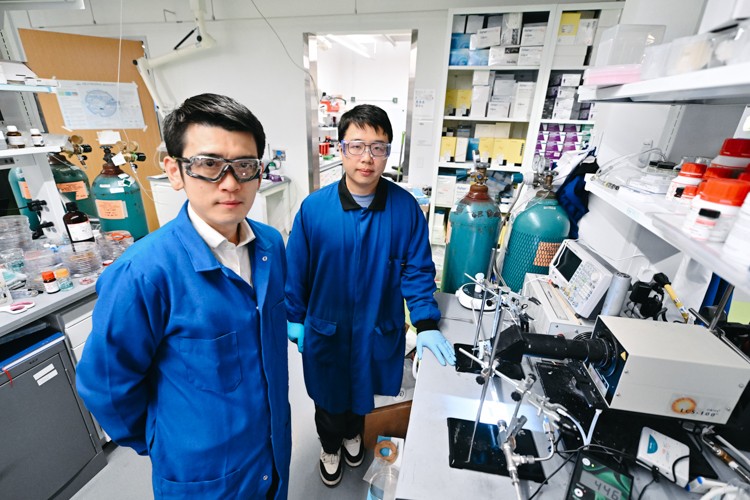
UChicago Pritzker School of Molecular Engineering Asst. Prof. Po-Chun Hsu and PhD student Yuanke Chen, a co-author of the new paper. (Photo by Elaina Eichorn)
>> In Other News: Schneider Electric Accelerates Industrial Decarbonization At COP30
Regenerated by sunlight
Current direct air capture technologies are massive, corporate-owned affairs requiring major investments in land, power and other resources. Hsu likens it to solar power—a technology once confined to utility-owned solar farms, but now a network of large farms and small rooftop panels working toward the same energy goal.
“These rooftop panels are possible because sunlight is more or less uniform. The CO₂ from the air is similar,” Hsu said. “We propose, using experiment and computation to demonstrate, that indeed we could retrofit our buildings to be part of the decarbonization effort.”
The team’s carbon nanofiber–based polyethylenimine (PEI) material would create a reusable filter that could slot into existing HVAC systems, similar to the air-purifying high-efficiency particulate arresting (HEPA) filters. Unlike HEPA filters, which head to landfills every six months to a year, the carbon-capture filters would have the CO₂ removed regularly and be returned to service.
Hsu and Wu envision an ecosystem where municipal waste management systems haul off the filters weekly with the garbage and recycling.
“They would have these saturated filters from household ventilation systems and commercial buildings, then replace them with new ones,” Hsu said. “They’d ship the saturated one to a centralized facility to dissolve the CO₂ or make it into highly concentrated CO₂ to capture or, even better, convert to high-value chemicals or fuel.”
The new material was specifically designed to show excellent solar absorptivity. This means the CO₂ can be removed from a saturated filter through solar thermal methods—including literally leaving the filter out under the sun.
“It has to be able to regenerate using renewable energy,” Hsu said. “The most common way to regenerate CO₂ with solvent is by heating it up. If you burn fossil fuels to heat up the solvent, then you will probably end up emitting more carbon dioxide than you capture.”
While the global benefits would rise as more places adopt the filter, lower energy bills aren’t the only benefits an individual would see from installing a direct air capture filter.
“This kind of air filter can also improve indoor air quality, especially in places like classrooms and offices where many people share the same space,” Wu said. “By keeping indoor carbon dioxide levels low, it helps people stay more alert, focused, and healthy.”
Citation: “Distributed direct air capture by carbon nanofiber air filters,” Wu et al, Science Advances, October 17, 2025. DOI: 10.1126/sciadv.adv6846
Subscribe to the newsletter
Daily decarbonization data and news delivered to your inbox
Follow the money flow of climate, technology, and energy investments to uncover new opportunities and jobs.
Latest issues
-
The US Hasn't Made Heavy Water Since 1982
Inside This Issue ⚛️ Aternium Completes FEED Studies for US Hydrogen, Heavy Water Project 🐄 Google, McKinsey Strike Brazil Carbon Removal Deal With Silvopasture Project 🔧 Cummins Selects Stargate ...
-
Why Colorado’s Koloma Has Japan’s Largest Utility Hooked
Inside This Issue ⚡ JERA Invests in Koloma to Explore Natural Hydrogen as a Future Low-Carbon Energy 🔬 New CATF Tool Provides Framework for Self-Assessment and Strengthening of Biomass Carbon Remo...
-
LNK Energies Targets $6.50 Hydrogen With No Federal Subsidies
Inside This Issue 🚛 MIT Startup Says It Can Turn Diesel Trucks Into Cheaper Hydrogen Haulers, See It at Disrupt 🏭 Baytown City Council Briefs: ExxonMobil Blue Hydrogen Agreement Approved 🌎 Colorad...
Company Announcements
-
A new interactive tool from Clean Air Task Force (CATF) provides a practical framework for the self-assessment and strengthening of biomass carbon removal (BiCRS) protocols to help ensure that carb...
-
LanzaJet Secures Financing to Scale SAF Production and Supply Global Customers
CHICAGO, Oct. 15, 2026 (GLOBE NEWSWIRE) -- LanzaJet, Inc., a leading next-gen fuels technology company and fuels producer, today announced fully committed new financing of at least $20 million to s...
-
44.01 and Frontier Advance Permanent CO₂ Storage Through In-Situ Mineralization
44.01's in-situ mineralization (ISM) process turns CO₂ into solid rock underground in a few years, after which the risk of reversal is functionally zero. >> In Other News: JERA Invests in ...
-
JERA Invests in Koloma to Explore Natural Hydrogen as a Future Low-Carbon Energy
JERA Co., Inc. (JERA), through its corporate venture capital arm JERA Ventures, has invested in Koloma, Inc. (Koloma), a U.S.-based natural hydrogen exploration and development company. The invest...