
KAIST AI Advances CO₂-Selective Material Discovery
Published by Todd Bush on June 30, 2025
_Korea Advanced Institute of Science and Technology_In order to help prevent the climate crisis, actively reducing already-emitted CO₂ is essential. Accordingly, direct air capture (DAC) — a technology that directly extracts only CO₂ from the air — is gaining attention. However, effectively capturing pure CO₂ is not easy due to water vapor (H₂O) present in the air. KAIST researchers have successfully used AI-driven machine learning techniques to identify the most promising CO₂-capturing materials among metal-organic frameworks (MOFs), a key class of materials studied for this technology.
>> In Other News: Arca’s Carbon Removal Methodology Successfully Validated by DNV
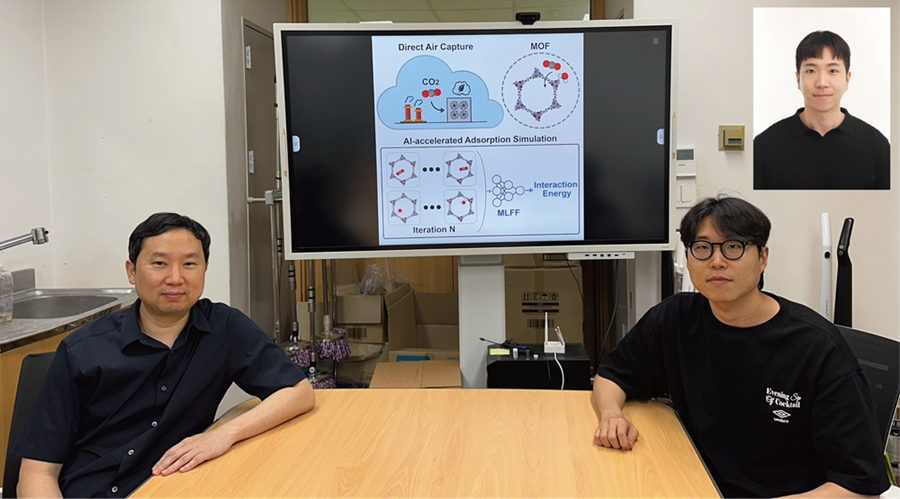
Photo 1. (From left) Professor Jihan Kim, Ph.D. candidate Yunsung Lim and Dr. Hyunsoo Park of the Department of Chemical and Biomolecular Engineering
KAIST (President Kwang Hyung Lee) announced on the 29th of June that a research team led by Professor Jihan Kim from the Department of Chemical and Biomolecular Engineering, in collaboration with a team at Imperial College London, has developed a machine-learning-based simulation method that can quickly and accurately screen MOFs best suited for atmospheric CO₂ capture.
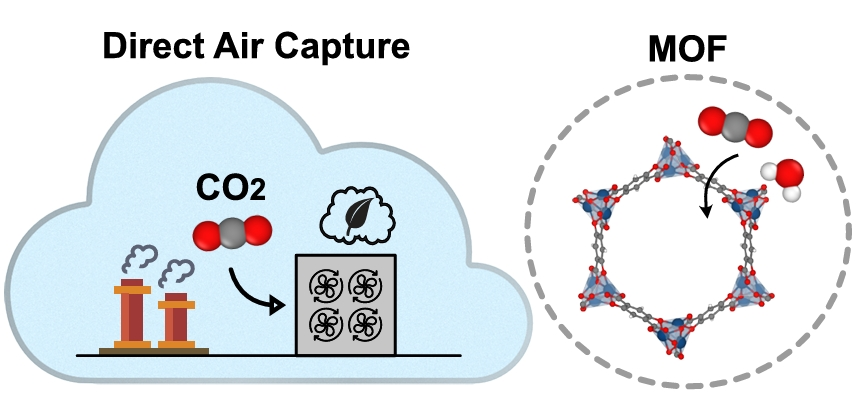
igure 1. Concept diagram of Direct Air Capture (DAC) technology and carbon capture using Metal-Organic Frameworks (MOFs). MOFs are promising porous materials capable of capturing carbon dioxide from the atmosphere, drawing attention as a core material for DAC technology.
To overcome the difficulty of discovering high-performance materials due to the complexity of structures and the limitations of predicting intermolecular interactions, the research team developed a machine learning force field (MLFF) capable of precisely predicting the interactions between CO₂, water (H₂O), and MOFs. This new method enables calculations of MOF adsorption properties with quantum-mechanics-level accuracy at vastly faster speeds than before.
Using this system, the team screened over 8,000 experimentally synthesized MOF structures, identifying more than 100 promising candidates for CO₂ capture. Notably, this included new candidates that had not been uncovered by traditional force-field-based simulations. The team also analyzed the relationships between MOF chemical structure and adsorption performance, proposing seven key chemical features that will help in designing new materials for DAC.
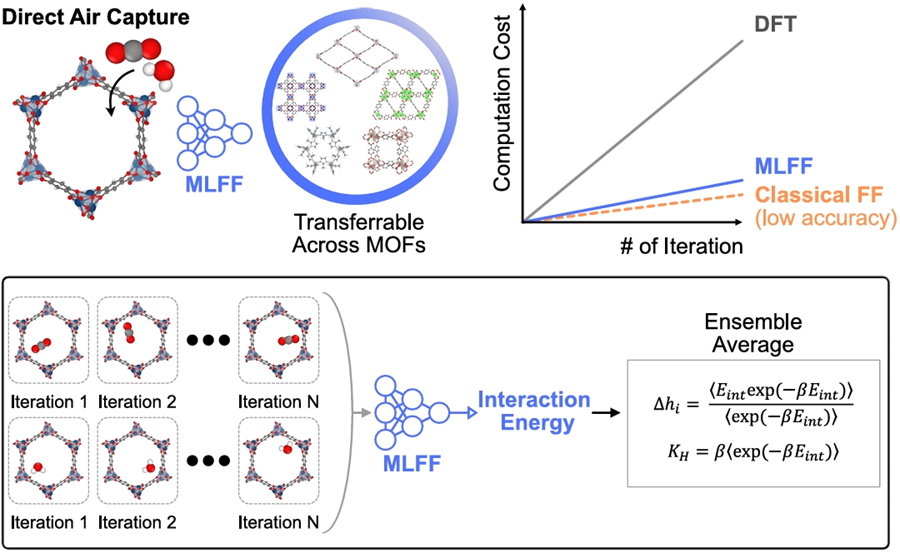
Figure 2. Concept diagram of adsorption simulation using Machine Learning Force Field (MLFF). The developed MLFF is applicable to various MOF structures and allows for precise calculation of adsorption properties by predicting interaction energies during repetitive Widom insertion simulations. It is characterized by simultaneously achieving high accuracy and low computational cost compared to conventional classical force fields.
This research is recognized as a significant advance in the DAC field, greatly enhancing materials design and simulation by precisely predicting MOF-CO₂ and MOF-H₂O interactions.
The results of this research, with Ph.D. candidate Yunsung Lim and Dr. Hyunsoo Park of KAIST as co-first authors, were published in the international academic journal Matter on June 12.
※Paper Title: Accelerating CO₂ direct air capture screening for metal–organic frameworks with a transferable machine learning force field※DOI: 10.1016/j.matt.2025.102203
This research was supported by the Saudi Aramco-KAIST CO₂ Management Center and the Ministry of Science and ICT's Global C.L.E.A.N. Project.
Subscribe to the newsletter
Daily decarbonization data and news delivered to your inbox
Follow the money flow of climate, technology, and energy investments to uncover new opportunities and jobs.
Latest issues
-
Can AirCapture’s Microwaves Cut DAC’s Energy Cost?
Inside This Issue 🌬️ Aircapture's Patented Microwave Direct Air Capture Technology Wins Tencent CarbonX 2.0 Award 🗾 Fujifilm, Tokyo Gas and TGES Agree to Supply City Gas Linked to Biomethane Produ...
-
380 MW of AI Power, Powered by Fuel Cells
Inside This Issue ⚡ FuelCell Energy and Fit Energy Announce Strategic Agreement for Up to 380 MW of Clean Power for Data Centers 🧭 China's Renewable Energy Mandates Set the Stage for Expanded Hydr...
-
250,000 Tonnes of CO2: One Shipping Deal
Inside This Issue 🚢 Fortescue and CMB.TECH Sign Milestone Agreement for 12 Ammonia Bulkers to Accelerate Zero-Emissions Shipping 🌱 Mati Carbon Hits New Bar for Carbon Removal Certification With Is...
Company Announcements
-
Aircapture's Patented Microwave Direct Air Capture Technology Wins Tencent CarbonX 2.0 Award
Aircapture will use the award to scale its DAC system engineered to reduce the cost of carbon capture at scale BERKELEY, Calif., June 25, 2026 /PRNewswire -- Aircapture, a Berkeley-based direct ai...
-
Groundwork BioAg Issues First Verified Carbon Credits Under Rootella Carbon® Program
Milestone issuance of high-durability soil carbon credits, the first to be issued under Verra VM0042 standard in the US, delivers highly-scalable carbon removal at a fraction of durable CDR costs. ...
-
HOPA Ports and the Mississaugas of the Credit Business Corporation (“MCBC”), the entity representing the business development interests of the Mississaugas of the Credit First Nation (“MCFN”), have...
-
Deep Sky Corporation today announced a strategic investment from Sumitomo Mitsui Banking Corporation (SMBC), supporting the advancement of Japan's carbon dioxide removal (CDR) and direct air captur...