
World's First Liquefied CO2 Carrier Equipped with Wind Challenger (Hard Sail Wind-assisted Propulsion Systems) - Approval in Principle (AiP) Obtained for a Three Units Design-
Published by Todd Bush on April 27, 2026
Mitsui O.S.K. Lines, Ltd. (MOL; President & CEO: Jotaro Tamura) today announced that MOL has obtained Approval in Principle (AiP) (Note 1) from the classification society, Nippon Kaiji Kyokai (ClassNK), on April 14, 2026 for a liquefied CO2 carrier (Note 2) equipped with three units of Wind Challenger, a hard sail wind-assisted propulsion system (Note 3). This Vessel design was jointly developed with Samsung Heavy Industries Co., Ltd. (SHI; Headquarters: Seoul, Republic of Korea), and the design aims to reduce fuel consumption and greenhouse gas (GHG) emissions by utilizing wind power for the cross-border transportation of liquefied CO2.
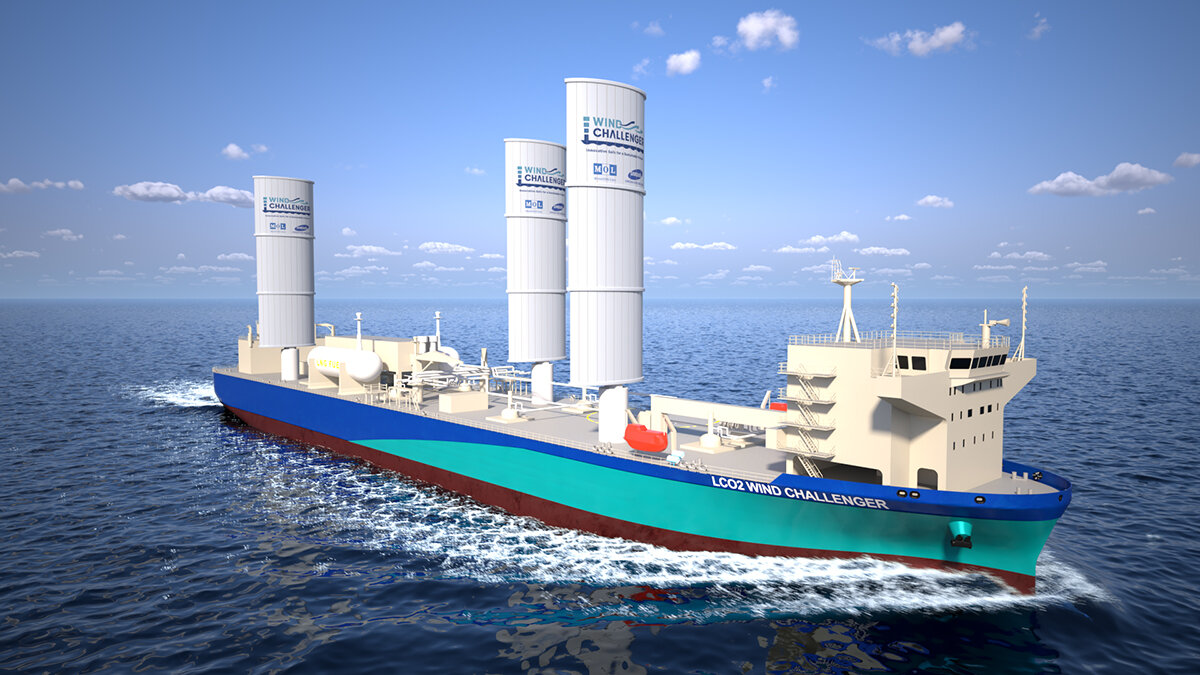
CG rendering of a liquefied CO2 carrier equipped with three Wind Challenger units
>> In Other News: Canada's Natural Hydrogen Bet Just Got a Lot Bigger
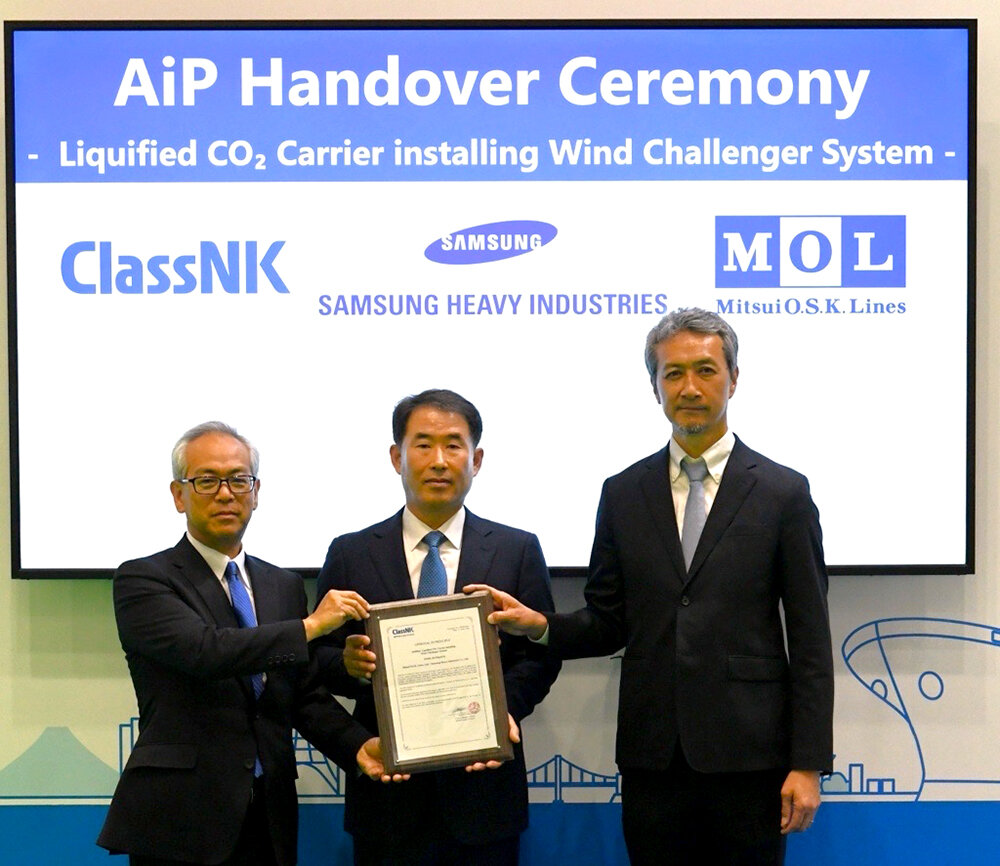
The AiP Award Ceremony
The AiP Award Ceremony for this vessel design was conducted on April 22, 2026, at the ClassNK booth during Sea Japan 2026, held at Tokyo Big Sight.
The AiP covers a vessel design for a 40,000 m3 cargo tank capacity liquefied CO2 carrier intended for cross-border CO2 transportation and equipped with three Wind Challenger units. In this vessel design, the navigation bridge and accommodation spaces are arranged toward the bow to ensure improved visibility required for ship handling while enabling the installation of three units of the Wind Challenger. By harnessing wind power to assist engine propulsion, the vessel is expected to achieve reductions in fuel consumption and GHG emissions. Moreover, the vessel design incorporates various safety considerations, including a safety passage between engine room and accommodation, optimized arrangements of navigation lights and placement of lifeboats. MOL has been working closely with SHI and ClassNK to conduct a HAZID (Hazard Identification Study) (note 4) to identify and assess risks specific to liquefied CO2 carriers equipped with wind-assisted propulsion systems and confirmed the technical feasibility and safety of the vessel concept.
Wind Challenger is a rigid sail system capable of automatic extension, retraction, and rotation. By effectively utilizing wind power while maintaining safe navigation, it contributes to a reduction in fuel consumption and GHG emissions. Applying this technology to liquefied CO2 carriers is expected to reduce GHG emissions generated during the CO2 transportation process within CCS (Carbon Capture and Storage) value chain, thereby contributing to further mitigation of environmental impact.
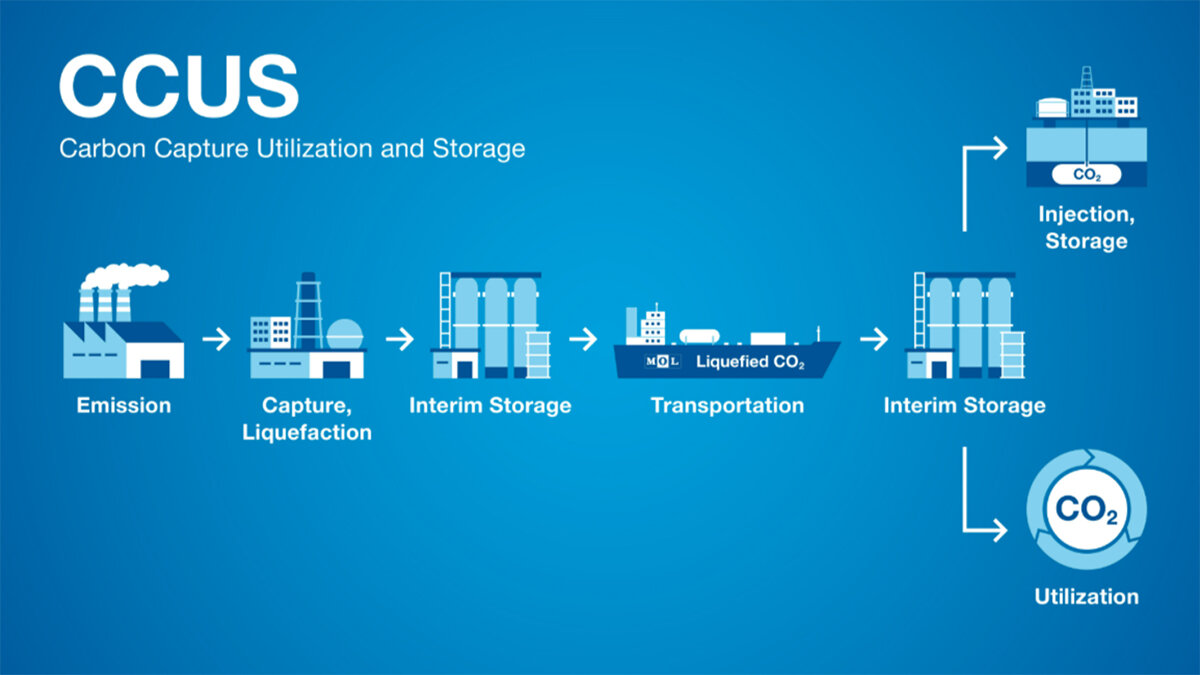
Image of Liquefied CO2 transportation and CCS Value Chain
MOL Group has set "Achieving net zero GHG emissions by 2050" in its medium-to-long-term target of the "Environmental Vision -BLUE ACTION 2035 Phase 2-". MOL plans to expand the number of vessels equipped with Wind Challenger to 25 vessels by 2030 and 80 vessels by 2035. To date, three vessels have already been delivered, and installation has been confirmed for a total of eight vessels (Note 5), including two LNG carriers scheduled for delivery in 2026 (Note 6). The development of this liquefied CO2 carrier concept represents an important step toward achieving both the decarbonization of society through CCS and reductions in fuel consumption and GHG emissions, contributing to MOL Group's goal of net zero emissions. MOL will continue to advance the development of wind-assisted propulsion technologies (note 7) such as Wind Challenger and, through the safe management and efficient operation of its environmentally friendly fleet, contribute to the reduction of CO2 emissions across society.
| LOA/Breadth | Approx. 224m / 35.2m |
| AiP Issuing Classification Society | ClassNK |
| Cargo tank capacity | Approx. 40,000 m³ |
| Wind Challenger specifications |
Number of units: 3 Height: Up to 49m (3-tier) Width: Approx. 15m Sail material: Fiber reinforced plastic |
(Note 1) Approval in Principle (AiP) is an initial approval granted by a classification society confirming that a vessel or equipment concept is technically feasible and poses no significant issues in terms of safety or applicable regulations at the conceptual design stage.
(Note 2) A liquefied CO2 carrier is designed to transport CO2 liquefied under low-temperature and pressurized conditions, enabling the large-scale marine transportation of CO2 captured from power plants and industrial facilities to storage sites.
(Note 3) For details, please refer to "Wind Challenger, Hard Sail Wind-Assisted Ship Propulsion System" on the MOL Solutions website".
(Note 4) A risk assessment and management method in which the magnitude and frequency of potential system hazards are discussed among experts to ensure that the system as a whole is sufficiently safe.
(Note 5) This Vessel Concept is not included among the eight vessels for which Wind Challenger installation has already been confirmed.
(Note 6) The vessels are currently under construction for Chevron Shipping Company and Tokyo LNG Tanker Co., Ltd., a wholly owned subsidiary of Tokyo Gas Co., Ltd.. (MOL and Chevron Shipping Company to Install Wind Challenger on LNG Carrier Wind-Assisted Ship Propulsion Systems is an LNG Shipping First | Mitsui O.S.K. Lines, Install Wind Challenger Hard Sail Propulsion Systems on LNG Carrier Serving Tokyo Gas | Mitsui O.S.K. Lines)
(Note 7) For details, Please refer to "MOL Wins Basic Design Approval for New LNG Carrier Equipped with 4 Wind Challenger, Hard Sail Wind-assisted Propulsion Systems."
Subscribe to the newsletter
Daily decarbonization data and news delivered to your inbox
Follow the money flow of climate, technology, and energy investments to uncover new opportunities and jobs.
Latest issues
-
Verra Landed CCP Approval. What Changes for DAC?
Inside This Issue ✅ Verra's CCS Credits Just Got the Integrity Seal Buyers Want 💰 South Korea Unveils $747 Billion Energy Transition Plan Through 2035 💧 Hydrogen and Carbon Capture and Storage in ...
-
Quebec Wood Waste Just Became Jet Fuel
Inside This Issue 🌲 ARC Bio Tests a Refinery Shortcut to Forest-Based SAF 💧 Scientists Just Found a New Way to Make Hydrogen from Water 🤝 How Channel Partnerships Are Helping More Organizations Ta...
-
How Vaulted Deep Turned Offtakes Into $35M Debt
Inside This Issue 🏦 How Carbon Removal Offtakes Are Starting to Unlock Commercial Debt 🌉 California Opens the Door to a Three-Way Carbon Market 🧪 New Material Developed at Oregon State Provides Bo...
Company Announcements
-
Ballard Secures 4.8MW Order From Siemens Mobility to Power Hydrogen Trains in Romania
24 FCrail™ fuel cell modules will power 12 Mireo Plus H trains, Romania’s first hydrogen fleet and the platform’s largest deployment to date. VANCOUVER, CANADA and MUNICH, GERMANY – Ballard Power ...
-
Company Update Approval Advances Strategic Growth of XCF's Diversified Alternative Energy Platform and Marks a Major Milestone as the Parties Work Toward Closing as Soon as Practicable HOUSTON, T...
-
On September 20, Yiwu County in Hami, Xinjiang, a centralized project bid opening and launch ceremony drew the attention of the entire hydrogen energy community, Dondel officially launched its Gree...
-
MEXICO CITY--BUSINESS WIRE--In the framework of today's World Habitat Day, here is an invitation to reflect on building more sustainable communities, where Mexico is moving firmly toward the energy...