
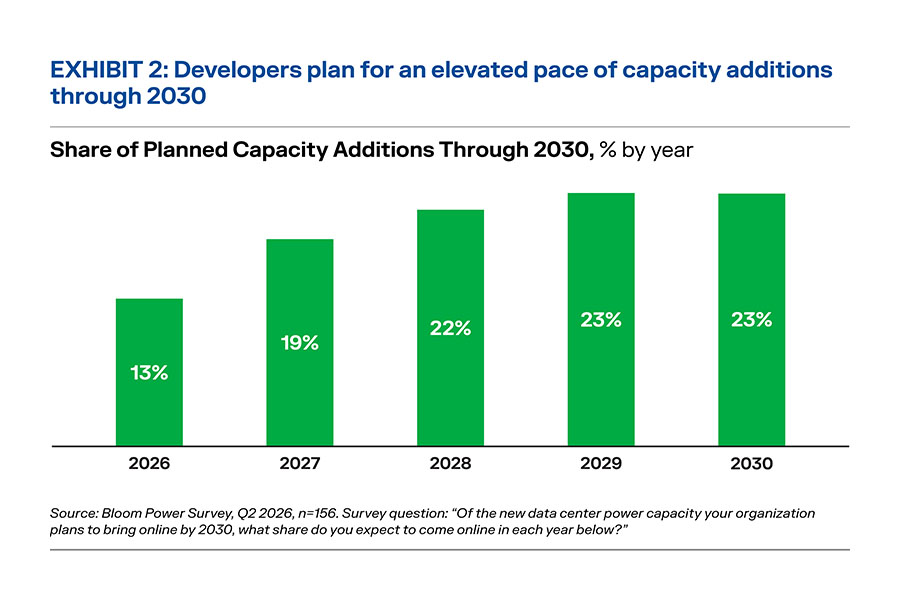
- Developers expect continued data center expansion through 2030 as AI adoption accelerates.
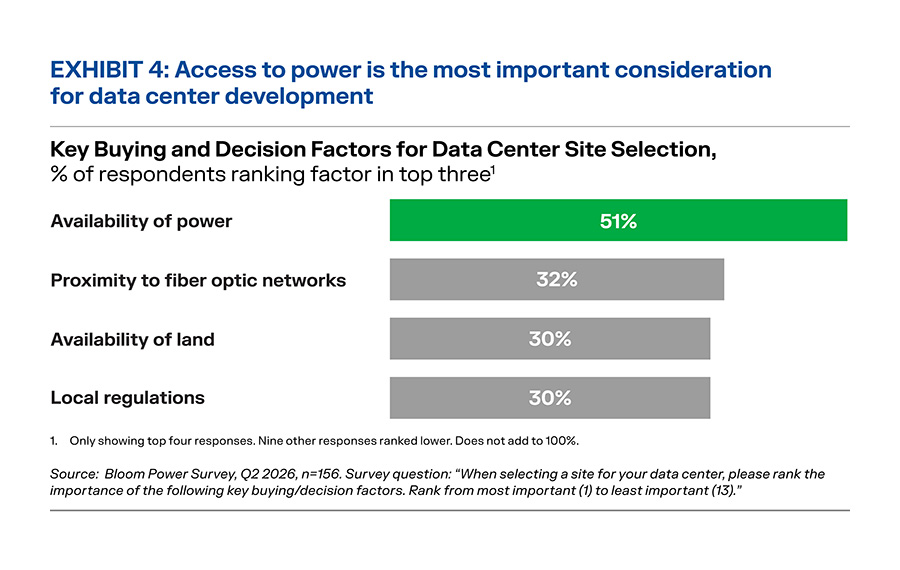
- Access to power remains the biggest challenge to growth, with 61% of developers planning to bring their own power if the grid cannot meet their needs
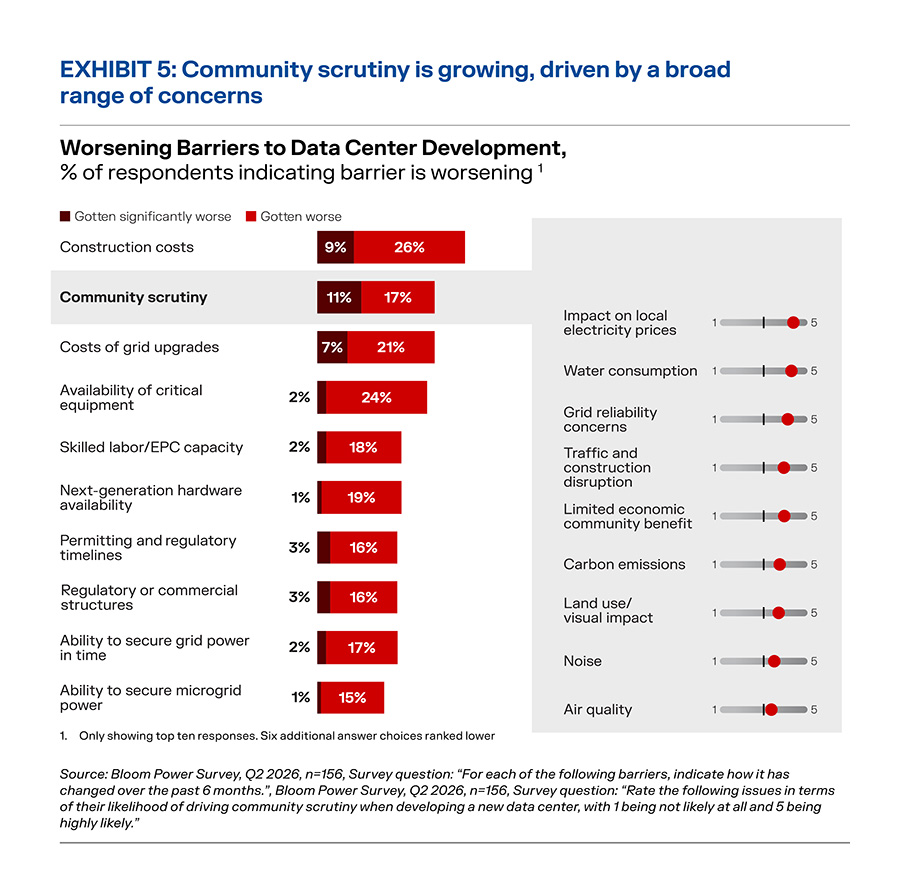
- Community scrutiny has become a growing barrier, driven by concerns over electricity prices, water consumption and grid reliability
SAN JOSE, California, June 15, 2026 — Bloom Energy (NYSE: BE), a global leader in power solutions, today released a mid-year update to its annual Data Center Power Report, which surveys decision-makers across the data center ecosystem. The report found that, while data center developers anticipate a prolonged period of expansion, power availability remains the defining constraint. At the same time, a broader set of barriers—including rising construction costs and growing community scrutiny—is threatening to slow the pace of new data center development.
>> In Other News: Gevo Announces Expansion of Carbon Business, Launch of New Digital Platform to Accelerate Market Access
Key findings from the report include:
Developers are planning significant capacity additions through the end of the decade as AI adoption accelerates. Inference now accounts for more than 50% of AI compute, reflecting the transition from model building to real-world applications, with inference driving sustained demand for new data center capacity.
Access to power remains the dominant issue for data center development, with 61% of developers planning to bring their own power if the grid is unavailable.
New barriers are affecting the buildout of large-scale projects, impacting the pace of execution: Community scrutiny has intensified over the past six months, with developers citing higher electricity prices, increased water consumption, and strain on grid reliability as the concerns most likely to influence projects. As of May 2026, at least 18 state bills and 86 local moratoriums have been proposed across the U.S.
Carbon capture is moving from concept to deployment: Nearly one-third of onsite-powered sites are expected to incorporate carbon capture by 2030, reflecting growing pressure to address emissions concerns while expanding power capacity.
A readiness gap risks slowing AI innovation: Chip developers expect high-density architectures and rack-level DC designs to be adopted in 2028, a full year ahead of data center developers’ plans, highlighting a growing readiness challenge as AI hardware requirements evolve.
“Access to power remains the biggest constraint to data center growth, but it is not the only issue. Community concerns are increasingly shaping which projects move forward,” said Natalie Sunderland, Chief Marketing Officer at Bloom Energy. “Our findings suggest that solutions that reduce strain on local infrastructure while helping developers bring new capacity online faster—such as clean onsite power—will play an important role. We believe the winners in the next phase of AI buildout will be those that can grow in a way that works for both operators and the communities that host them.”
The 2026 Bloom Energy Data Center Power Report Mid-Year Pulse is based on surveys commissioned via a double-blind process between Bloom Energy and respondents. Surveys were conducted in April 2026 among 156 decision-makers across the data center ecosystem, reflecting perspectives from hyperscalers, colocation providers, neoclouds, data center developers, chip developers, with 79% of respondents US-based. The survey was supplemented with interviews with industry leaders and public announcements. Download a copy of the report here.
About Bloom Energy
Bloom Energy empowers enterprises to meet soaring energy demands and responsibly take charge of their power needs. The company’s fuel cell systems provide ultra-resilient, clean, and highly scalable onsite electricity for Fortune 500 customers around the world, including data centers, semiconductor manufacturing, large utilities, and other commercial and industrial sectors as well as mission-critical organizations in local communities, such as hospitals, college campuses and retailers. Headquartered in Silicon Valley, Bloom Energy employs more than 2,000 people worldwide and manufactures its systems in the United States. For more information, visit BloomEnergy.com.
Subscribe to the newsletter
Daily decarbonization data and news delivered to your inbox
Follow the money flow of climate, technology, and energy investments to uncover new opportunities and jobs.
Latest issues
-
Who Bought Gevo’s $50M in 45Z Credits?
Inside This Issue ⛽ Gevo Sells $70M in 45Z Credits to a New Kind of Buyer 🌱 South Pole, Gaïago, and Gold Standard Issue European Soil Carbon Credits, Unlocking Verified Regenerative Agriculture Re...
-
Verra Landed CCP Approval. What Changes for DAC?
Inside This Issue ✅ Verra's CCS Credits Just Got the Integrity Seal Buyers Want 💰 South Korea Unveils $747 Billion Energy Transition Plan Through 2035 💧 Hydrogen and Carbon Capture and Storage in ...
-
Quebec Wood Waste Just Became Jet Fuel
Inside This Issue 🌲 ARC Bio Tests a Refinery Shortcut to Forest-Based SAF 💧 Scientists Just Found a New Way to Make Hydrogen from Water 🤝 How Channel Partnerships Are Helping More Organizations Ta...
Company Announcements
-
Mineral Europa: A Game Changer for Shipping
Antwerp, Oct. 09, 2026 (GLOBE NEWSWIRE) -- Antwerp, 9 October 2026 – CMB.TECH NV (“CMB.TECH” or the “Company”) (NYSE: CMBT, Euronext Brussels: CMBT and Euronext Oslo Børs: CMBTO) today announces th...
-
Download PDF (170.95 KB) Eni CCUS Holding, owned jointly by Eni and Global Infrastructure Partners ("GIP"), part of BlackRock, announces that Liverpool Bay CCS has completed the installation of th...
-
First-of-its-kind project in France and Belgium marks a major breakthrough for carbon credit buyers seeking high-integrity, high-impact regenerative agriculture removals in Europe; providing buyer...
-
Gevo and ClimeFi Complete Carbon Removal Transaction, Advancing Gevo's Growing Carbon Business
Transaction supports Gevo's path toward a carbon business exceeding $30 million in annual revenue from existing operations ENGLEWOOD, Colo., Oct. 08, 2026 (GLOBE NEWSWIRE) -- Gevo, Inc. (NASDAQ: G...