Alaska Airlines Announces Agreement With Shell Aviation to Help Expand Sustainable Aviation Fuel Market in Pacific Northwest
Published by Todd Bush on March 23, 2023
New collaboration will advance development in the sustainable aviation fuel market and long-term jet fuel supply
SEATTLE, March 23, 2023 /PRNewswire/ -- Today, Alaska Airlines announced an agreement with Shell Aviation to expand the sustainable aviation fuel (SAF) market beyond a standard fuel supply agreement. The innovative cross-industry collaboration brings together a world-class fuel supply chain and the fifth-largest domestic carrier to procure and use sustainable fuel, while working together to define and tackle what it will take to advance SAF technology, development, infrastructure and investment.
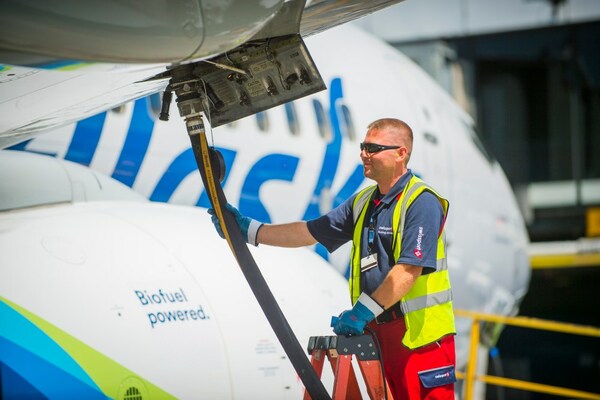
A fueler services an Alaska Airlines aircraft before flight.
>> In Other News: GE and Svante Announce Collaboration to Develop Carbon Capture Technology for Power Generation
"Alaska Airlines has set our course to net zero by 2040 and sustainable aviation fuels represent the greatest near-term opportunity to make a step-level change on that journey," said Diana Birkett Rakow, senior vice president for public affairs and sustainability at Alaska Airlines. "That's why we've pioneered SAF technologies for more than a decade. But we can't scale the market alone. We're excited to take this next step in the journey with Shell, to leverage their deep knowledge of the energy industry, its infrastructure requirements and supply chain to make lower lifecycle carbonSAF more widely available for the future."
Details of the agreement include commitments to deepen understanding of the technology, infrastructure, carbon accounting systems and public policy support needed to bring SAF to more markets, in greater quantities and at a more sustainable long-term cost. The companies will put particular focus on enabling supply to the West Coast and alleviating fueling infrastructure challenges in the Pacific Northwest.
Shell Aviation will also supply up to 10 million gallons of neat SAF to Alaska Airlines at their hub in Los Angeles.
"We're excited to expand our strong relationship with Alaska Airlines and amplify our efforts to help decarbonize aviation through SAF supply on the West Coast and in the Pacific Northwest," said Jan Toschka, president of Shell Aviation. "We need support from the entire ecosystem to build a sustainable future for aviation. This deep level of collaboration will help us put the technologies and supply chain in place to advance the industry."
Both Alaska Airlines and Shell Aviation share an ambition to help scale the SAF market by concurrently addressing cost and volume through multiple strategies to grow availability and commercial viability of SAF.
"With Shell's world-class fuel supply chain and deep technical knowledge, we're aiming to transform West Coast fuel supply," said Ann Ardizzone, vice president of strategic sourcing and supply chain management at Alaska Airlines. "By leveraging the fuel infrastructure expertise of a major fuel producer, we can advance SAF access in more markets, accelerating the market scale of SAF to reach our environmental goals."
SAF is a safe, certified drop-in fuel that meets the jet fuel standards to reduce carbon emissions by as much as 80% of lifecycle emissions.
Learn more about Alaska Airlines efforts to reduce its climate impact and go net zero by 2040 at
https://news.alaskaair.com/collection/planet.
Alaska Airlines
Alaska Airlines and our regional partners serve more than 120 destinations across the United States, Belize, Canada, Costa Rica and Mexico. We emphasize low fares and award-winning customer service. Alaska is a member of the oneworld global alliance. With the alliance and our additional airline partners, our guests can travel to more than 900 destinations on more than 20 airlines while earning and redeeming miles on flights to locations around the world. Learn more about Alaska at https://news.alaskaair.com. Alaska Airlines and Horizon Air are subsidiaries of Alaska Air Group.
SOURCE Alaska Airlines
Subscribe to the newsletter
Daily decarbonization data and news delivered to your inbox
Follow the money flow of climate, technology, and energy investments to uncover new opportunities and jobs.
Companies
Latest issues
-
Verra Landed CCP Approval. What Changes for DAC?
Inside This Issue ✅ Verra's CCS Credits Just Got the Integrity Seal Buyers Want 💰 South Korea Unveils $747 Billion Energy Transition Plan Through 2035 💧 Hydrogen and Carbon Capture and Storage in ...
-
Quebec Wood Waste Just Became Jet Fuel
Inside This Issue 🌲 ARC Bio Tests a Refinery Shortcut to Forest-Based SAF 💧 Scientists Just Found a New Way to Make Hydrogen from Water 🤝 How Channel Partnerships Are Helping More Organizations Ta...
-
How Vaulted Deep Turned Offtakes Into $35M Debt
Inside This Issue 🏦 How Carbon Removal Offtakes Are Starting to Unlock Commercial Debt 🌉 California Opens the Door to a Three-Way Carbon Market 🧪 New Material Developed at Oregon State Provides Bo...
Company Announcements
-
Ballard Secures 4.8MW Order From Siemens Mobility to Power Hydrogen Trains in Romania
24 FCrail™ fuel cell modules will power 12 Mireo Plus H trains, Romania’s first hydrogen fleet and the platform’s largest deployment to date. VANCOUVER, CANADA and MUNICH, GERMANY – Ballard Power ...
-
Company Update Approval Advances Strategic Growth of XCF's Diversified Alternative Energy Platform and Marks a Major Milestone as the Parties Work Toward Closing as Soon as Practicable HOUSTON, T...
-
On September 20, Yiwu County in Hami, Xinjiang, a centralized project bid opening and launch ceremony drew the attention of the entire hydrogen energy community, Dondel officially launched its Gree...
-
MEXICO CITY--BUSINESS WIRE--In the framework of today's World Habitat Day, here is an invitation to reflect on building more sustainable communities, where Mexico is moving firmly toward the energy...