
ARC Bio Demonstrates Canadian Forest Residue Pathway to Sustainable Aviation Fuel
Published by Todd Bush on September 30, 2026
PORT-CARTIER, QC, Sept. 30, 2026 /CNW/ - ARC Bio, the Canadian joint venture between an affiliate of Bioénergie AE Cote-Nord Canada Inc. ("Bioénergie AECN") and Alder Renewables, today announced the successful demonstration of a pathway to produce sustainable aviation fuel ("SAF") from Canadian forest residues through refinery co-processing.
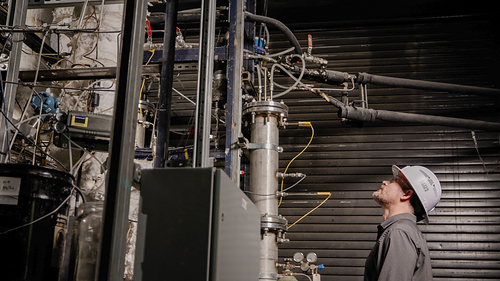
FCC Coprocessing
>> In Other News: Canada Explores Article 6 Path to Global Carbon Buyers
The demonstration brings together Canada's forest products industry, renewable fuels technology and existing refining infrastructure to show how residual woody biomass can be converted into a refinery-ready biocrude for processing alongside conventional feedstocks to produce transportation fuels, including SAF.
"Canada has the biomass feedstock, the forest sector expertise, the industrial capability and the refining infrastructure to build an important new clean fuel value chain," said Serge Mercier, President of Bioénergie AECN. "This work creates a direct connection between Canada's forest sector economy and the growing need for low-carbon fuels in aviation and marine transportation markets."
The project upgraded fast pyrolysis bio-oil produced from Canadian forest residues by Bioénergie AECN in Port-Cartier into barrel-scale quantities of Alder Renewable Crude (ARC). This biocrude was then processed in a fluid catalytic cracking, or FCC, pilot unit that simulates commercial refinery operation. Carbon-14 analysis of the resulting fuel products confirmed the presence of biogenic carbon from the wood residue-derived feedstock.
The FCC campaign successfully produced a jet-range fuel fraction that was isolated and evaluated for blending compatibility with HEFA-based SAF produced from fats, oils and greases. The resulting SAF blend met the key ASTM International D1655 fuel-property specifications evaluated in the screening. The work represents an important step toward demonstrating that biocrude produced from Canadian forest residues can enter existing refinery infrastructure and be converted into finished transportation fuels.
"The significance of this demonstration is not simply that we produced a renewable jet-range fuel," said Derek Vardon, CEO of Alder Renewables. "We demonstrated a pathway connecting Canadian forest residues with refinery infrastructure already operating at commercial scale. That creates the potential for a scalable, capital-efficient route to bring forest-derived renewable carbon into aviation fuel markets."
With financial support from Boeing, the project was established to validate the conversion of forest residues into SAF in Canada and generate the technical and economic data needed to support future commercial-scale facilities.
A New Market Opportunity for Canada's Forest Sector
Canada's forest industry generates large volumes of wood residues. As traditional markets face changing demand and international trade pressures, creating higher-value uses for these residues can strengthen forest-sector economics while supplying renewable carbon to industries that are difficult to decarbonize.
The project also demonstrates opportunities to create value from low-value woody biomass, including forest residues generated through forest management and wildfire-risk reduction, where appropriate feedstock supply chains can be established.
By converting these materials into an energy-dense, transportable biocrude, ARC Bio is developing a model that connects distributed forestry resources with large-scale fuel refining infrastructure.
Leveraging Refinery Infrastructure Already in Place
Unlike pathways requiring an entirely new standalone fuel refinery, ARC Bio's approach is designed to integrate with existing refinery operations. Fluid catalytic cracking is widely used in refineries around the world to produce transportation fuel components. Introducing Alder Renewable Crude into an FCC process creates a pathway connecting renewable feedstocks with existing commercial fuel production assets.
The next stage of the program will generate additional refinery-relevant data to support larger-scale trials. ARC Bio's roadmap is ultimately aimed at enabling a first-of-a-kind Canadian commercial project combining forest-residue conversion, biocrude production and refinery integration.
Learn more about ARC Bio's milestone and latest activities at ARC Bio News.
About ARC Bio and its Partners
ARC Bio is a Canadian joint venture between an affiliated company of Bioénergie AECN and Alder Renewables focused on converting Canadian forest residues into renewable fuels. The collaboration combines commercial fast pyrolysis, renewable crude upgrading, and refinery processing to advance sustainable aviation fuel and marine fuels in Canada. Bioénergie AECN operates North America's largest fast pyrolysis bio-oil facility using wood residue feedstocks in Port-Cartier, Quebec. The Port-Cartier facility has an annual production capacity of 40 million litres of bio-oil. Alder Renewables develops upgrading technology that converts fast pyrolysis bio-oil into refinery-ready biocrude for downstream production of low-carbon fuels and other industrial products.
SOURCE Arc-Bio
Subscribe to the newsletter
Daily decarbonization data and news delivered to your inbox
Follow the money flow of climate, technology, and energy investments to uncover new opportunities and jobs.
Latest issues
-
Colorado Joins the 7-State CCS Permit Fast Lane
Inside This Issue ⚖️ Colorado Takes Over Class VI Permits: What Changes for CCS? 🏭 Hebei Shoulang Facility Using LanzaTech Technology Achieves World’s First ISCC EU RCF Certification for Ethanol P...
-
The US Hasn't Made Heavy Water Since 1982
Inside This Issue ⚛️ Aternium Completes FEED Studies for US Hydrogen, Heavy Water Project 🐄 Google, McKinsey Strike Brazil Carbon Removal Deal With Silvopasture Project 🔧 Cummins Selects Stargate ...
-
Why Colorado’s Koloma Has Japan’s Largest Utility Hooked
Inside This Issue ⚡ JERA Invests in Koloma to Explore Natural Hydrogen as a Future Low-Carbon Energy 🔬 New CATF Tool Provides Framework for Self-Assessment and Strengthening of Biomass Carbon Remo...
Company Announcements
-
Citi Closes $72 Million Carbon Removal-Linked Note to Support Applied Carbon Biochar Project
HIGHLIGHTS Citi structured an innovative $72 million carbon removal-linked note to provide upfront capital for Applied Carbon's biochar project, marking a first-of-its-kind "outcome bond" for ver...
-
New platform opens access to the same rigorous project evaluations trusted by the world's leading carbon removal procurement programs Today, Relae (formerly Carbon Direct) launched The Diligence C...
-
Inside BLM's 650,000-Acre Bet on Wyoming Carbon Storage
The Bureau of Land Management has offered right-of-way grants covering about 649,438 acres of federal pore space in southwest Wyoming. The September 21, 2026 offers went to Moxa Carbon Storage LLC ...
-
NEW YORK, BUSINESS WIRE, SWITCH Maritime (Switch), a leading developer of zero-emission vessels, secured a Design Basis Agreement (DBA) with the United States Coast Guard (USCG) for the SWITCH-150,...