
Bloom Energy Inaugurates High Volume Electrolyzer Production Line
Published by Todd Bush on November 2, 2022
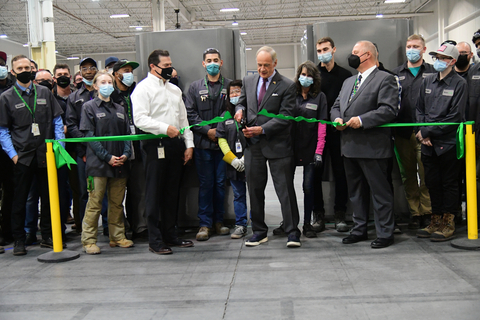
NEWARK, Del.--(BUSINESS WIRE)--Bloom Energy Corporation (NYSE: BE), today, inaugurated its high volume commercial electrolyzer line at the company’s Newark facility, increasing the company’s generating capacity of electrolyzers to two gigawatts. The award-winning technology is the most energy-efficient design to produce clean hydrogen to date.
bloom energy electrolyzer
>> In Other News: Elemental Excelerator Doubles Down on Climate Tech Investments In Hard-To-Decarbonize Industries
In the last decade, the facility has produced over 1 gigawatt (GW) of resilient, sustainable, and cost-effective fuel cell-based Energy Servers. The Bloom Electrolyzer relies on the same, commercially proven solid oxide technology platform used to produce electricity, so streamlining existing manufacturing for higher volume electrolyzer output allows Bloom to best meet the needs of the market.
The technology’s significant capabilities for hydrogen production are being demonstrated in partnerships with Xcel Energy and Idaho National Labs to harness nuclear and steam power, and will be demonstrated with LSB Industries, Inc. to decarbonize industrial and agricultural sectors. Internationally, the technology is in use in South Korea.
“Through the domestic production of technologies like Bloom Energy’s electrolyzer, we are making strides towards American energy independence, as well as a sustainable clean hydrogen market, which is critical for decarbonizing hard-to-abate industries like fertilizer, steel, cement, and aviation,” said Sharelynn Moore, Executive Vice President and Chief Business Development and Marketing Officer, Bloom Energy. “Our employees work every day to overcome one of humanity’s greatest challenges, and today’s inauguration celebrates their strength and ability to transform a successful manufacturing plant into a world class facility committed to a secure, net-zero energy future.”
The Bloom Electrolyzer supports a trajectory for hydrogen to become economically accessible by producing hydrogen up to 45 percent more efficiently than PEM and alkaline electrolyzers when combined with external heat. By operating at high temperatures, Bloom’s electrolyzer consumes 15 percent less electricity than other electrolyzer technologies when electricity is the sole input source. This allows for the Bloom Electrolyzer to be deployed across a broad variety of commercial hydrogen applications, using multiple energy sources, including intermittent renewable energy and excess heat at manufacturing facilities and businesses.
Electrolyzer production demonstrates the growing momentum for American clean energy manufacturing following the passage of the Inflation Reduction Act (IRA) earlier this year, which supports technologies and financial mechanisms that will make the United States’ transition to clean energy a reality.
In addition to its work on the east coast, Bloom Energy marked the expansion of its growing American manufacturing footprint this July, with the grand opening of its new state-of-the-art, 164,000 square foot, multi-gigawatt facility in Fremont, California. This facility represents a $200 million investment and is expected to create more than 400 additional clean energy jobs by year-end, bringing Bloom’s California headcount to nearly 2,000 in addition to its 715 Delaware employees.
About Bloom Energy
Bloom Energy empowers businesses and communities to responsibly take charge of their energy. The company’s leading solid oxide platform for distributed generation of electricity and hydrogen is changing the future of energy. Fortune 100 companies around the world turn to Bloom Energy as a trusted partner to deliver lower carbon energy today and a net-zero future. For more information, visit https://www.bloomenergy.com.
Subscribe to the newsletter
Daily decarbonization data and news delivered to your inbox
Follow the money flow of climate, technology, and energy investments to uncover new opportunities and jobs.
Latest issues
-
Why Colorado’s Koloma Has Japan’s Largest Utility Hooked
Inside This Issue ⚡ JERA Invests in Koloma to Explore Natural Hydrogen as a Future Low-Carbon Energy 🔬 New CATF Tool Provides Framework for Self-Assessment and Strengthening of Biomass Carbon Remo...
-
LNK Energies Targets $6.50 Hydrogen With No Federal Subsidies
Inside This Issue 🚛 MIT Startup Says It Can Turn Diesel Trucks Into Cheaper Hydrogen Haulers, See It at Disrupt 🏭 Baytown City Council Briefs: ExxonMobil Blue Hydrogen Agreement Approved 🌎 Colorad...
-
Why Gulf Coast CCS Teams Are Watching Liverpool Bay
Inside This Issue 💂 Eni’s Douglas Platform Sets the Offshore CCS Blueprint 🌲 Pacolet Milliken Expands Its Biomass Platform With the Acquisition of Georgia Renewable Power 🧪 Metacon Receives EU Fun...
Company Announcements
-
A new interactive tool from Clean Air Task Force (CATF) provides a practical framework for the self-assessment and strengthening of biomass carbon removal (BiCRS) protocols to help ensure that carb...
-
LanzaJet Secures Financing to Scale SAF Production and Supply Global Customers
CHICAGO, Oct. 15, 2026 (GLOBE NEWSWIRE) -- LanzaJet, Inc., a leading next-gen fuels technology company and fuels producer, today announced fully committed new financing of at least $20 million to s...
-
44.01 and Frontier Advance Permanent CO₂ Storage Through In-Situ Mineralization
44.01's in-situ mineralization (ISM) process turns CO₂ into solid rock underground in a few years, after which the risk of reversal is functionally zero. >> In Other News: JERA Invests in ...
-
JERA Invests in Koloma to Explore Natural Hydrogen as a Future Low-Carbon Energy
JERA Co., Inc. (JERA), through its corporate venture capital arm JERA Ventures, has invested in Koloma, Inc. (Koloma), a U.S.-based natural hydrogen exploration and development company. The invest...