
Breakthrough Blueprint: Scaling Carbon-Storing Concrete with Paebbl and Goldbeck
Published by Todd Bush on May 20, 2026
At Holcim, we believe the path to net zero involves reimagining the materials that build our world. It’s about partnering across the building value chain to scale innovative solutions, such as Paebbl Rebond - a breakthrough carbon-storing supplementary cementitious material (SCM).
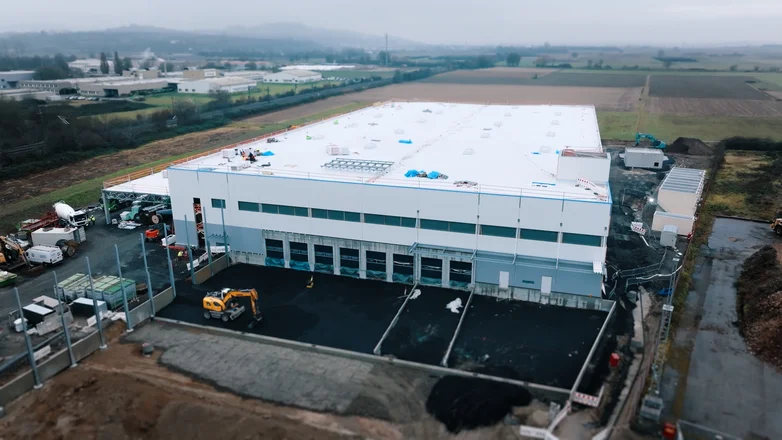
Through our groundbreaking collaboration with Swedish startup Paebbl – which we’ve invested in through Holcim MAQER Ventures – and general contractor Goldbeck, we helped build a distribution center for a global retail giant in Germany using this unique SCM.
>> In Other News: Vaulted Deep Named to 2026 CNBC Disruptor 50 Amid Rapid Expansion of Waste Infrastructure
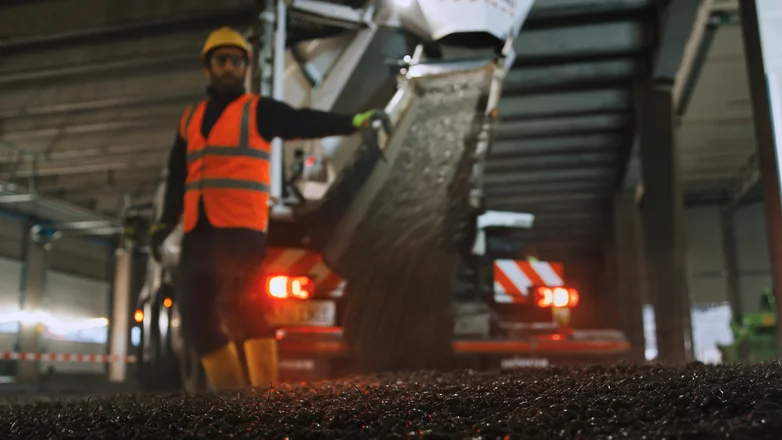
With this successful pour of an industrial floor slab – the first commercial-scale application of Paebbl Rebond – together we’ve moved an innovative carbon-storing Holcim concrete beyond pilot batches and the lab, and out onto the jobsite.
Impressive material science
All three project partners came together with a clear goal: validate the performance of Paebbl’s novel, carbon-storing SCM, Paebbl Rebond, under real-world conditions, and demonstrate its potential to decarbonize the built environment.

By bringing together a global retail giant, a leading general contractor, a materials science startup, and our own specialized production teams from Holcim Group and Holcim South Germany, we proved that innovation in building materials doesn't happen in a vacuum - it happens in a synchronized ecosystem, with collaboration at the core.
BENGT STEINBRECHER | HEAD OF HOLCIM MAQER VENTURES
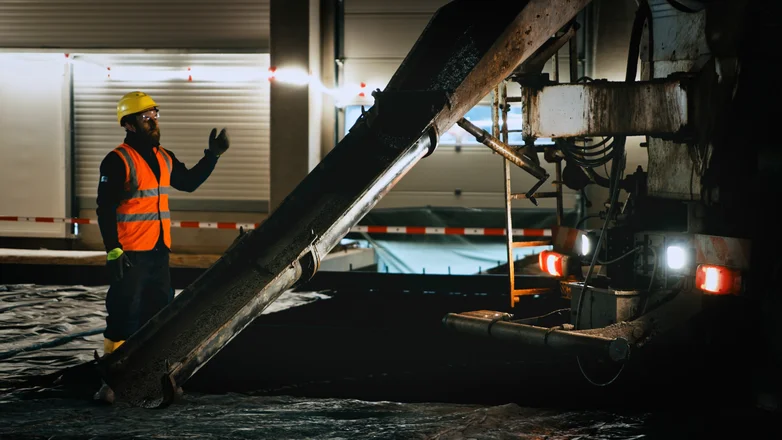

Developed using advanced CO2 mineralization technology, Paebbl’s SCM mimics and accelerates a natural process to bind captured carbon into stable minerals. Designed for use in cement and concrete applications, the result is a reactive powder composed primarily of magnesium carbonate and silicon dioxide that can replace a portion of traditional cement. Instead of emitting more carbon as part of the production process, it captures it permanently.
Fast innovation is possible
This groundbreaking project also proved that fast innovation is possible when stakeholders align. From our initial scoping discussions in June, 2025 to the final pour in December of the same year, the project moved from concept to implementation in just six months.
Together with Goldbeck and Paebbl, Holcim South Germany worked to ensure that this new material met the rigorous demands of ready-mix flooring concrete for the distribution center. We applied a phased validation approach that left nothing to chance:
Laboratory testing at the Holcim Innovation Center: First trials in mortar and concrete to quantify performance of the Paebbl material in representative mix designs.
Plant trials by Holcim South Germany at our Offenburg readymix plant: Assessing workability, air content, and bleeding behavior to ensure the concrete performed exactly like our standard reference concrete.
Life Cycle Assessment (LCA): Collaborating with Paebbl to produce a verified Environmental Product Declaration (EPD).
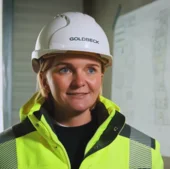
As a general contractor, our priority is ensuring that new materials meet the performance, warranty, and scheduling requirements of our projects. The concrete with Paebbl’s carbon-storing material performed exactly as needed: same workability, same strength class, same construction timeline. That is what gives us confidence to deploy this at a greater scale.
DR. PAMELA ZUSCHLAG | DEVELOPMENT ENGINEER, GOLDBECK TECHNOLOGIES
Sustainability and performance
One of the key project takeaways is that sustainability does not have to come at the price of performance. The special EPD-certified Holcim concrete achieved a 80% strength activity index compared to the reference mix and maintained equivalent fresh concrete properties.
The project also confirmed that Paebbl Rebond can be seamlessly integrated into existing batching, transport, and placement workflows without specialized equipment or changes to contractor practices. This "plug-and-play" capability is essential for driving the rapid adoption of innovative and low-carbon solutions across the industry.
The sustainability results were equally impressive:
13% embodied carbon reduction to the reference CEM II/B-M: By replacing approximately 15% of the cement, we reduced the carbon footprint by 29.2kg of CO2/m3
Permanent carbon storage: Beyond the avoided emissions, the concrete permanently sequestered 886 kg of CO2 through mineralization across the 420m2 project area
Scalability: If applied to a standard project of 6,500m2, this technology could save an estimated 38 tons of CO2 from the concrete alone

Sustainable construction cannot rely on a single company acting alone. This project shows what becomes possible when a material innovator, a building materials and solutions provider, and a general contractor align around a shared ambition.
The result is a concrete floor with permanently stored carbon, and we believe this model can inspire the entire industry. Without compromising on high-performance, we can decarbonize fast with an aligned value chain.
ANA LUISA VAZ | VP PRODUCTS, PAEBBL
As Paebbl plans its first commercial-scale applications from 2028, Holcim looks forward to transforming more carbon into concrete with our partners. This project proves how we can scale innovative technologies for a more sustainable built environment, collaborating closely together.
Subscribe to the newsletter
Daily decarbonization data and news delivered to your inbox
Follow the money flow of climate, technology, and energy investments to uncover new opportunities and jobs.
Latest issues
-
Who Bought Gevo’s $50M in 45Z Credits?
Inside This Issue ⛽ Gevo Sells $70M in 45Z Credits to a New Kind of Buyer 🌱 South Pole, Gaïago, and Gold Standard Issue European Soil Carbon Credits, Unlocking Verified Regenerative Agriculture Re...
-
Verra Landed CCP Approval. What Changes for DAC?
Inside This Issue ✅ Verra's CCS Credits Just Got the Integrity Seal Buyers Want 💰 South Korea Unveils $747 Billion Energy Transition Plan Through 2035 💧 Hydrogen and Carbon Capture and Storage in ...
-
Quebec Wood Waste Just Became Jet Fuel
Inside This Issue 🌲 ARC Bio Tests a Refinery Shortcut to Forest-Based SAF 💧 Scientists Just Found a New Way to Make Hydrogen from Water 🤝 How Channel Partnerships Are Helping More Organizations Ta...
Company Announcements
-
Mineral Europa: A Game Changer for Shipping
Antwerp, Oct. 09, 2026 (GLOBE NEWSWIRE) -- Antwerp, 9 October 2026 – CMB.TECH NV (“CMB.TECH” or the “Company”) (NYSE: CMBT, Euronext Brussels: CMBT and Euronext Oslo Børs: CMBTO) today announces th...
-
Download PDF (170.95 KB) Eni CCUS Holding, owned jointly by Eni and Global Infrastructure Partners ("GIP"), part of BlackRock, announces that Liverpool Bay CCS has completed the installation of th...
-
First-of-its-kind project in France and Belgium marks a major breakthrough for carbon credit buyers seeking high-integrity, high-impact regenerative agriculture removals in Europe; providing buyer...
-
Gevo and ClimeFi Complete Carbon Removal Transaction, Advancing Gevo's Growing Carbon Business
Transaction supports Gevo's path toward a carbon business exceeding $30 million in annual revenue from existing operations ENGLEWOOD, Colo., Oct. 08, 2026 (GLOBE NEWSWIRE) -- Gevo, Inc. (NASDAQ: G...