
The third vessel for the Norwegian CCS effort Northern Phoenix was named last week as it undergoes commissioning (Northern Lights)
A new segment of shipping, purpose-built CO2 carriers designed to support the emerging efforts at carbon capture and storage (CCS), continues to grow. The first of the commercial operations is beginning, and the sector is driving the development of the ships.
>> In Other News: We’re Advancing Wetland Restoration and Carbon Removal Science in Google’s Backyard
Northern Lights, a partnership between Equinor, Shell, and TotalEnergies was the first to enter the segment, starting commercial operations in 2025. It was designed with an initial capacity of 1.5 million tonnes per year and has already announced plans for expansion. It also became the first cross-border project as it has commercial contracts with Yara in the Netherlands, Ørsted in Denmark, Stockholm Exergi in Sweden, and Inherit in Norway.
Last week, on April 9, the company celebrated the naming of its third ship, the Northern Phoenix, a 7,500 cbm gas carrier, with the third ship under a long-term charter from Bernhard Schulte. The vessels transport the CO2 to the company’s facility in Norway, where it is prepared and pumped offshore into permanent storage in a reservoir 2,600 meters under the seabed. The first vessels are fueled with LNG and incorporate a rotor for wind-assisted propulsion.
In the second phase, Northern Lights reports it will expand capacity to 5 million tonnes of CO2 per year by 2028. To support this expansion, the company in January announced new partnerships with Kawasaki Kisen Kaisha ("K" LINE), and MISC Berhad, which ordered one ship and plans a second, and two ships with Mitsui O.S.K. Lines. The first three ships, it said, would each have an increased capacity of 12,000 cbm and are expected to enter service between the second half of 2028 and the first half of 2029.
The next entrant into the sector is completing its final commissioning and will work with Project Greensand’s offshore storage effort, being developed by INEOS Energy in Denmark. The vessel for this project is being developed by Royal Wagenborg.
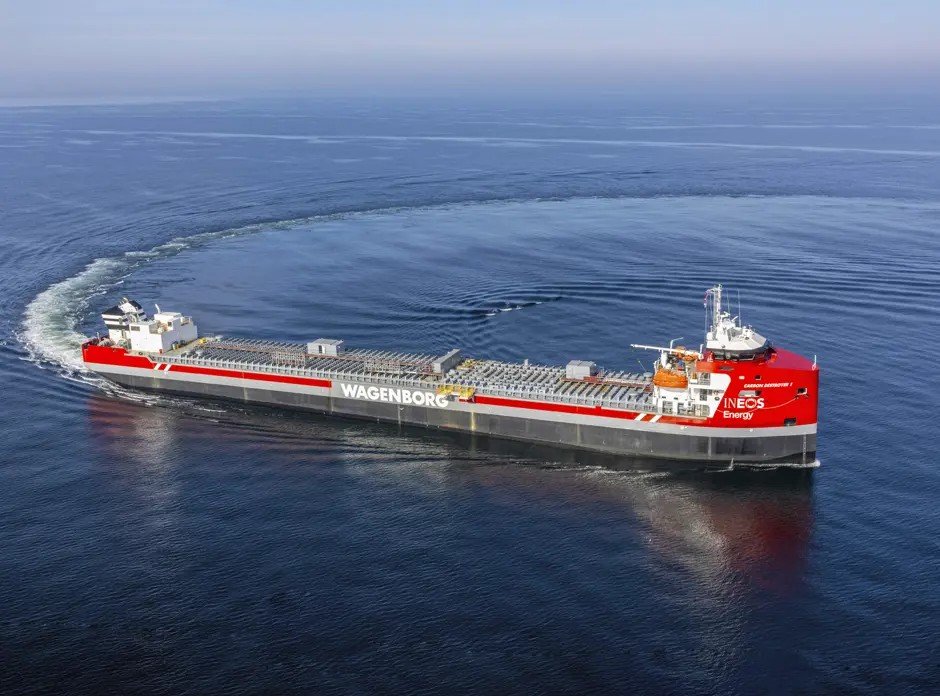
Carbon Destroyer 1 on sea trials is a shuttle carrier to move CO2 directly to a storage program in Denmark (Royal Wagenborg)
Named Carbon Destroyer 1, they took a different approach, building a ship to shuttle between Esbjerg in Denmark and the Nini Fields. It will be a 36-hour cycle. The ship is 150 meters (492 feet) in length and will have a cargo capacity of 5,000 tones of liquified CO2, giving it the capacity to handle approximately 600,000 tonnes of CO2 per year.
The vessel is being called a DP2 CO2 carrier, and it is equipped with dynamic positioning and will directly connect to the storage site. It was also outfitted with unique tanks with consideration for the thermodynamic behavior of liquified CO2.
Carbon Destroyer 1, built by Royal Niestern Sander, recently completed its sea trials off the Dutch coast, where they tested propulsion, maneuverability, the DP2 system’s performance, and the equipment aboard the vessel. It has now arrived in Port Esbjerg for final commissioning. It is expected to enter service later this year.
The Japanese government is also supporting a project that will demonstrate undersea CO2 storage while also seeking to encourage the development of the supply chain. It corresponds with Japan’s goal to achieve net-zero by 2050.
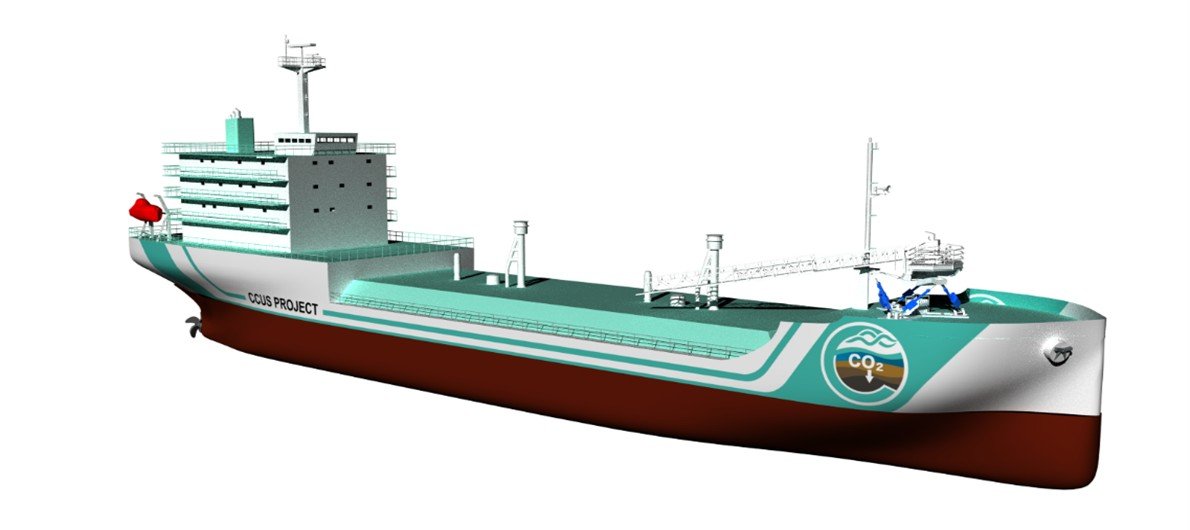
Japan's concept for a CO2 carrier includes gangways to attach to the structure at the storage site (SKSS)
Shin Kurushima Sanoyasu Shipbuilding reported at the end of March that it had received Approval in Principle (AiP) from ClassNK for its concept of a CO2 transport vessel. Their version links the ship with a so-called Socket SPAR at the storage site. The vessel concept is similar to other offshore support vessels as it incorporates large gangways so that the ship’s crew can access the Socket SPAR structure. The ship will link to the structure to pump the CO2 with the injection facility.
The shipyard highlights that the AiP was just for the vessel but notes it is a key part of the development of Japan’s efforts at CCS.
This new segment of shipping is rapidly developing to meet the anticipated demand for CO2 transport and storage. To meet net-zero emissions by 2050, scientists project that roughly 1 gigaton (1 billion tonnes) of per year will need to be captured and transported for storage.
Subscribe to the newsletter
Daily decarbonization data and news delivered to your inbox
Follow the money flow of climate, technology, and energy investments to uncover new opportunities and jobs.
Latest issues
-
Colorado Joins the 7-State CCS Permit Fast Lane
Inside This Issue ⚖️ Colorado Takes Over Class VI Permits: What Changes for CCS? 🏭 Hebei Shoulang Facility Using LanzaTech Technology Achieves World’s First ISCC EU RCF Certification for Ethanol P...
-
The US Hasn't Made Heavy Water Since 1982
Inside This Issue ⚛️ Aternium Completes FEED Studies for US Hydrogen, Heavy Water Project 🐄 Google, McKinsey Strike Brazil Carbon Removal Deal With Silvopasture Project 🔧 Cummins Selects Stargate ...
-
Why Colorado’s Koloma Has Japan’s Largest Utility Hooked
Inside This Issue ⚡ JERA Invests in Koloma to Explore Natural Hydrogen as a Future Low-Carbon Energy 🔬 New CATF Tool Provides Framework for Self-Assessment and Strengthening of Biomass Carbon Remo...
Company Announcements
-
Citi Closes $72 Million Carbon Removal-Linked Note to Support Applied Carbon Biochar Project
HIGHLIGHTS Citi structured an innovative $72 million carbon removal-linked note to provide upfront capital for Applied Carbon's biochar project, marking a first-of-its-kind "outcome bond" for ver...
-
New platform opens access to the same rigorous project evaluations trusted by the world's leading carbon removal procurement programs Today, Relae (formerly Carbon Direct) launched The Diligence C...
-
Inside BLM's 650,000-Acre Bet on Wyoming Carbon Storage
The Bureau of Land Management has offered right-of-way grants covering about 649,438 acres of federal pore space in southwest Wyoming. The September 21, 2026 offers went to Moxa Carbon Storage LLC ...
-
NEW YORK, BUSINESS WIRE, SWITCH Maritime (Switch), a leading developer of zero-emission vessels, secured a Design Basis Agreement (DBA) with the United States Coast Guard (USCG) for the SWITCH-150,...