
The Canadian government's new auto strategy confirms a $5,000 incentive for hydrogen fuel cell electric vehicles (FCEVs) starting February 16, 2026. This rebate puts federal demand-side support firmly in place, but the question on everyone's mind is straightforward: where will drivers actually refuel?
The answer is taking shape faster than many expected. While the incentive creates the pull, infrastructure investment is building the push.
>> In Other News: ‘Almost Impossible to Destroy’: Material Captures CO2 and Frees It at the Flick of a Photoswitch
The Policy Details That Matter
The $5,000 rebate applies equally to battery electric vehicles and FCEVs, treating hydrogen mobility as a legitimate zero-emission pathway. The program runs through 2030 with declining incentives. In 2026, buyers get $5,000. By 2027, that drops to $4,000, then $3,000 in 2028 and 2029, before settling at $2,000 in 2030.
There's a catch, though. The final transaction value must stay under $50,000 for vehicles from free-trade partner countries. Canadian-made vehicles face no price cap. This creates a window where early adopters can maximize savings while manufacturers scale production.
Toyota and Hyundai have been vocal about what needs to happen next. The incentive matters, but without refueling stations, consumer adoption stalls. Fleet operators need corridor coverage. Municipal transit requires depot infrastructure. Long-haul trucking demands strategic placement along major freight routes.
>> RELATED: 14 Green Hydrogen Projects Reshaping America's Energy Future

Infrastructure Investment Accelerates Across Western Canada
Alberta is positioning itself as Canada's hydrogen corridor. Air Products announced plans to build a network of commercial-scale hydrogen refueling stations connecting Edmonton and Calgary along the Queen Elizabeth II Highway. Each station can fuel up to 200 heavy-duty trucks or 2,000 cars daily.

"In Canada, hydrogen is essential to decarbonizing transportation where heavy-duty vehicles travel long distances in extreme temperatures."
Rachel Smith, Vice President and General Manager, Air Products Canada
Alberta Premier Danielle Smith confirmed government backing for hydrogen infrastructure development. The province allocated nearly $60 million in funding to 28 hydrogen projects worth $280 million total. This includes Linde Canada's $64.4 million project to install hydrogen production, distribution, and refueling infrastructure in Edmonton and Fort Saskatchewan.
British Columbia is taking a different approach, focusing on clustered deployment. HTEC operates six light-duty hydrogen fueling stations across the province. The Canada Infrastructure Bank provided a $337 million loan to expand this network to 20 stations, 18 in B.C. and two in Alberta.
"Unlocking the potential of clean hydrogen is an essential step in decarbonizing and growing a prosperous, clean economy in Canada."
Jonathan Wilkinson, Canadian Minister of Energy and Natural Resources
The federal auto strategy includes $1.5 billion for the Canada Infrastructure Bank's Charging and Hydrogen Refueling Infrastructure Initiative. This funding creates the backbone for provincial and private-sector buildout.
Why Fleets and Corridors Come First
Consumer FCEV adoption follows a predictable pattern. Early infrastructure clusters around commercial fleets, then expands along major corridors. Canada's strategy reflects this reality.
Transit agencies, delivery companies, and freight operators offer the volume needed to justify station investment. These fleets run predictable routes, return to central depots, and consume enough hydrogen daily to support station economics.
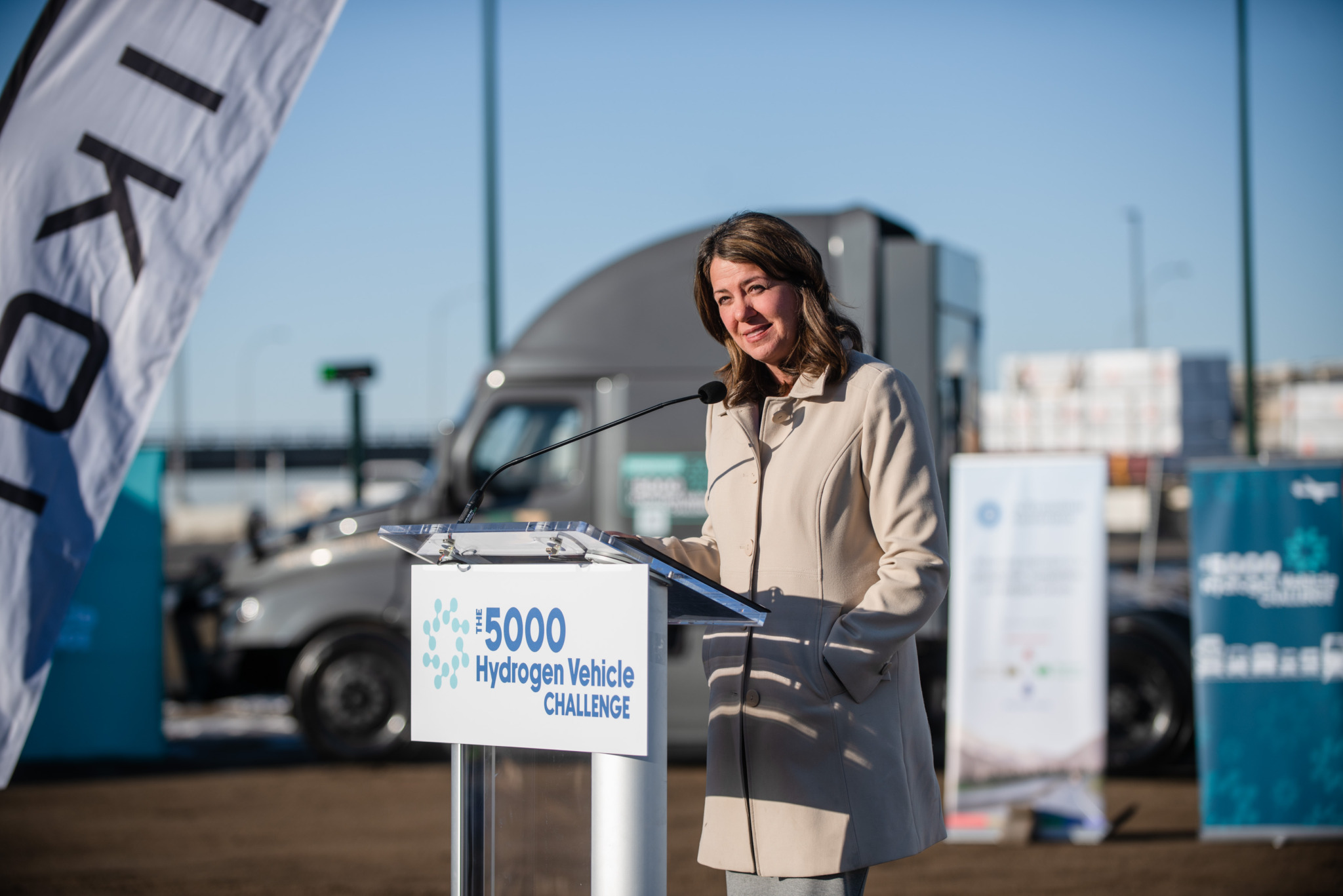
Alberta's 5,000 Hydrogen Vehicle Challenge aims to put that many hydrogen or dual-fuel vehicles on Western Canadian roads by 2028. This target focuses on heavy-duty applications where hydrogen's advantages, fast refueling and long range, matter most.
>> RELATED: Hydrogen Hubs Face Critical Turning Point

An outline of the the progress of hydrogen infrastructure development across key Canadian regions, featuring Alberta's Hydrogen Highway, British Columbia's expanding station network, Ontario's focus on industrial and fleet applications, and Quebec's partnership with Toyota to supply hydrogen-powered vehicles.
The economics shift when hydrogen serves multiple vehicle classes. A station supporting both light-duty passenger vehicles and Class 8 trucks distributes infrastructure costs across higher utilization. Air Products designed its Alberta stations with this multi-modal approach specifically in mind.
Production Capacity Already Exists
Canada produces significant hydrogen volumes already, mostly gray hydrogen from natural gas for industrial applications. Alberta's established hydrogen production infrastructure gives it a head start. Converting existing production to blue hydrogen with carbon capture or scaling green hydrogen from renewable electricity becomes economically viable when demand materializes.
Edmonton Global initiated the 5,000 Hydrogen Vehicle Challenge at the 2024 Canadian Hydrogen Convention. The goal recognizes Alberta's production advantages while acknowledging the chicken-and-egg challenge. You need vehicles to justify stations. You need stations to sell vehicles.
The $5,000 incentive breaks that stalemate by making FCEVs price-competitive with comparable battery electric vehicles. Combined with three years of complimentary fuel from manufacturers like Toyota, early adopters face minimal financial risk.
>> RELATED: Pacific Clean Fuels Announces California's Largest Hydrogen Fleet Partnership

Provincial Incentives Stack With Federal Support
British Columbia's CleanBC program offers additional rebates for zero-emission vehicles, including FCEVs. Stacking provincial and federal incentives can reduce purchase costs by more than $9,000 in some cases.
Manitoba, Quebec, and other provinces maintain their own EV incentive programs. While details vary, most include FCEVs alongside battery electric options. This multi-level policy support creates favorable conditions for early FCEV deployment.
The challenge remains distribution. Hydrogen stations cluster in specific regions, limiting where consumers can practically own FCEVs today. But that's changing as infrastructure investment accelerates.
What Happens Next
The February 16, 2026 launch date creates urgency. Manufacturers will likely increase Canadian FCEV availability to capture incentive-driven demand. Infrastructure developers face pressure to deliver operational stations before consumer interest peaks.
Regional hub strategies make sense in Canada's geography. Rather than attempting nationwide coverage immediately, focusing on Alberta's Edmonton-Calgary corridor, B.C.'s Lower Mainland, and Ontario's industrial centers concentrates resources where they'll generate the most impact.
Commercial fleets bridge the gap. Transit buses, delivery vans, and municipal vehicles provide the baseline demand that justifies station investment. As infrastructure density increases, consumer adoption becomes more practical.
The $5,000 incentive won't create a hydrogen vehicle boom overnight. But combined with infrastructure investment, production capacity, and favorable policy alignment, it establishes the conditions for hydrogen mobility to scale beyond pilot projects into commercial reality.
Canada's approach, pairing demand incentives with infrastructure funding and leveraging existing industrial hydrogen capacity, offers a template other jurisdictions are watching closely.
Subscribe to the newsletter
Daily decarbonization data and news delivered to your inbox
Follow the money flow of climate, technology, and energy investments to uncover new opportunities and jobs.
Latest issues
-
The US Hasn't Made Heavy Water Since 1982
Inside This Issue ⚛️ Aternium Completes FEED Studies for US Hydrogen, Heavy Water Project 🐄 Google, McKinsey Strike Brazil Carbon Removal Deal With Silvopasture Project 🔧 Cummins Selects Stargate ...
-
Why Colorado’s Koloma Has Japan’s Largest Utility Hooked
Inside This Issue ⚡ JERA Invests in Koloma to Explore Natural Hydrogen as a Future Low-Carbon Energy 🔬 New CATF Tool Provides Framework for Self-Assessment and Strengthening of Biomass Carbon Remo...
-
LNK Energies Targets $6.50 Hydrogen With No Federal Subsidies
Inside This Issue 🚛 MIT Startup Says It Can Turn Diesel Trucks Into Cheaper Hydrogen Haulers, See It at Disrupt 🏭 Baytown City Council Briefs: ExxonMobil Blue Hydrogen Agreement Approved 🌎 Colorad...
Company Announcements
-
A new interactive tool from Clean Air Task Force (CATF) provides a practical framework for the self-assessment and strengthening of biomass carbon removal (BiCRS) protocols to help ensure that carb...
-
LanzaJet Secures Financing to Scale SAF Production and Supply Global Customers
CHICAGO, Oct. 15, 2026 (GLOBE NEWSWIRE) -- LanzaJet, Inc., a leading next-gen fuels technology company and fuels producer, today announced fully committed new financing of at least $20 million to s...
-
44.01 and Frontier Advance Permanent CO₂ Storage Through In-Situ Mineralization
44.01's in-situ mineralization (ISM) process turns CO₂ into solid rock underground in a few years, after which the risk of reversal is functionally zero. >> In Other News: JERA Invests in ...
-
JERA Invests in Koloma to Explore Natural Hydrogen as a Future Low-Carbon Energy
JERA Co., Inc. (JERA), through its corporate venture capital arm JERA Ventures, has invested in Koloma, Inc. (Koloma), a U.S.-based natural hydrogen exploration and development company. The invest...