
Canada just made history in carbon removal. On April 28, 2026, Carbon Removal Canada and Frontier announced the launch of the Quebec Surficial Mineralization Hub in Thetford Mines, Quebec, marking the world's first dedicated facility for surficial mineralization research and demonstration.
The hub is built on the site of a former asbestos mining region with over 800 megatonnes of serpentinite mine tailings, one of the largest accessible deposits in the world. What was once an environmental liability is now the foundation of a potential carbon removal breakthrough.
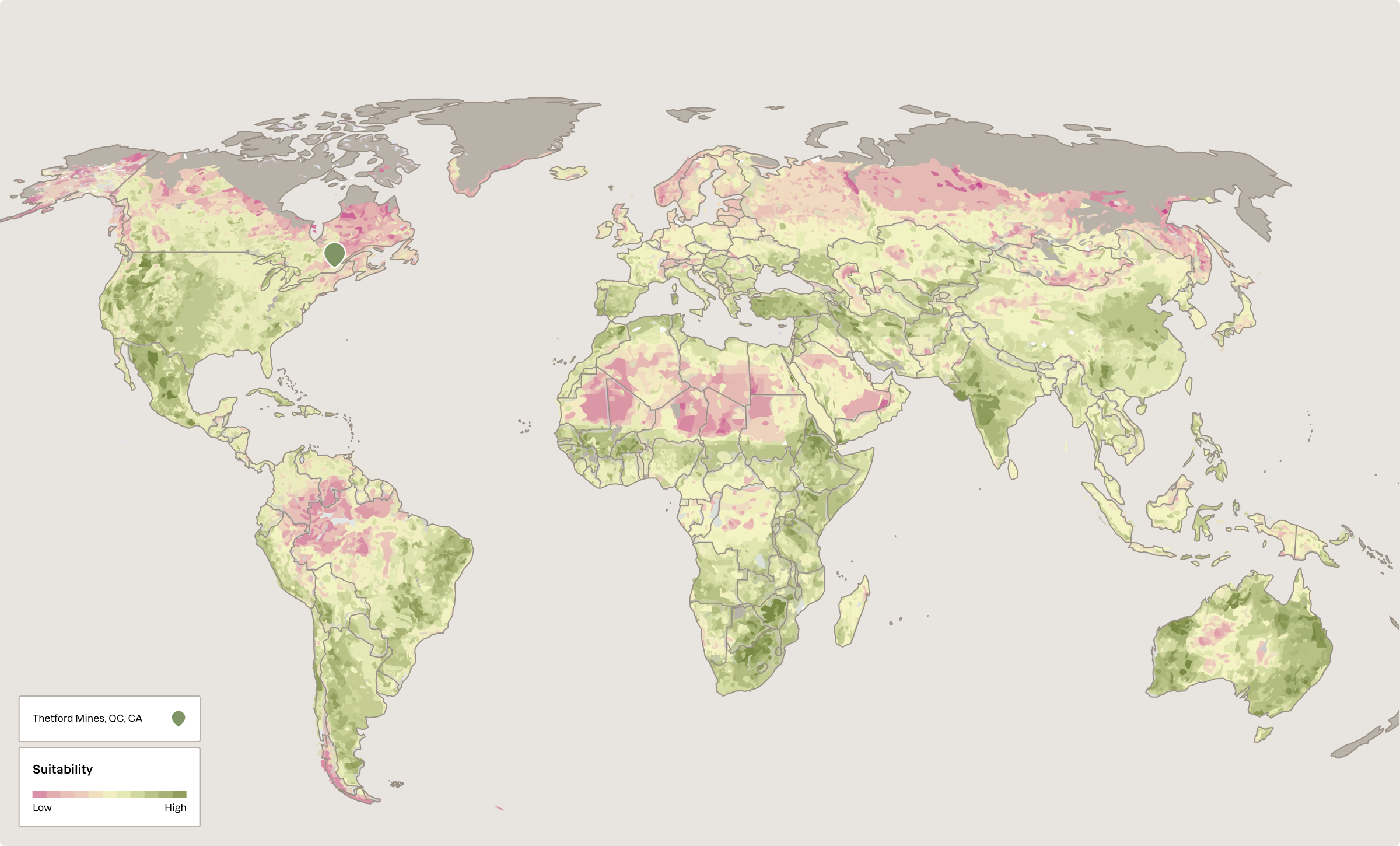
Global suitability of surficial mineralization sites
>> In Other News: Hyroad Energy And Total Hydrogen Solutions Announce Commercial Fueling Agreement To Support Hydrogen Trucking In Texas
What Is Surficial Mineralization?
Surficial mineralization is a natural process where certain rocks absorb CO2 from the air and convert it into stable carbonate minerals, locking carbon away permanently. In nature, this takes thousands of years. By grinding the rock and exposing it to air, that timeline compresses into decades.
Frontier estimates the pathway could deliver hundreds of gigatons of removal at costs under $80 per ton. The math is compelling: serpentinite, the rock type at the core of this approach, is reactive enough to absorb CO2 efficiently and abundant enough to scale globally. Much of the processing technology already exists in the mining industry, keeping costs relatively low.
Why Thetford Mines?
Quebec holds an extraordinary concentration of already-mined serpentinite tailings, and Thetford Mines sits at the center of it. Commercial projects in the region could remove between 400 and 700 megatonnes of carbon, representing an estimated $60 to $175 billion in economic value. The process could also yield critical minerals like nickel, magnesium, and cobalt as a byproduct.
Despite the potential, the field is still early-stage. Of more than 500 companies Frontier has reviewed since 2022, only a handful are actively working on surficial mineralization. Starting a company in this space is expensive: teams need rock feedstock, permits, and specialized lab equipment before they can test a single idea.
The hub directly addresses that gap.
What the Hub Offers
Early-stage teams accepted into the hub will gain access to a permitted site where social license is already established, 10,000 tons of serpentinite mine tailings as feedstock, and shared lab equipment for processing, measurement, and monitoring.
Successful applicants will also receive prepurchases or R&D grants from Frontier, as part of its advance market commitment to purchase $1 billion in permanent carbon removal between 2022 and 2030.
Na'im Merchant, Executive Director of Carbon Removal Canada, put it plainly: "Thetford Mines has carried the weight of Canada's industrial legacy for generations. Today, that same geology becomes the foundation for something the world has never seen. This hub will help prove that carbon removal is not a distant promise. Rather, it is happening now, in Canada, with the community behind it."
Hannah Bebbington Valori, Head of Deployment at Frontier, echoed the urgency: "Surficial mineralization could remove gigatons of CO2, but we need more teams in the field to prove it, and right now, the upfront costs make it nearly impossible to get started."
Rooted in Community Transformation
The hub is also a key pillar of DuGrisAuVert ("From Grey to Green"), a regional initiative led by the Société de développement économique de la région de Thetford and the MRC des Appalaches. The plan aims to transform the region's mining heritage into a hub for circular economy innovation and environmental industry.
The region's geology, experienced mining workforce, and existing infrastructure make it uniquely positioned to lead this emerging sector at scale.
About Carbon Removal Canada
Carbon Removal Canada is an independent nonprofit accelerating the responsible scale-up of carbon removal technologies through policy advocacy, market development, and research.
About Frontier
Frontier is an advance market commitment founded by Stripe, Alphabet, Shopify, Meta, McKinsey, and tens of thousands of businesses using Stripe Climate, with a goal of purchasing $1 billion in permanent carbon removal between 2022 and 2030.
Subscribe to the newsletter
Daily decarbonization data and news delivered to your inbox
Follow the money flow of climate, technology, and energy investments to uncover new opportunities and jobs.
Latest issues
-
Why Is Wyoming Giving 650,000 Acres to Carbon Storage?
Inside This Issue 🪨 Inside Blm's 650,000-Acre Bet on Wyoming Carbon Storage 🏭 California Advances Carbon Capture and Removal Regulations Under SB 905 ⚡ Why a Japanese Power Giant Is Betting on Den...
-
Colorado Joins the 7-State CCS Permit Fast Lane
Inside This Issue ⚖️ Colorado Takes Over Class VI Permits: What Changes for CCS? 🏭 Hebei Shoulang Facility Using LanzaTech Technology Achieves World’s First ISCC EU RCF Certification for Ethanol P...
-
The US Hasn't Made Heavy Water Since 1982
Inside This Issue ⚛️ Aternium Completes FEED Studies for US Hydrogen, Heavy Water Project 🐄 Google, McKinsey Strike Brazil Carbon Removal Deal With Silvopasture Project 🔧 Cummins Selects Stargate ...
Company Announcements
-
Citi Closes $72 Million Carbon Removal-Linked Note to Support Applied Carbon Biochar Project
HIGHLIGHTS Citi structured an innovative $72 million carbon removal-linked note to provide upfront capital for Applied Carbon's biochar project, marking a first-of-its-kind "outcome bond" for ver...
-
New platform opens access to the same rigorous project evaluations trusted by the world's leading carbon removal procurement programs Today, Relae (formerly Carbon Direct) launched The Diligence C...
-
Inside BLM's 650,000-Acre Bet on Wyoming Carbon Storage
The Bureau of Land Management has offered right-of-way grants covering about 649,438 acres of federal pore space in southwest Wyoming. The September 21, 2026 offers went to Moxa Carbon Storage LLC ...
-
NEW YORK, BUSINESS WIRE, SWITCH Maritime (Switch), a leading developer of zero-emission vessels, secured a Design Basis Agreement (DBA) with the United States Coast Guard (USCG) for the SWITCH-150,...