
Louisiana and Texas Projects Signal a Turning Point for Carbon Management
Big moves are happening in the U.S. carbon capture space—and two major players are leading the charge: Occidental and its carbon-focused subsidiary 1PointFive. Together, they’re building the kind of infrastructure that goes beyond climate promises and gets right into the business of removing carbon dioxide at scale.
In April 2025, two major milestones were announced. One is a 25-year sequestration agreement with CF Industries for a low-carbon ammonia facility in Louisiana. The other? EPA approval of Class VI permits for the world’s largest Direct Air Capture (DAC) facility in Ector County, Texas—named STRATOS.
These two projects reflect a growing shift in how industry, policy, and technology can come together to make decarbonization real, practical, and profitable.
>> RELATED: Occidental and 1PointFive Secure Class VI Permits for STRATOS Direct Air Capture Facility
The Louisiana Deal: A 25-Year Commitment to Clean Ammonia
CF Industries, along with partners JERA Co., Inc. and Mitsui & Co., Inc., is building the Bluepoint low-carbon ammonia facility in Ascension Parish, Louisiana. The goal? To produce ammonia from natural gas—but with significantly reduced carbon emissions.
That’s where 1PointFive steps in. Under the agreement, carbon captured from the Bluepoint facility will be transported and _safely stored underground_ at the Pelican Sequestration Hub in Louisiana. This site has already reached its final investment decision and is deep into development.
Jeff Alvarez, President, 1PointFive Sequestration, said: "CF Industries' and its partners confidence in our Pelican Sequestration Hub is a validation of our expertise managing carbon dioxide and how we collaborate with industrial organizations to become their commercial sequestration partner."
The hub will use geologic formations more than a mile deep to permanently store industrial CO₂. And with backing from Occidental, which brings over 50 years of experience managing CO₂, this project has the kind of foundation that builds long-term trust.
CF Industries' CEO Tony Will added: "Having a proven carbon capture and sequestration partner was essential to enabling our industry-leading project and the manufacturing jobs it will create."
This isn’t just about carbon—it’s also about jobs, growth, and making U.S. energy infrastructure more competitive.

>> In Other News: CF Industries Forms JV With Jera, Mitsui for $4 Billion Low-Carbon Ammonia Plant
STRATOS: World’s Largest Direct Air Capture Facility
While Louisiana looks to industrial emissions, Texas is going straight to the source: the air itself.
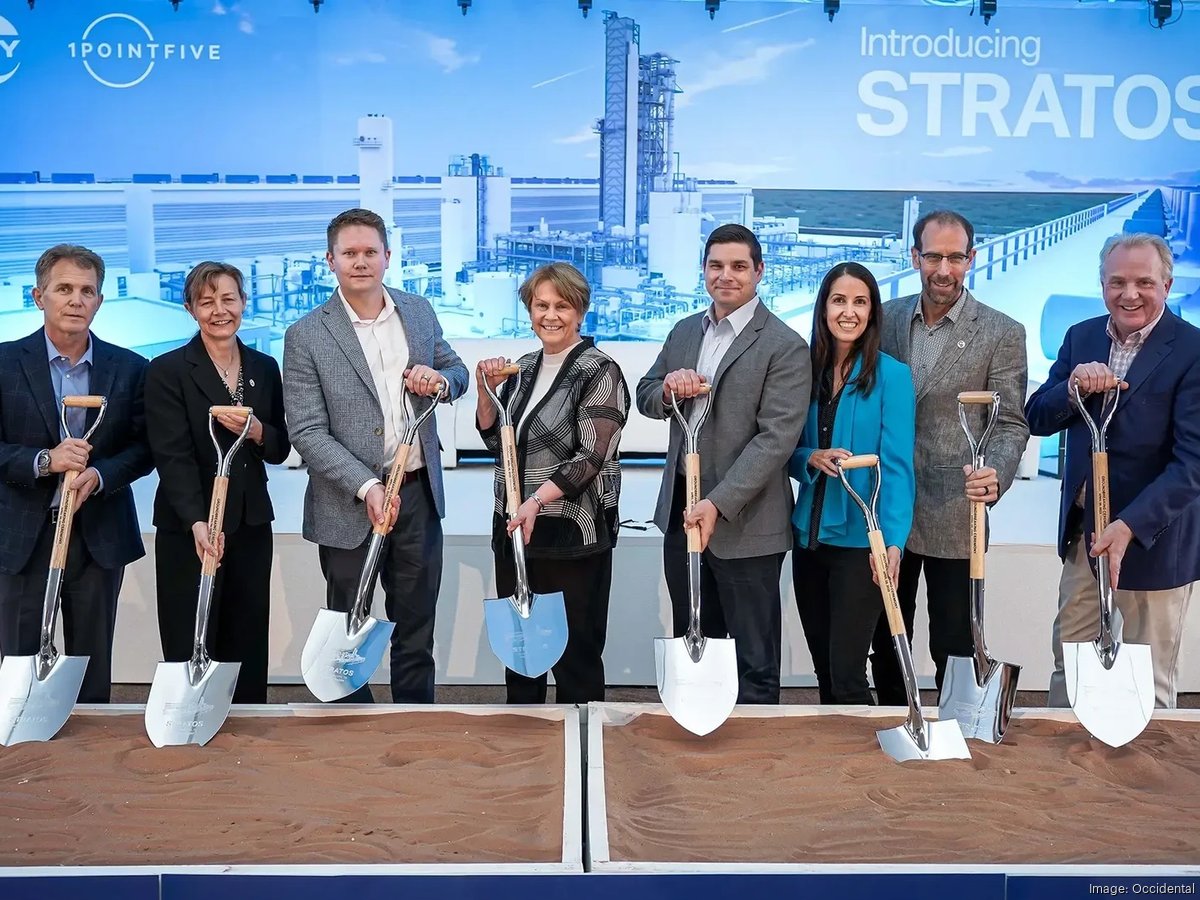
STRATOS, the flagship DAC facility from 1PointFive, is designed to capture up to 500,000 tonnes of CO₂ directly from the atmosphere every year. That captured carbon will then be stored underground in compliance with newly granted Class VI permits from the U.S. Environmental Protection Agency.
Issued under the Safe Drinking Water Act’s Underground Injection Control program, these permits are the first ever granted for a DAC-specific project.
Vicki Hollub, President and Chief Executive Officer, Occidental, said: "The permits are a catalyst to unlock value from carbon dioxide and advance Direct Air Capture technology as a solution to help organizations address their emissions or produce vital resources and fuels."
STRATOS is expected to begin commercial operations later in 2025. This means the U.S. is just months away from seeing a fully operational DAC facility capturing carbon at an industrial scale—something that was mostly theoretical just a few years ago.
Why This Matters for the Industry
These projects are doing more than ticking ESG boxes. They’re laying the groundwork for an ecosystem where carbon becomes a managed asset—not just a liability.
And they show how public and private sectors can work together: rigorous EPA oversight, deep industry experience, and big infrastructure investments all converging on a single mission.
Together, the Pelican Hub and STRATOS reflect what’s possible when decarbonization is treated as a serious business model—not just a PR goal.
The Bigger Picture: Carbon as an Enabler
These moves also elevate the value of natural gas, especially when used to make products like ammonia—vital for global food production. By capturing the CO₂ from that process, companies like CF Industries are proving that you don’t have to choose between economic growth and climate responsibility.
And DAC technology like STRATOS? It opens doors to future fuels and synthetic products made from atmospheric carbon—think sustainable aviation fuels or climate-neutral plastics.
It’s not about stopping industry. It’s about transforming it. And doing it with tools that already exist—just waiting to be scaled.
A New Phase for U.S. Energy
This isn’t a pilot. These aren’t maybes. These are multibillion-dollar bets on carbon capture infrastructure in key U.S. regions—Louisiana and Texas.
With heavy hitters like Occidental, CF Industries, and 1PointFive at the helm, carbon capture and hydrogen-linked solutions are finally moving from whiteboards to wellheads.
It’s a clear signal to global investors and policymakers: The U.S. isn’t just participating in the low-carbon economy. It’s helping build it.
Subscribe to the newsletter
Daily decarbonization data and news delivered to your inbox
Follow the money flow of climate, technology, and energy investments to uncover new opportunities and jobs.
Latest issues
-
Why Gulf Coast CCS Teams Are Watching Liverpool Bay
Inside This Issue 💂 Eni’s Douglas Platform Sets the Offshore CCS Blueprint 🌲 Pacolet Milliken Expands Its Biomass Platform With the Acquisition of Georgia Renewable Power 🧪 Metacon Receives EU Fun...
-
Who Bought Gevo’s $50M in 45Z Credits?
Inside This Issue ⛽ Gevo Sells $70M in 45Z Credits to a New Kind of Buyer 🌱 South Pole, Gaïago, and Gold Standard Issue European Soil Carbon Credits, Unlocking Verified Regenerative Agriculture Re...
-
Verra Landed CCP Approval. What Changes for DAC?
Inside This Issue ✅ Verra's CCS Credits Just Got the Integrity Seal Buyers Want 💰 South Korea Unveils $747 Billion Energy Transition Plan Through 2035 💧 Hydrogen and Carbon Capture and Storage in ...
Company Announcements
-
Former Saskatchewan cabinet minister Rob Norris takes the helm as MAX Power prepares to begin completions and pursues a dual listing in the United States, with Ran Narayanasamy moving to the newly...
-
CORALVILLE, IA, Oct. 13, 2026 (GLOBE NEWSWIRE) -- SunHydrogen, Inc. (OTCQB: HYSR), the developer of a breakthrough technology to produce renewable hydrogen using sunlight and water, today provided ...
-
Verde Secures Landmark ASTM EPD Verification for Engineered Biochar Road Application
Among the first independently verified EPDs for biochar in road construction, validating low-carbon data to accelerate commercialization with Ergon and global licensing ST. LOUIS, Oct. 13, 2026 (G...
-
Industrial-scale project brings new approach to brine management and water security to the region PERTH, Australia, Oct. 13, 2026 /PRNewswire/ -- Capture6 yesterday launched Project Tortuga, an in...