
ExxonMobil And BASF Join Forces To Advance Low-Emission Hydrogen Through Methane Pyrolysis Technology
Published by Todd Bush on November 18, 2025
- Industry leaders team up to accelerate methane pyrolysis—a technology that produces low-emission hydrogen and solid carbon.
- Methane pyrolysis complements both companies’ technology portfolios.
- A demonstration plant is planned in Baytown, Texas, to validate the technology at scale.
ExxonMobil and BASF have formed a strategic collaboration to advance methane pyrolysis technology, a next step toward delivering efficient, cost-competitive, low-emission hydrogen solutions for industrial use. The companies have signed a joint development agreement to co-develop methane pyrolysis technology, including plans to construct a demonstration plant aimed at commercial readiness.
Strength in collaboration
“This collaboration combines technological innovations and industrial expertise of ExxonMobil and BASF to accelerate the development of low-emission hydrogen,” said Mike Zamora, president of ExxonMobil Technology and Engineering Company. “Methane pyrolysis holds real potential, especially in regions where traditional carbon capture and storage solutions are less viable. ExxonMobil brings decades of deep technical knowledge in methane pyrolysis and a shared commitment to innovation.”
BASF has been developing methane pyrolysis technology over the past several years in a project funded by the German Federal Ministry of Research, Technology and Space (BMFTR).
“This novel methane pyrolysis technology generates competitive low-emission hydrogen and has a high potential for further reduction of the carbon footprint of our product portfolio. In line with our new Winning Ways Strategy, it will contribute to our ambition to be the preferred chemical company to enable our customers’ green transformation,” said Dr. Stephan Kothrade, member of the Board of Executive Directors and Chief Technology Officer at BASF. “We have been working on this technology for more than a decade and developed a superior reactor concept that we successfully validated at our test plant in Ludwigshafen. By combining BASF’s process innovation with ExxonMobil’s scale-up expertise we are bringing this cost-efficient low-emission hydrogen solution closer to economically viable industrial deployment.”
>> In Other News: Blue Ammonia Boom: U.S. Market Eyes 3,200% Surge
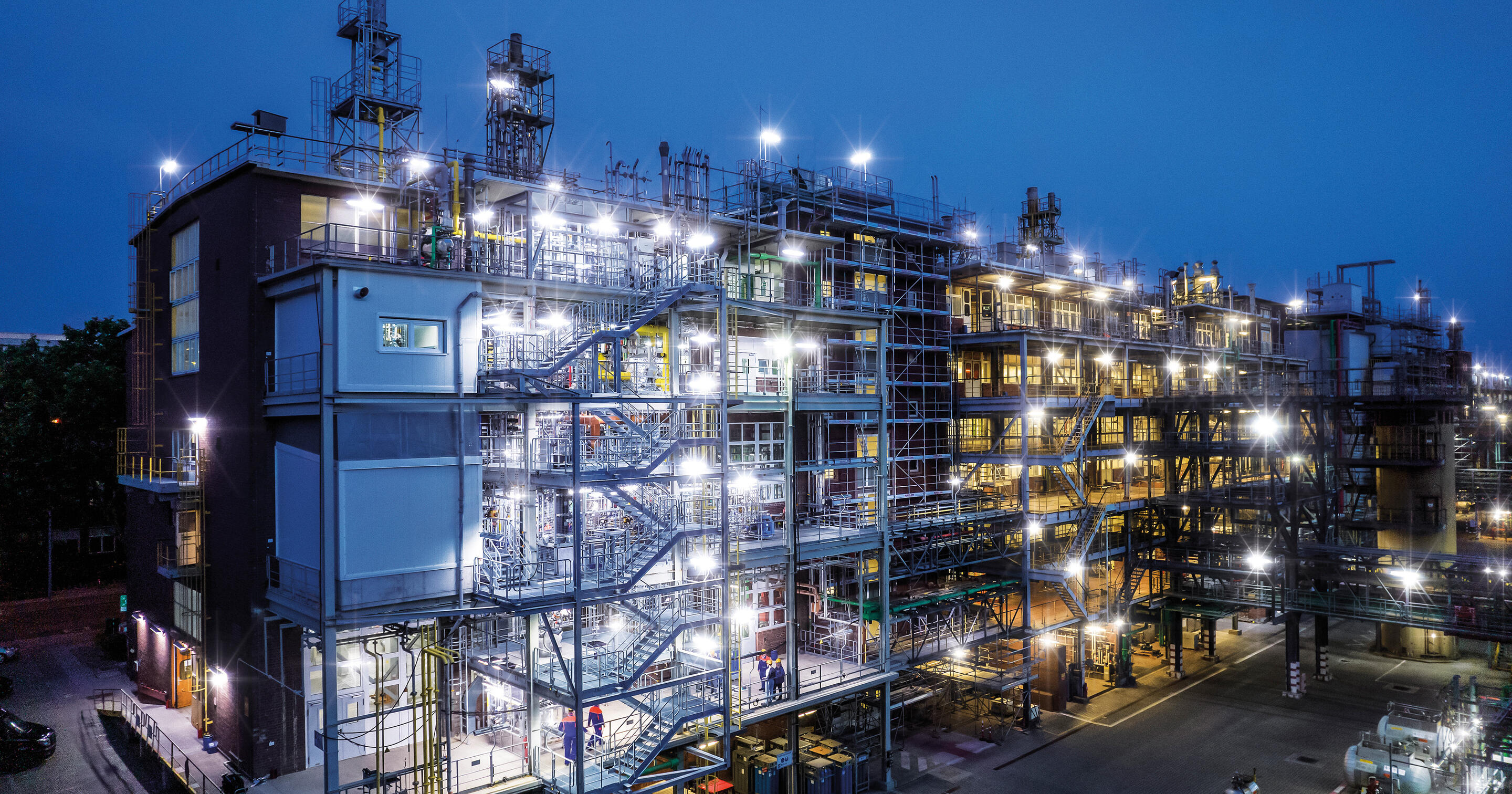
Ludwigshafen site(Feature Image: BASF - Methane pyrolysis pilot plant in Ludwigshafen, Germany)
A competitive approach to low-emission hydrogen
Methane pyrolysis uses electricity to convert natural gas or other gases, like bio-methane, into hydrogen and solid carbon. The technology offers several significant advantages: it does not generate process-related CO2 emissions, unlike traditional methods such as steam-methane reforming, requires approximately five times less electrical energy than water electrolysis and does not require the use of water. Moreover, it leverages existing natural gas infrastructure, and therefore is easily deployable in different locations. The lack of process CO2 emissions makes it particularly attractive for regions where carbon capture and storage face geologic, technical or policy-related challenges.
This process creates two valuable products: low-emission hydrogen and high-purity solid carbon. Hydrogen is both an important energy carrier and an essential feedstock in the chemical industry. The solid carbon has applications across multiple industries including steel, aluminum manufacturing, construction and advanced carbon products, like battery materials.
Demonstration plant to advance commercial readiness
The companies plan to construct and operate a demonstration plant capable of producing up to 2,000 tons of low-emission hydrogen and 6,000 tons of solid carbon product annually. This facility – which will be located at ExxonMobil’s Baytown Complex – will serve as a critical step toward commercial readiness and help validate the technology at scale.
Strategic milestone for hydrogen solutions
Methane pyrolysis technology complements ExxonMobil's broader strategy to deliver hydrogen solutions that work across geographies and infrastructure realities. ExxonMobil is committed to delivering solutions in the hydrogen value chain, and this collaboration marks a strategic milestone in the company’s pursuit of scalable, efficient and globally deployable hydrogen solutions.
Building the future of hydrogen - one molecule at a time.
Subscribe to the newsletter
Daily decarbonization data and news delivered to your inbox
Follow the money flow of climate, technology, and energy investments to uncover new opportunities and jobs.
Companies
Latest issues
-
Who Bought Gevo’s $50M in 45Z Credits?
Inside This Issue ⛽ Gevo Sells $70M in 45Z Credits to a New Kind of Buyer 🌱 South Pole, Gaïago, and Gold Standard Issue European Soil Carbon Credits, Unlocking Verified Regenerative Agriculture Re...
-
Verra Landed CCP Approval. What Changes for DAC?
Inside This Issue ✅ Verra's CCS Credits Just Got the Integrity Seal Buyers Want 💰 South Korea Unveils $747 Billion Energy Transition Plan Through 2035 💧 Hydrogen and Carbon Capture and Storage in ...
-
Quebec Wood Waste Just Became Jet Fuel
Inside This Issue 🌲 ARC Bio Tests a Refinery Shortcut to Forest-Based SAF 💧 Scientists Just Found a New Way to Make Hydrogen from Water 🤝 How Channel Partnerships Are Helping More Organizations Ta...
Company Announcements
-
Mineral Europa: A Game Changer for Shipping
Antwerp, Oct. 09, 2026 (GLOBE NEWSWIRE) -- Antwerp, 9 October 2026 – CMB.TECH NV (“CMB.TECH” or the “Company”) (NYSE: CMBT, Euronext Brussels: CMBT and Euronext Oslo Børs: CMBTO) today announces th...
-
Download PDF (170.95 KB) Eni CCUS Holding, owned jointly by Eni and Global Infrastructure Partners ("GIP"), part of BlackRock, announces that Liverpool Bay CCS has completed the installation of th...
-
First-of-its-kind project in France and Belgium marks a major breakthrough for carbon credit buyers seeking high-integrity, high-impact regenerative agriculture removals in Europe; providing buyer...
-
Gevo and ClimeFi Complete Carbon Removal Transaction, Advancing Gevo's Growing Carbon Business
Transaction supports Gevo's path toward a carbon business exceeding $30 million in annual revenue from existing operations ENGLEWOOD, Colo., Oct. 08, 2026 (GLOBE NEWSWIRE) -- Gevo, Inc. (NASDAQ: G...