
For the first time anywhere on Earth, a stimulated geologic hydrogen well is being developed with proprietary technology designed to pull zero-carbon hydrogen directly out of rock. GeoRedox Corporation and Canada Nickel Company signed a Memorandum of Understanding on May 20, 2026, to launch the program at the Crawford Nickel Project near Timmins, Ontario. No one has done this before, and the geology beneath Crawford is a key reason this site was chosen.
Key Facts
- GeoRedox Corporation is a Boston-based early-stage technology developer founded in 2024 by scientists and engineers from MIT.
- GeoRedox will fund the demonstration program in full. Canada Nickel contributes site access, rock samples, technical data, and expertise.
- The same ultramafic geology at Crawford underlies more than 20 of Canada Nickel's projects across the Timmins Nickel District.
- Crawford was named the second project fast-tracked under Ontario's One Project, One Process framework in January 2026 and is expected to attract approximately C$5 billion in investment.
- Canada Nickel's IPT Carbonation process is projected to sequester up to 1.5 million tonnes of CO2 annually at peak production, with total storage expected to reach 54 million tonnes over Crawford's 41-year project life.
- The NetCarb partnership, signed in June 2025, has the potential to push Crawford's lifetime CO2 storage capacity to more than 500 million tonnes, with annual capacity of 10 to 15 million tonnes.
- Crawford's in-situ carbon injection pilot, completed in late 2025 and confirmed in February 2026, successfully sequestered approximately 12 tonnes of CO2 dissolved at a depth of 396 metres, with no surface leakage detected.
>> In Other News: Carbon Direct Releases Sustainable Agricultural Biomass Sourcing Guide for Carbon Dioxide Removal, in Collaboration With Microsoft and Stripe
What Makes This a World First?
The geologic hydrogen field has seen growing attention in recent years. Exploration teams have mapped formations, research labs have run bench-scale experiments, and startups have raised early capital across multiple continents. But no one has drilled a well specifically designed to stimulate hydrogen production from ultramafic rock, until now.
That distinction matters. Passive geologic hydrogen accumulates naturally in underground reservoirs. Stimulated geologic hydrogen is different: it accelerates a chemical reaction already occurring inside the rock, extracting hydrogen at volumes and speeds that passive accumulation cannot match. GeoRedox's proprietary Advanced Weathering Enhancement (AWE) technology is built specifically for this approach.
The AWE system produces ultralow-cost hydrogen from rocks and geological formations distributed widely around the world, without the need for a capping layer or reservoir. That removes one of the key constraints in conventional geologic hydrogen exploration. Governments and private teams globally have been racing to unlock this resource, but no one has yet drilled a stimulated well. You don't need to find a trap. You need the right rock.
Crawford has the right rock.
>> RELATED: The Global Race to Unlock Geologic Hydrogen: A New Frontier in Clean Energy

Ultramafic rock can act as both the feedstock and natural reactor for hydrogen production. When water reacts with iron- and magnesium-rich minerals such as olivine and pyroxene, serpentinization releases molecular hydrogen without combustion, electrolysis, or external industrial energy input.
Why Does Ultramafic Rock Matter for Hydrogen Production?
When water moves through ultramafic formations and contacts iron- and magnesium-rich minerals like olivine and pyroxene, a chemical reaction called serpentinization occurs. That reaction is exothermic and releases molecular hydrogen as a direct by-product. No combustion, no electrolysis, and no industrial energy input is needed to drive the process.
The geological formation acts as both the feedstock and the reactor. GeoRedox's AWE technology is designed to stimulate and accelerate this process. Crawford's ultramafic geology is the same rock type underlying all of Canada Nickel's more than 20 projects across the Timmins Nickel District, giving any validated technique here a wide potential application across the region.
Beyond Timmins, equivalent ultramafic formations with similar chemistry exist across multiple continents. Serpentinization chemistry is consistent regardless of jurisdiction. A successful AWE demonstration at Crawford would carry technical implications well beyond Ontario, since GeoRedox is already developing projects across North America, Europe, India, and Africa.

"Crawford gives us the ideal real-world setting to validate our technology alongside a world-class mining operation. The opportunity to develop a project with Canada Nickel in a well-developed industrial region with extensive infrastructure is truly exciting."
Robert Stoner, President, GeoRedox Corporation
Why Crawford? The Infrastructure and Policy Case
First-of-kind demonstrations often fail in remote locations, and it rarely comes down to the science alone. Logistics and permitting are the real bottlenecks. Crawford removes most of those risks from the start.
Timmins is an established mining camp with a documented permitting history, a regional skilled labor pool, and a supply chain built around large-scale resource operations. Other developers working in ultramafic settings are starting from scratch on infrastructure. Crawford is not.
On January 13, 2026, Ontario formally named Crawford as the second project to advance under its One Project, One Process (1P1P) framework. The designation coordinates permitting and review timelines across provincial ministries, reducing regulatory friction for major mining developments. The project is projected to attract approximately C$5 billion in investment and is expected to rank among the Western world's largest nickel sulphide projects and among the world's lowest-carbon nickel operations once in operation.
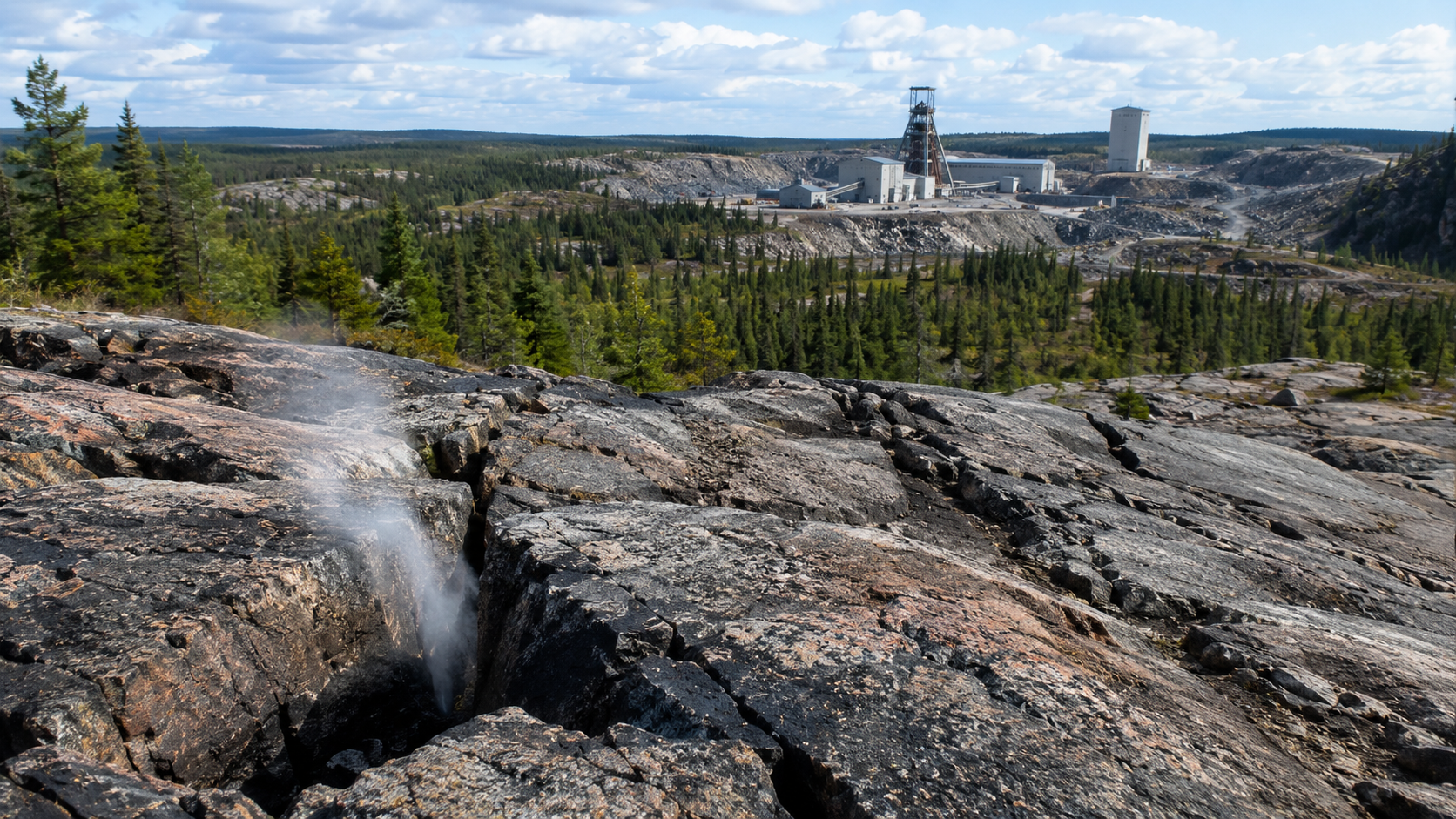
How Does This Fit Into Canada Nickel's Layered Zero-Carbon Strategy?
The GeoRedox MOU does not arrive at a blank slate. Canada Nickel has been building a layered decarbonization platform at Crawford for years, and the hydrogen production layer is the newest addition to that stack.
Canada Nickel's proprietary In-Process Tailings (IPT) Carbonation process uses ultramafic mining tailings as a permanent CO2 storage medium. Once Crawford reaches peak production, IPT Carbonation is projected to sequester up to 1.5 million tonnes of CO2 annually, with total storage expected at 54 million tonnes over the project's 41-year life. The Government of Canada backed this process with a C$3.4 million contribution in February 2025.
"The ultramafic rock that hosts our Crawford deposit and twenty-plus projects across the Timmins Nickel District is precisely the geology GeoRedox's technology is designed for. This partnership brings us a significant step closer to a Zero-Carbon Industrial Cluster in Northeast Ontario."
Mark Selby, CEO, Canada Nickel Company
In June 2025, Canada Nickel added another layer with a partnership with Australia-based NetCarb. The NetCarb process targets a more complete carbonation of serpentine minerals through a CO2 activity swing reactor. It has the potential to increase Crawford's annual CO2 storage capacity to between 10 and 15 million tonnes, with lifetime capacity at Crawford alone potentially exceeding 500 million tonnes.
In late 2025, Canada Nickel and the University of Texas at Austin ran an in-situ CO2 injection pilot at Crawford, supported by the U.S. Department of Energy's ARPA-E program. Injection ran from November 20 to December 18, 2025. Results confirmed in February 2026 showed approximately 12 tonnes of CO2 sequestered dissolved at a depth of 396 metres, with no surface leakage detected throughout the field test.
The GeoRedox AWE well is now the fourth layer. The same rock that permanently stores CO2 also produces hydrogen through serpentinization chemistry. Both processes stem from the same geological reality of Crawford's ultramafic formation.
Crawford's Zero-Carbon Stack: Four Programs, One Rock Formation
| Program | Technology | Status (as of May 2026) |
|---|---|---|
| IPT Carbonation | CO2 mineralization in ultramafic tailings | Pilot plant level; C$3.4M federal funding secured (February 2025) |
| NetCarb Partnership | CO2 activity swing reactor; targets serpentine carbonation | Early commercialization phase; partnership signed June 9, 2025 |
| UT Austin In-Situ Pilot | CO2-saturated water injection into ultramafic rock at 396m depth | Completed; approximately 12 tonnes CO2 sequestered, zero surface leakage detected (results confirmed February 2026) |
| GeoRedox AWE Well | Stimulated geologic hydrogen via Advanced Weathering Enhancement of ultramafic rock | MOU signed May 20, 2026; first-of-kind demonstration program launching |
What the Zero-Carbon Industrial Cluster Would Actually Look Like
Canada Nickel's stated goal is to build a zero-carbon industrial cluster in the Timmins Nickel District. The cluster would convert Crawford's nickel, chromium, and cobalt concentrates into finished critical mineral products while running on zero-carbon energy and drawing on the region's geological carbon storage capacity.
Hydrogen is not peripheral to that vision. Hydrogen is used extensively in metals refining and processing. If GeoRedox's AWE technology can supply carbon-free hydrogen directly from the ultramafic geology beneath the mine, the cluster would not need to import it from an external source. No electrolyzer farm. No dedicated pipeline connection to a separate production facility.
Geologic hydrogen produced on-site could feed into the same industrial processes that handle the ore. That is a fundamentally different model for industrial hydrogen supply than anything currently operating at scale, and it has never been field-validated before this program.
Canadian Public Affairs Channel segment on Canada Nickel’s Crawford Nickel Project in Timmins, Ontario — one of the world’s largest ultramafic nickel deposits with strong potential for large-scale carbon sequestration.
Keep Expectations Calibrated: This Is a Demonstration Program
The MOU between GeoRedox and Canada Nickel is the starting line, not the finish. The AWE technology has not yet been validated at commercial scale, and stimulated geologic hydrogen as a category is pre-commercial globally. GeoRedox was founded in 2024 and is still in early project development across its target regions.
The Crawford demonstration is designed to generate the field data that either confirms or refines the technology's viability. Other companies working in stimulated geologic hydrogen, such as Vema Hydrogen in France, are at comparable early stages. The entire field is pre-commercial.
What sets Crawford apart is site quality and partner track record. Canada Nickel has already run a successful in-situ injection pilot, secured federal funding for its carbonation program, and achieved Ontario's 1P1P fast-track designation. The GeoRedox demonstration inherits a site that has already executed technically complex, first-of-kind underground programs, which is a meaningful operational advantage.
The Bigger Picture: What a Successful Test Could Prove
Geologic hydrogen's most underappreciated potential is also its most transformative. If stimulated production from ultramafic rock works at scale, it opens a pathway to carbon-free hydrogen produced directly at an industrial site, with no electrolyzers, no pipelines from a separate facility, and no renewable energy input needed to drive the reaction.
Green hydrogen requires large-scale renewable electricity. Blue hydrogen requires natural gas and carbon capture infrastructure. Geologic hydrogen requires the right geology and a technology to unlock it. Ultramafic formations with equivalent chemistry to Crawford's are distributed across multiple continents. If GeoRedox validates AWE technology in Ontario, the implications reach well beyond one Canadian mining district.
Crawford is the first data point. Timmins is where the test begins.
For ongoing coverage of carbon removal, BECCS, and corporate CDR procurement, subscribe to Decarbonfuse.com.
Subscribe to the newsletter
Daily decarbonization data and news delivered to your inbox
Follow the money flow of climate, technology, and energy investments to uncover new opportunities and jobs.
Latest issues
-
Why Is Wyoming Giving 650,000 Acres to Carbon Storage?
Inside This Issue 🪨 Inside Blm's 650,000-Acre Bet on Wyoming Carbon Storage 🏭 California Advances Carbon Capture and Removal Regulations Under SB 905 ⚡ Why a Japanese Power Giant Is Betting on Den...
-
Colorado Joins the 7-State CCS Permit Fast Lane
Inside This Issue ⚖️ Colorado Takes Over Class VI Permits: What Changes for CCS? 🏭 Hebei Shoulang Facility Using LanzaTech Technology Achieves World’s First ISCC EU RCF Certification for Ethanol P...
-
The US Hasn't Made Heavy Water Since 1982
Inside This Issue ⚛️ Aternium Completes FEED Studies for US Hydrogen, Heavy Water Project 🐄 Google, McKinsey Strike Brazil Carbon Removal Deal With Silvopasture Project 🔧 Cummins Selects Stargate ...
Company Announcements
-
Citi Closes $72 Million Carbon Removal-Linked Note to Support Applied Carbon Biochar Project
HIGHLIGHTS Citi structured an innovative $72 million carbon removal-linked note to provide upfront capital for Applied Carbon's biochar project, marking a first-of-its-kind "outcome bond" for ver...
-
New platform opens access to the same rigorous project evaluations trusted by the world's leading carbon removal procurement programs Today, Relae (formerly Carbon Direct) launched The Diligence C...
-
Inside BLM's 650,000-Acre Bet on Wyoming Carbon Storage
The Bureau of Land Management has offered right-of-way grants covering about 649,438 acres of federal pore space in southwest Wyoming. The September 21, 2026 offers went to Moxa Carbon Storage LLC ...
-
NEW YORK, BUSINESS WIRE, SWITCH Maritime (Switch), a leading developer of zero-emission vessels, secured a Design Basis Agreement (DBA) with the United States Coast Guard (USCG) for the SWITCH-150,...