
The most comprehensive record yet of carbon dioxide stored underground through Geological Carbon Dioxide Storage has been published today, revealing that 43.6 million tonnes were sequestered in 2024 alone – a new annual record – and that 421.7 million tonnes have now been stored in the past three decades.
The 2026 Annual Report from The London Register of Subsurface CO₂ Storage, led by researchers from Imperial College London, tracks the annual rates of CO₂ stored by operational projects worldwide. This year’s edition expands the Register to 70 projects across 17 countries on six continents.
>> In Other News: We’re Moving $2M+ to Climate Solutions
“Our latest report shows that geological CO2 storage has become a global enterprise, with annual reported storage more than doubling between 2016 and 2024, and the Register itself now covering 69 individual projects around the world,” said Professor Samuel Krevor, Director of the Register from the Department of Earth Science and Engineering (ESE) at Imperial.
The consistency of these operations, and the fact that new countries and projects continue to join the Register, shows that geological storage is demonstrated as a large-scale mitigation technology. Professor Samuel Krevor, Director of The London Register of Subsurface CO2 Storage
“The consistency of these operations, and the fact that new countries and projects continue to join the Register, shows that geological storage is demonstrated as a large-scale mitigation technology.”
The consistency of these operations, and the fact that new countries and projects continue to join the Register, shows that geological storage is demonstrated as a large-scale mitigation technology.
The consortium behind the Register brings together more than 30 international experts from academia, industry and government, including the Department of Energy Science & Engineering at Stanford, MIT Civil and Environmental Engineering, the Global CCS Institute, the Carbon Capture & Storage Association, IEAGHG and CSIRO.
Record year driven by Brazil and the US
Geological CO2 storage is a process where CO2 captured from industrial sources and power production, or directly from the atmosphere, is injected it into rocks deep underground, allowing this greenhouse gas to be safely stored for potentially thousands of years.
The London Register of Subsurface CO2 Storage is focused on tracking geological storage – “Where the sources of CO2 today are dominated by industrial capture, removals from the atmosphere are projected to emerge as the leading technology using geological storage by mid-century”, said Professor Krevor.
Annual amounts of CO₂ stored with colouring by continent, country, and individual project. The hashed grey in the bar for 2025 represents the amount of CO2 stored in 2024 by projects where data has not yet been published. Credit: The London Register of Subsurface CO2 Storage Annual Report 2026.
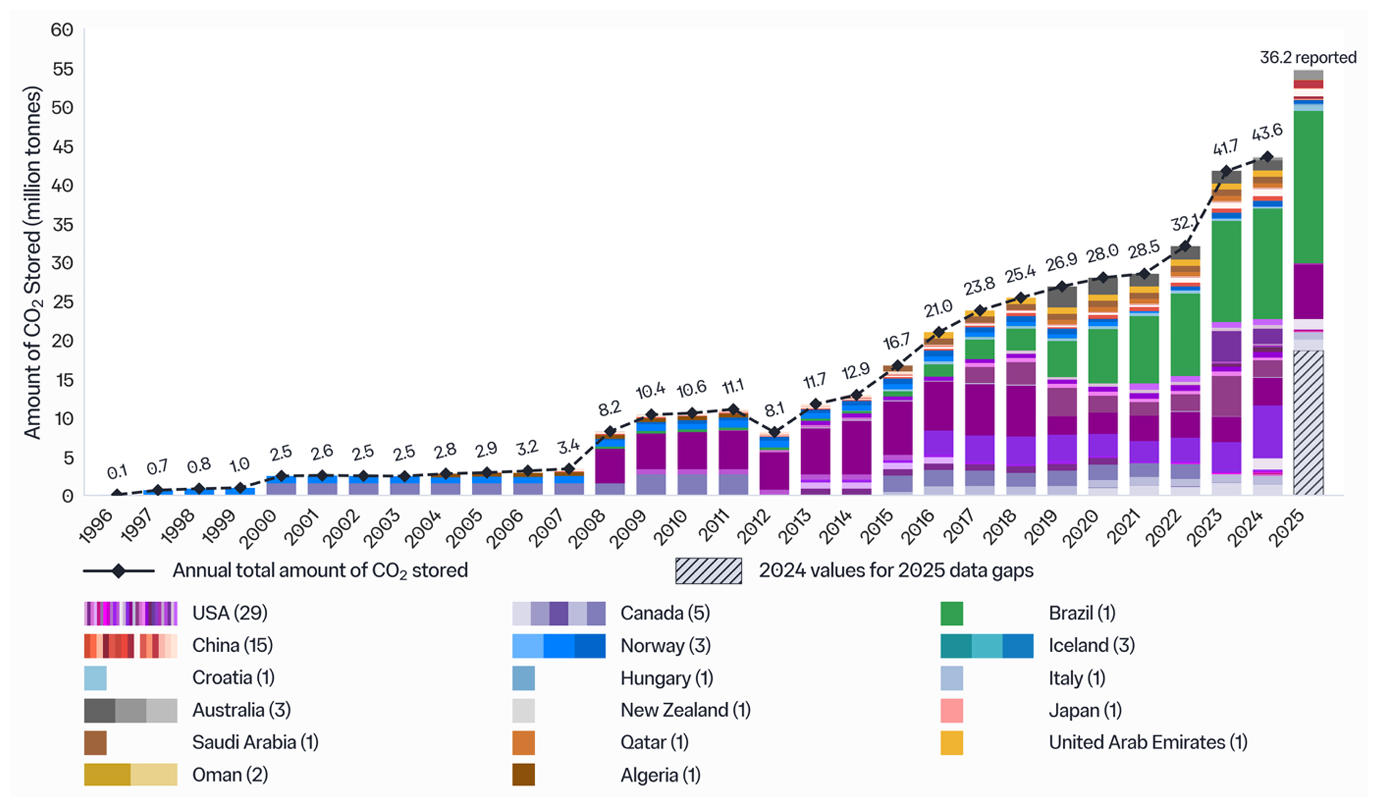
Building on the Register’s findings last year, the 2026 report finds that reported annual storage rose from 21.0 million tonnes in 2016 to a record 43.6 million tonnes in 2024 (2024 stands as the most recent complete reporting year).
Projects in the US remain the largest contributors by number, with 23 projects reporting a combined 20.2 million tonnes, while Brazil’s Petrobras Santos Basin Pre-Salt Oil Field remained the single largest project, reporting 14.2 million tonnes (approximately one-third of the global total).
China’s reported storage increased to 1.7 million tonnes in 2024, driven primarily by the Shengli Oilfield and the newly included Daqing Aonan Oilfield, while Australia reported 1.7 million tonnes with the addition of the Moomba project. New Zealand and Italy both entered the Register for the first time, and in Europe the Northern Lights project in Norway began injection in August 2025.
Revised figures
This year’s report includes significant revisions to previously published figures, following a new interpretation of data from the North Burbank Unit to account for recycled CO₂, a correction of double counting between company-level and project-level reporting, and revised national inventory figures for Sleipner (the world’s first commercial CCS project).
These revisions reflect the latest evidence... That transparency matters if geological CO2 storage is to earn the confidence of policymakers and investors. Dr Xiaowei Gao, Executive Director of The London Register of Subsurface CO2 Storage
Cumulative geological CO2 storage through 2023 has therefore been revised from 351.4 to 342.0 million tonnes – a decrease of 2.7% – while the 2023 annual figure has been revised from 45.2 to 41.7 million tonnes.
“These revisions reflect the latest evidence, and we have been explicit in the report about where the accounting for reported storage remains uncertain,” said Dr Xiaowei Gao, Executive Director of the Register from Imperial’s Department of Earth Science and Engineering. “That transparency matters if geological CO2 storage is to earn the confidence of policymakers and investors.”
These revisions reflect the latest evidence... That transparency matters if geological CO2 storage is to earn the confidence of policymakers and investors.
Incomplete data already show 36.2 million tonnes
At the time of publication, 29 projects across 12 countries had reported 2025 storage data, with an aggregate of 36.2 million tonnes – a figure the authors caution is incomplete and should not be interpreted as a full-year global total.
Brazil’s Petrobras Santos Basin project has already reported 19.6 million tonnes for 2025, an increase from 14.2 million tonnes in 2024, while operations in China have reported 2.6 million tonnes across seven projects and the United States 8.9 million tonnes across six projects.
Meanwhile, several large US projects with 2024 data, including the Denver Unit/Wasson San Andres Field, Hobbs Field, Seminole San Andres Unit and Shute Creek, do not yet have corresponding 2025 records in the Register.
Accounting for uncertainties
While US projects use rigorous accounting when reporting under the Environmental Protection Agency’s regulation governing CO₂ injected for underground sequestration, the report highlights that the basis for accounting is less clear for many other projects.
A large share of the reported storage – 82.3% of the cumulative total – is also categorised as Geological Storage with Oil Recovery, much of which aims to extend the operating life of an existing oil field. However, around a third of the stored CO₂ reported under this category – 112.5 million tonnes, or 32.4% of the cumulative total – is simply recorded as ‘injected,’ potentially without adjustments for the CO₂ that is later brought back to the surface and reinjected underground.
The more precisely we can trace every tonne of CO₂ from injection to permanent storage, the stronger the evidence base we can provide as the technology grows to the scale that climate targets demand. Professor Samuel Krevor, Professor of Subsurface Carbon Storage, Department of Earth Science & Engineering, Imperial
“In this Register we endeavour to compile values of storage net of any losses and accounting for recycled and reinjected CO₂,” the authors write. “There are, however, uncertainties in the meaning of the reported values for those projects with ambiguous or unstated bases.” An analysis of these uncertainties will be incorporated into upcoming reports.
Professor Krevor said: “To meet the 1.5°C target pledged by the Paris Agreement, all projections indicate that geological CO2 storage must scale up to one billion tonnes of CO₂ storage or more per year by 2050.”
“The more precisely we can trace every tonne of CO₂ from injection to permanent storage, the stronger the evidence base we can provide as the technology grows to the scale that climate targets demand.”
Subscribe to the newsletter
Daily decarbonization data and news delivered to your inbox
Follow the money flow of climate, technology, and energy investments to uncover new opportunities and jobs.
Latest issues
-
Why Is Wyoming Giving 650,000 Acres to Carbon Storage?
Inside This Issue 🪨 Inside Blm's 650,000-Acre Bet on Wyoming Carbon Storage 🏭 California Advances Carbon Capture and Removal Regulations Under SB 905 ⚡ Why a Japanese Power Giant Is Betting on Den...
-
Colorado Joins the 7-State CCS Permit Fast Lane
Inside This Issue ⚖️ Colorado Takes Over Class VI Permits: What Changes for CCS? 🏭 Hebei Shoulang Facility Using LanzaTech Technology Achieves World’s First ISCC EU RCF Certification for Ethanol P...
-
The US Hasn't Made Heavy Water Since 1982
Inside This Issue ⚛️ Aternium Completes FEED Studies for US Hydrogen, Heavy Water Project 🐄 Google, McKinsey Strike Brazil Carbon Removal Deal With Silvopasture Project 🔧 Cummins Selects Stargate ...
Company Announcements
-
China Launches World's First Semi-Submersible Offshore Wind-to-Hydrogen Platform
The world's first semi-submersible offshore wind-to-hydrogen platform has floated in Jiangmen, south China's Guangdong Province, opening a new avenue for the development and utilization of clean ma...
-
We’re Moving $2M+ to Climate Solutions
New companies, new ways to back existing ones, and every purchase built to pull in more capital We’re adding new companies to our portfolio and getting creative with how we put more money behind e...
-
Citi Closes $72 Million Carbon Removal-Linked Note to Support Applied Carbon Biochar Project
HIGHLIGHTS Citi structured an innovative $72 million carbon removal-linked note to provide upfront capital for Applied Carbon's biochar project, marking a first-of-its-kind "outcome bond" for ver...
-
New platform opens access to the same rigorous project evaluations trusted by the world's leading carbon removal procurement programs Today, Relae (formerly Carbon Direct) launched The Diligence C...