
Google Is Buying Climate Impact on Two Clocks at Once
Published by Todd Bush on September 21, 2026
Google is buying climate impact on two timelines at the same time. Its September 10, 2026, deal for 1 million rice methane credits from Mitti Labs targets warming this decade. A September 16 agreement with Terradot adds 1 million tonnes of methane impact by 2030 and 1 million tonnes of permanent removal by 2040.
Add a pledge of at least $50 million for superpollutants and a research round worth more than $6 million, and a clear pattern appears. Google is paying for fast cooling now and durable carbon storage later.

What Did Google Buy from Mitti Labs in India?
Google agreed to buy 1 million carbon credits from Mitti Labs through 2030, which both companies call the largest rice methane offtake announced to date. Mitti Labs is a Bengaluru-based company that combines satellite technology, AI and field operations to cut methane from rice farming.
The program covers about 100,000 hectares of smallholder farms in Karnataka, Andhra Pradesh and Telangana, according to Mitti Labs. More than 70,000 farmers are expected to adopt alternate wetting and drying, or AWD, which lets paddies dry out between floodings.
Mitti Labs says AWD can cut rice methane by up to 50% and irrigation water by close to 40% without hurting yields. The partnership aims to eliminate 3 million tonnes of near-term warming impact on a 20-year basis by 2030. That equals 1 million tonnes on a 100-year basis.
The credits carry an "A" rating from ratings agency Sylvera. Founded in 2023, Mitti Labs has raised $12.5 million from backers including Aramco Ventures and Lightspeed India.
"Google is committed to finding the most promising solutions that neutralize warming across both the near and long term. Mitti Labs' approach delivers critical near-term atmospheric impact by cutting methane emissions, while conserving billions of gallons of water and empowering smallholder farmers to deploy advanced water-management practices."
Kate Brandt, Chief Sustainability Officer, Google
Mitti Labs' GeoAI platform, developed with NASA support, tracks flooding and soil moisture down to individual smallholder plots. The company says its programs have saved 500 billion liters of water to date.
Key Facts
- Mitti Labs will deliver 1 million carbon credits to Google by 2030 across about 100,000 hectares in India.
- More than 70,000 smallholder farmers in Karnataka, Andhra Pradesh and Telangana are expected to take part.
- Terradot will deliver 1 million tonnes of methane impact (GWP20) by 2030 and 1 million tonnes of permanent removal by 2040.
- The Terradot project spans more than 200,000 hectares of rice farmland in Rio Grande do Sul, Brazil.
- Google's earlier Terradot deal covers 200,000 tonnes of ERW removal for delivery by the early 2030s.
- Google pledged at least $50 million for superpollutant projects through 2030.
- Google's 2026 R&D awards offer more than $6 million, with applications closing September 25, 2026.
>> In Other News: Brazil's Mombak Raises New Fund, Adds Salesforce as Carbon Credit Buyer
Why Is Google Buying Methane Cuts and Carbon Removal Together?
Google buys both because methane and carbon dioxide warm the planet on different clocks. Methane has driven roughly one-third of human-caused warming to date, but it clears the atmosphere in about a decade, according to Terradot.
Carbon dioxide behaves differently. It builds up and keeps heating the planet for centuries. Lowering long-term temperatures therefore requires durable removal.
Methane cuts bring relief within a few years. Enhanced rock weathering, or ERW, works more slowly. Crushed rock needs time to dissolve before its carbon storage is fully realized.
As short-lived methane benefits fade, permanent carbon removal phases in to replace them. Google set out this sequencing in its 2026 Environmental Report. Randy Spock, now Google's head of carbon removal, has described superpollutant action as a complement to CO2 removal, not a substitute.

Google's portfolio layers fast-acting methane cuts with slower, permanent carbon removal so the climate benefit carries past 2030.
Google also published a paper in May 2026 with guidelines for combining carbon removal and superpollutant abatement. Google says the Terradot project delivers a net decrease in warming when measured on a temperature-over-time basis.
How Does Terradot Anchor Google's Long-Duration Track?
Terradot first joined Google's durable removal track through a 200,000-tonne ERW purchase announced in December 2024. Google described that deal, set for delivery by the early 2030s, as the largest ERW agreement to date at the time.
Terradot is a Stanford-founded developer with ERW operations in Brazil and the United States. It spreads crushed volcanic rock on farmland, where natural weathering pulls CO2 from the air. The 2024 purchase came with a Google equity stake as Terradot launched with $58.2 million in funding.
Other buyers followed. Microsoft signed a 12,000-tonne removal agreement with Terradot for delivery between 2026 and 2029.
On September 16, 2026, Google and Terradot went further with a megaton-scale project in southern Brazil. It runs AWD and ERW on the same rice fields across more than 200,000 hectares in Rio Grande do Sul.
Google will buy 1 million tonnes of CO2e methane elimination by 2030, measured on a 20-year basis. It will also buy 1 million tonnes of permanent carbon removal by 2040, which Google calls its largest removal purchase so far.
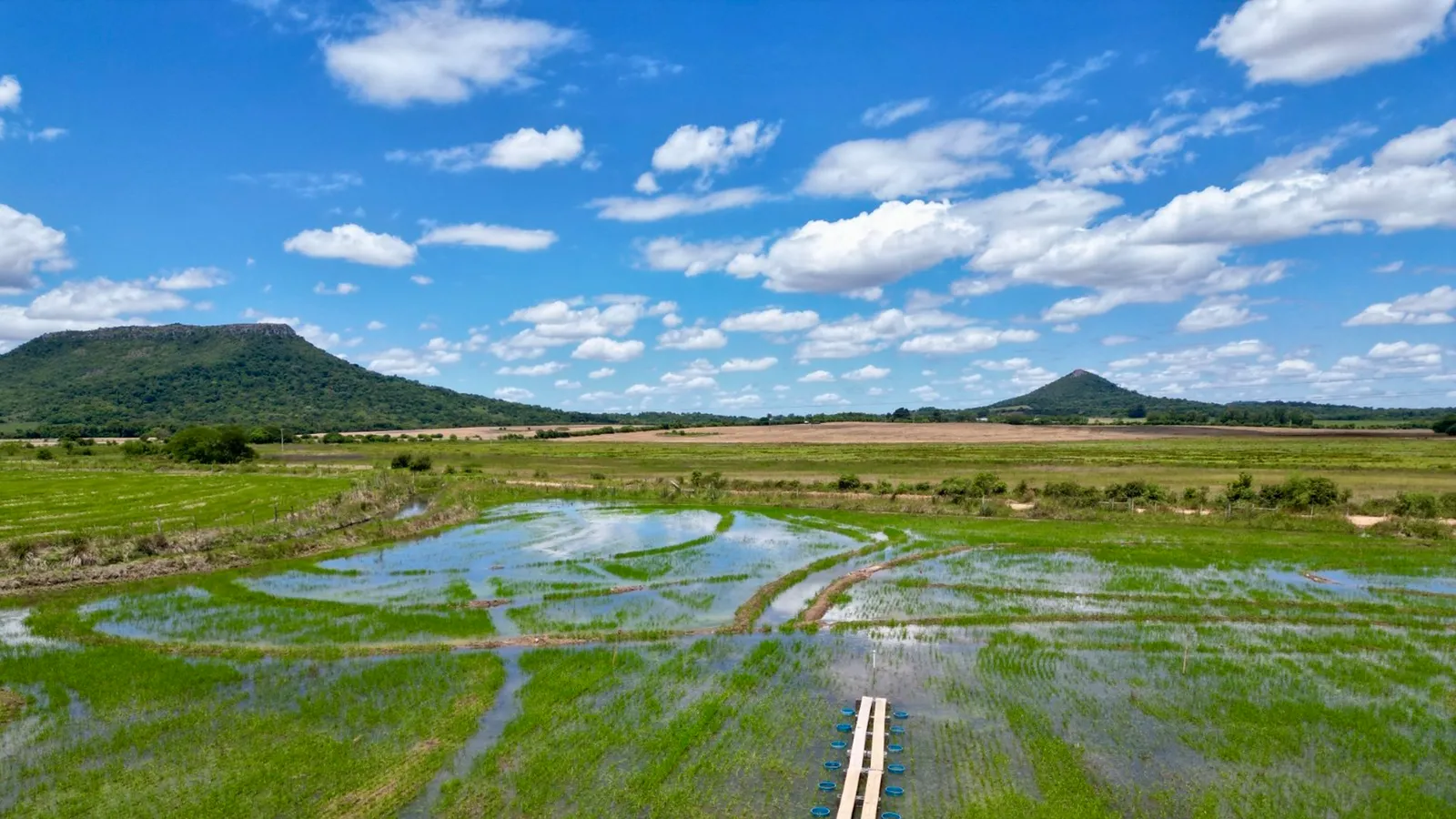
Rice fields in Rio Grande do Sul enrolled in the Terradot and Google project, which pairs methane cuts with enhanced rock weathering. Photo: Terradot via Business Wire.
Terradot says it has deployed more than 500,000 tonnes of rock and treated 20,000 hectares so far. The company is targeting 1 million tonnes of CO2 removal per year by 2035.
Google is also funding AWD methane research at Terradot and the Soil & Environmental Biogeochemistry Lab at Stanford Doerr School of Sustainability.

"We built this agreement to be a template, not a one-off. It's the largest carbon removal purchase Google has ever made, and by incorporating action on superpollutants, we realize that impact by 2030."
Randy Spock, Head of Carbon Removal, Google
Google's Two-Track Portfolio at a Glance
Google's commitments since December 2024 split into near-term methane cuts, long-duration removal, and research that supports both. Delivery dates run from 2030 for methane credits to 2040 for permanent removal.
| Commitment | Partner | Track | Scale | Timeline |
|---|---|---|---|---|
| ERW carbon removal (announced December 2024) | Terradot | Long-duration | 200,000 tonnes | By the early 2030s |
| Superpollutant pledge (March 2026) | Superpollutant Action Initiative | Near-term | At least $50 million | Through 2030 |
| R&D awards (August 2026) | Universities, nonprofits and businesses | Both | More than $6 million | Funds expected by end of 2026 |
| Rice methane credits (September 10, 2026) | Mitti Labs, India | Near-term | 1 million credits, about 100,000 hectares | By 2030 |
| AWD plus ERW project (September 16, 2026) | Terradot, Brazil | Both | 1 million tonnes methane impact (GWP20) and 1 million tonnes removal | 2030 (methane) and 2040 (removal) |
The two methane figures use different yardsticks. Mitti Labs' 1 million credits equal 1 million tonnes on a 100-year basis. Terradot's methane tranche is stated on a 20-year basis instead.
What Do the $50 Million Pledge and $6 Million Awards Add?
Google committed at least $50 million through 2030 to superpollutant projects. It is also funding more than $6 million in research to strengthen both tracks.
Google announced the pledge on March 5, 2026, as a participant in the newly formed Superpollutant Action Initiative. The coalition, organized by the Beyond Alliance, expects to mobilize about $100 million by 2030.
Participants include Amazon, Autodesk, Figma, JPMorganChase, Salesforce and Workday. The group says aggressive superpollutant cuts could avoid more than 0.5°C of warming by 2050.
Google's Mitti Labs and Terradot methane deals put that superpollutant focus into practice.
>> RELATED: Climeworks Announces Key Performance Improvements at Mammoth
On August 11, 2026, Google opened its 2026 Carbon Removal and Superpollutant Elimination R&D Awards, worth more than $6 million. Individual grants range from $350,000 to $500,000 across 12 priority areas and an open call.
Two research areas focus on methane. One targets abatement for diffuse, low-concentration streams such as landfill gas and dairy exhaust.
Applications close September 25, 2026. Google expects to disburse funds by the end of the year.
Is the Two-Track Model Spreading to Other Corporate Buyers?
Amazon is also buying rice methane credits, with a commitment covering more than 685,000 tonnes of CO2e. The Good Rice Alliance announced the long-term offtake with Amazon on April 22, 2026.
The alliance is backed by Bayer, with GenZero and Shell as partners. It works with more than 13,000 smallholder rice farmers across 35,000 hectares in India. Amazon is the primary buyer for the project's initial crediting phase.
Google Sustainability field notes on Terradot’s enhanced rock weathering work in Brazil, showing how crushed rock is spread on farmland to accelerate permanent CO2 removal.
Durable removal is scaling alongside methane action. Decarbonfuse covered record carbon removal market growth in the first half of 2025, led by large tech buyers.
ERW supply is also maturing. Registry Isometric issued the first independently verified enhanced weathering credits to InPlanet, an ERW developer working in Brazil. Whirlpool has since chosen InPlanet for its durable carbon removal portfolio.
Where the Two Clocks Meet
Google's 2026 deals give corporate buyers a working template. Near-term methane credits deliver impact by 2030. Permanent removal carries that impact through 2040.
Google says it structured the Terradot deal so any buyer, supplier or government can follow the same approach. For companies weighing methane cuts against removal, Google's answer is to fund both on purpose.
Frequently Asked Questions
What is alternate wetting and drying in rice farming?
Alternate wetting and drying lets rice paddies dry out periodically instead of staying flooded all season. Mitti Labs says the practice can cut methane by up to 50% and irrigation water by close to 40% without lowering yields.
How does enhanced rock weathering remove carbon dioxide?
Developers spread crushed silicate rock, such as basalt, on farmland. Rainwater reacts with the rock and pulls CO2 from the air, converting it into bicarbonate that is stored durably.
Why do GWP20 and GWP100 methane figures differ?
Methane is short-lived but potent, so its warming effect looks larger over 20 years than over 100 years. That is why Mitti Labs' 3 million tonnes on a 20-year basis equal 1 million tonnes on a 100-year basis.
For ongoing coverage of carbon removal, BECCS, and corporate CDR procurement, subscribe to Decarbonfuse.com.
Subscribe to the newsletter
Daily decarbonization data and news delivered to your inbox
Follow the money flow of climate, technology, and energy investments to uncover new opportunities and jobs.
Latest issues
-
LNK Energies Targets $6.50 Hydrogen With No Federal Subsidies
Inside This Issue 🚛 MIT Startup Says It Can Turn Diesel Trucks Into Cheaper Hydrogen Haulers, See It at Disrupt 🏭 Baytown City Council Briefs: ExxonMobil Blue Hydrogen Agreement Approved 🌎 Colorad...
-
Why Gulf Coast CCS Teams Are Watching Liverpool Bay
Inside This Issue 💂 Eni’s Douglas Platform Sets the Offshore CCS Blueprint 🌲 Pacolet Milliken Expands Its Biomass Platform With the Acquisition of Georgia Renewable Power 🧪 Metacon Receives EU Fun...
-
Who Bought Gevo’s $50M in 45Z Credits?
Inside This Issue ⛽ Gevo Sells $70M in 45Z Credits to a New Kind of Buyer 🌱 South Pole, Gaïago, and Gold Standard Issue European Soil Carbon Credits, Unlocking Verified Regenerative Agriculture Re...
Company Announcements
-
LanzaJet Secures Financing to Scale SAF Production and Supply Global Customers
CHICAGO, Oct. 15, 2026 (GLOBE NEWSWIRE) -- LanzaJet, Inc., a leading next-gen fuels technology company and fuels producer, today announced fully committed new financing of at least $20 million to s...
-
44.01 and Frontier Advance Permanent CO₂ Storage Through In-Situ Mineralization
44.01's in-situ mineralization (ISM) process turns CO₂ into solid rock underground in a few years, after which the risk of reversal is functionally zero. >> In Other News: JERA Invests in ...
-
JERA Invests in Koloma to Explore Natural Hydrogen as a Future Low-Carbon Energy
JERA Co., Inc. (JERA), through its corporate venture capital arm JERA Ventures, has invested in Koloma, Inc. (Koloma), a U.S.-based natural hydrogen exploration and development company. The invest...
-
Company Update First-quarter contracts mark Karbon‑X's rapid and successful commercial entry into European low-carbon fuel markets Rapidly established European commercial relationships, market ac...