
Google, McKinsey, Tencent Invest in Indonesia Carbon Removal
Published by Todd Bush on July 13, 2026
Google and McKinsey will purchase 335,000 metric tons of nature-based removals through the Symbiosis Coalition, while Tencent will purchase 300,000 metric tons as its first offtake outside of China.
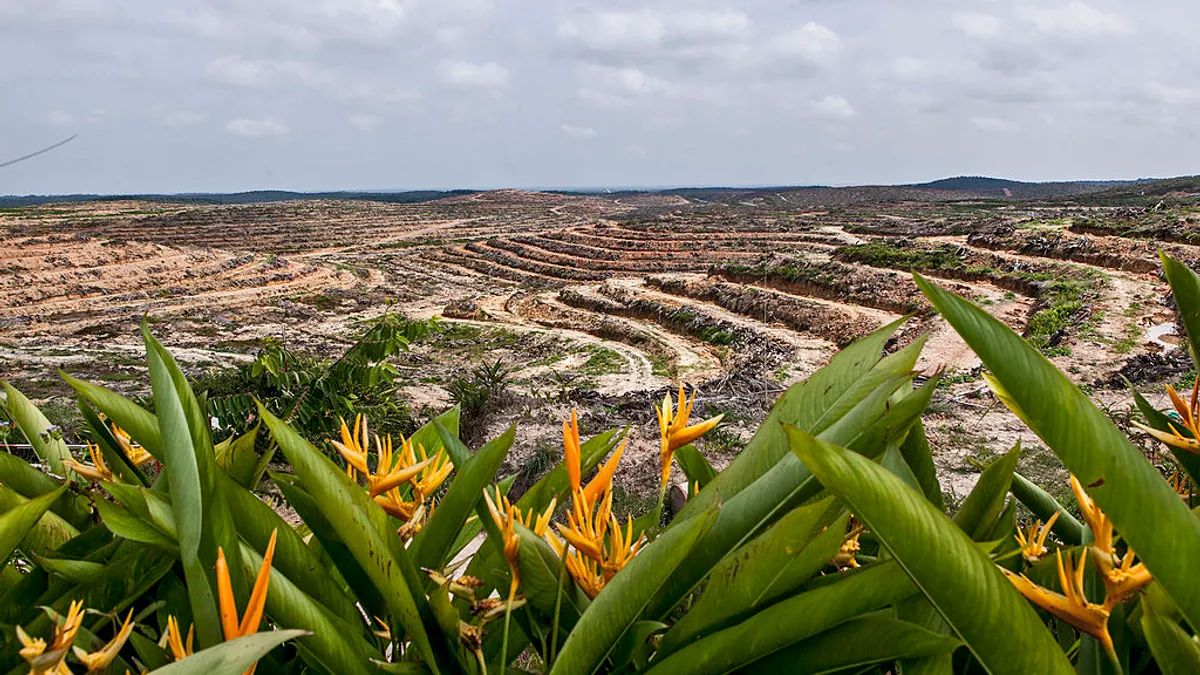
A view of land clearing for palm oil plantation in Siak district on July 11, 2014 in Riau province, Sumatra, Indonesia. Indonesia had the second-largest decrease in forest-area by square miles from 2000-2020, according to the World Population Review.
Dive Brief:
Nature-based carbon removal company Thryve.Earth announced Wednesday it had secured its first corporate offtakes for 650,000 metric tons of carbon removals through separate deals with Google and Mckinsey & Company — through the Symbiosis Coalition — and Tencent, the largest company in China by market capitalization.
Google and McKinsey will purchase 335,000 metric tons of carbon removals, an offtake agreement they made together as members of the Symbiosis Coalition, according to a July 8 release. The coalition represents a group of buyers who have made an advanced market commitment to contract 20 million tons of nature-based carbon removal credits by 2030.
Tencent, the technology and entertainment conglomerate, will separately purchase 300,000 metric tons of carbon removals, per the release. The company said the deal represents its first offtake outside of China.
Dive Insight:
Thryve, which has flagship carbon removal projects in India and Indonesia, said the removal credits will come from its project restoring rainforests in Sulawesi, Indonesia. Both deals with Google and McKinsey plus Tencent will run for a course of 10 years.
The project will look to restore 6,000 hectares of the ecosystem using “a mixed crop farming system that sequesters carbon, replenishes soils, reduces fire risk, and increases biodiversity and income for local farmers,” Thryve said in the release.
>> In Other News: Canadian PM Visits Saudi Arabia to Strengthen Energy, Mining Partnerships
The carbon removal company said carbon financing “is critical to enabling this project to scale,” and the offtake commitments will provide the volume and price certainty needed to raise the financing needed to scale to thousands of hectares.
The farming system used by the project will create layers of crops and canopy to diversify farmers’ income, in addition to income from carbon revenues. The top canopy of the forest will be made of sugar palm plants and timber trees; a middle portion will grow papayas, avocados, coffee and bananas; and chili and corn will be grown on the ground level, according to the release. The planted fruit and timber trees will store carbon long term, according to Thryve.
Symbiosis Coalition Executive Director Julia Strong said in the release that the offtake agreements gives Thryve certainty about its ability to build at scale, which is “exactly the kind of signal that unlocks the impact of this market and of projects like Thryve for people and planet.”
“The Thryve project demonstrates that positive community and ecological outcomes are not just co-benefits of high-integrity projects but importantly are co-drivers of success,” Strong said.
The Symbiosis Coalition was launched in 2024 by Google, Meta, Microsoft, McKinsey and Salesforce. Bain & Co. and REI have also become coalition members since the group’s launch. In addition to its advance market commitment to buy afforestation, reforestation or revegetation-based carbon removals, Symbiosis is hoping its work in the market will help with some of the high costs, low investor interest or dwindling public trust in the social and environmental impact of nature-based removal projects.
This deal with Thryve becomes the third announced removal contract from the Symbiosis Coalition. Google and McKinsey, as coalition members, bought 215,000 metric tons of removals from Brazilian carbon removal company Mombak in November. In March, the coalition announced that Google, Mckinsey and Meta had contracted over 130,000 metric tons of removals from Living Carbon, a company working on reforestation in the Appalachians.
Tencent has a goal of achieving carbon neutrality across its operations and value chain and for 100% of the electricity it consumes to be “green power” by 2030. The company’s net-zero strategy focuses around energy efficiency, renewable energy and supporting emerging carbon offset technologies, according to its website.
Subscribe to the newsletter
Daily decarbonization data and news delivered to your inbox
Follow the money flow of climate, technology, and energy investments to uncover new opportunities and jobs.
Latest issues
-
113 CCS Projects: What's Driving the Surge?
Inside This Issue 🏭 Global CCS Hits 113 Projects as Americas Lead Capacity 💰 We're Moving $2M+ to Climate Solutions 💧 China Launches World's First Semi-submersible Offshore Wind-to-hydrogen Platfo...
-
Why Is Wyoming Giving 650,000 Acres to Carbon Storage?
Inside This Issue 🪨 Inside Blm's 650,000-Acre Bet on Wyoming Carbon Storage 🏭 California Advances Carbon Capture and Removal Regulations Under SB 905 ⚡ Why a Japanese Power Giant Is Betting on Den...
-
Colorado Joins the 7-State CCS Permit Fast Lane
Inside This Issue ⚖️ Colorado Takes Over Class VI Permits: What Changes for CCS? 🏭 Hebei Shoulang Facility Using LanzaTech Technology Achieves World’s First ISCC EU RCF Certification for Ethanol P...
Company Announcements
-
China Launches World's First Semi-Submersible Offshore Wind-to-Hydrogen Platform
The world's first semi-submersible offshore wind-to-hydrogen platform has floated in Jiangmen, south China's Guangdong Province, opening a new avenue for the development and utilization of clean ma...
-
We’re Moving $2M+ to Climate Solutions
New companies, new ways to back existing ones, and every purchase built to pull in more capital We’re adding new companies to our portfolio and getting creative with how we put more money behind e...
-
Citi Closes $72 Million Carbon Removal-Linked Note to Support Applied Carbon Biochar Project
HIGHLIGHTS Citi structured an innovative $72 million carbon removal-linked note to provide upfront capital for Applied Carbon's biochar project, marking a first-of-its-kind "outcome bond" for ver...
-
New platform opens access to the same rigorous project evaluations trusted by the world's leading carbon removal procurement programs Today, Relae (formerly Carbon Direct) launched The Diligence C...