
A gasification facility that went dark in 2016 is about to become one of the most ambitious carbon capture and clean ammonia projects in American history. Wabash Valley Resources (WVR), backed by a $1.559 billion DOE loan and Honeywell's advanced solvent carbon capture (ASCC) technology, will restart the West Terre Haute, Indiana plant to produce 500,000 metric tons of anhydrous ammonia annually by 2028. This is what it looks like when CCS stops being a retrofit idea and becomes an industrial revival tool.
Key Facts
- DOE loan: $1.559 billion, part of a total $2.6 billion investment in the project (WVR, October 2025)
- Target output: 500,000 metric tons of anhydrous ammonia per year by 2028
- CO2 captured and stored: approximately 1.65 million metric tons annually, injected one mile underground (Honeywell press release, October 2025)
- EPA permit allows up to 1.67 million metric tons of CO2 injection per year (EPA, January 2024)
- The facility has been idle since 2016, making this one of the largest industrial restarts paired with CCS in the U.S.
- Engineering and design: SAMSUNG E&A, using Honeywell's ASCC technology
- Groundbreaking expected by end of 2025; commercial operations targeted for 2028
>> In Other News: Mantel and Wood Announce MOU to Scale High-Temperature Carbon Capture
What Happens When You Combine CCS with a Dormant Industrial Asset?
The short answer: you get a facility that serves two urgent national needs at once. The West Terre Haute plant will produce domestic fertilizer for Corn Belt farmers while permanently storing carbon dioxide underground. That combination is what makes this project different from a standard CCS deployment.
Most carbon capture projects are grafted onto existing, active operations. This one is rebuilding from scratch, using an idle coal gasification plant as the foundation. The facility has been dormant since 2016. By the time it restarts, it will capture and store approximately 1.65 million metric tons of CO2 annually, injected a mile below the earth's surface into geological formations. The EPA permit for the injection wells allows up to 1.67 million metric tons per year.
That is not a pilot. That is one of the largest carbon sequestration installations in the country.
>> RELATED: CF Industries Flips Switch on Massive CCS Hub That Changes Everything

How Is Honeywell's Technology Being Used Here?
Honeywell is supplying its ASCC technology, developed for post-combustion carbon capture applications and capable of capturing more than 95 percent of CO2 from process gas streams. In the ASCC process, CO2 is absorbed into an amine solvent, stripped out, and then routed for geological storage. SAMSUNG E&A, a global engineering firm, is handling the facility's overall design and has a joint commercial agreement with Honeywell to market the ASCC technology globally.
The Wabash Valley project represents a particularly complex application: integrating ASCC capture into a plant being brought back to life after nearly a decade offline.
"As energy demand increases, Honeywell's carbon capture technologies help customers like Wabash Valley Resources optimize operations and reduce emissions to help boost the domestic production of important inputs like ammonia to support American agriculture. WVR's West Terre Haute facility highlights the importance of public-private partnerships and shows the key role they play in advancing innovative technologies that can modernize traditional industries and improve the reliability and resilience of the U.S. energy sector."
Ken West, President and CEO, Honeywell Energy and Sustainability Solutions
Why Does It Matter That This Plant Was Shut Down?
The "second life" angle is the part most coverage has missed. The gasification facility in West Terre Haute sat idle for nearly a decade. Coal communities like this one saw those shutdowns as permanent losses: jobs, tax base, and regional identity tied to industrial infrastructure that simply stopped operating.
WVR is restarting and modernizing that same plant, not building on a greenfield site. That decision has real implications for how America thinks about stranded industrial assets. There are hundreds of shuttered facilities across the Midwest with existing infrastructure, experienced local workforces, and geological characteristics suited for carbon storage. This project shows they do not have to stay shuttered.
The DOE loan is $1.559 billion toward a total project investment of $2.6 billion. That capital is flowing into West Terre Haute, Indiana, into a region that lost its major industrial employer in 2016. The project is expected to create hundreds of union construction jobs and 125 permanent positions once fully operational, according to WVR's project disclosures.
| Milestone | Timeline | Detail |
|---|---|---|
| EPA Well Permits Issued | January 2024 | Construction permits for two underground CO2 injection wells in Vigo and Vermillion Counties |
| DOE Conditional Commitment | September 2024 | $1.559 billion loan guarantee announced as part of $2.4B total investment at time of announcement |
| DOE Loan Closed; Honeywell Partnership Announced | October 2025 | Loan finalized; total project investment updated to $2.6 billion |
| Groundbreaking | End of 2025 (anticipated) | Construction begins on modernized gasification plant |
| Full Commercial Operations | 2028 | 500,000 metric tons of ammonia per year; approximately 1.65 million metric tons of CO2 stored annually |
What Does This Mean for American Farmers?
Anhydrous ammonia is the backbone of U.S. fertilizer supply. American agriculture currently imports ammonia from Canada, the Caribbean, the Middle East, and Russia. That dependency creates price volatility and supply chain risk for farmers across the Eastern Corn Belt, which relies on approximately one million metric tons of ammonia annually.
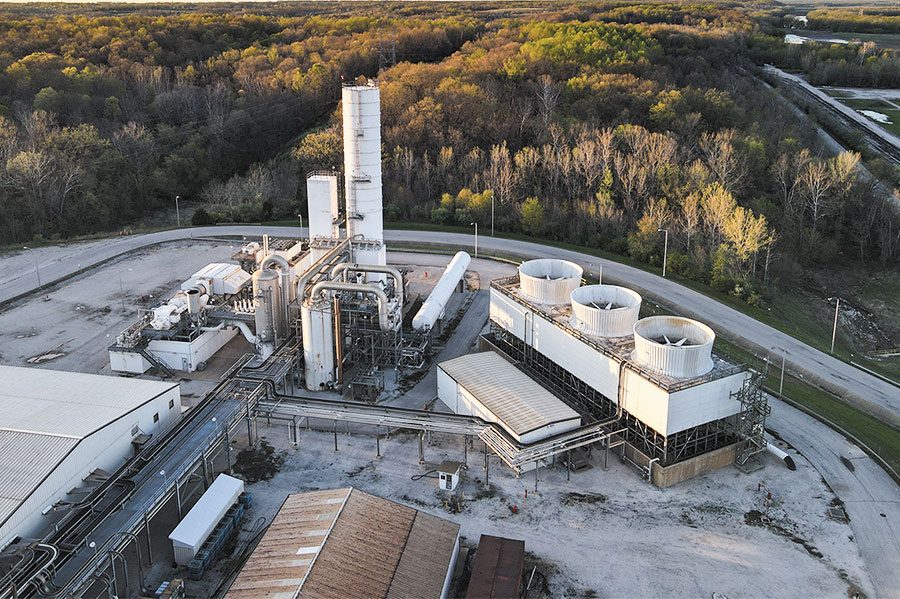
WVR's West Terre Haute facility will be the first domestically produced low-carbon ammonia source located in the Corn Belt. At 500,000 metric tons per year at full capacity, the plant is projected to displace roughly half of the Eastern Corn Belt's ammonia import volume. WVR aims to apply direct downward pressure on fertilizer costs for Illinois, Indiana, Ohio, and surrounding state farmers by producing that supply closer to where it is needed.
The broader low-carbon ammonia market is accelerating, with major projects in Louisiana and elsewhere competing for this opportunity. WVR's geographic position inside the Corn Belt, close to end users, gives it a logistics advantage over Gulf Coast producers.
>> RELATED: LSB Industries' Arkansas CCS Well Puts Blue Ammonia Within Reach
Who Else Is Involved?
This project assembled a broad coalition of technology and finance partners across nearly a decade of development.
- Honeywell (Charlotte, NC) is supplying ASCC carbon capture technology for the facility.
- SAMSUNG E&A (global engineering firm) is leading facility design and jointly markets Honeywell's ASCC technology.
- Baker Hughes (Houston, TX) is providing compression systems, injection well construction, and CarbonEdge monitoring and verification services for CO2 sequestration. This is the first deployment of CarbonEdge on a project of this scale.
- Casale SA (Switzerland) is supplying its proprietary N-LOOP ammonia synthesis technology, designed to produce 1,630 tonnes of ammonia per day.
- Climate Investment, a decarbonization fund founded by eleven major global energy companies, was an early backer of WVR's carbon capture program.
- South Korean investors Hanwha Asset Management and Korea Investment Real Asset Management have also committed capital, with the Korean government involved in supporting the partnership.

"Our goals are to strengthen America's fertilizer supply chain by reducing dependence on imports and advancing cleaner, more efficient production here at home. By utilizing Honeywell technology, we are paving the way for cleaner fertilizer production in the United States."
Dan Williams, CEO, Wabash Valley Resources
How Does This Fit Into the Broader CCS Picture?
The U.S. carbon capture sector now counts more than 270 publicly announced projects, representing $77.5 billion in capital investment, according to the Carbon Capture Coalition. Most are still in development. The Wabash Valley project is one of the few moving from loan commitment to active construction.
It also represents a specific and underused model: pairing CCS with existing idle infrastructure rather than greenfield builds. That approach changes the economics substantially. Geological surveys, existing site permits, and physical plant infrastructure are already in place. Projects like AtmosClear in Louisiana and the broader U.S. CCS buildout are pursuing sequestration through new-build facilities. Wabash Valley Resources is demonstrating a different path.
The industrial decarbonization challenge needs both approaches. But the "second life" model, if it works in Indiana, could become a template for stranded assets across the country. There are no shortage of dormant industrial sites that might follow the same playbook.
Wabash Valley Resources (WVR) is restarting the idle West Terre Haute gasification plant to produce 500,000 metric tons of low-carbon anhydrous ammonia per year while capturing and storing ~1.65 million metric tons of CO₂ annually using Honeywell’s Advanced Solvent Carbon Capture (ASCC) technology. Backed by a $1.559 billion DOE loan guarantee.
The Numbers That Tell the Story
By 2028, the West Terre Haute plant will store approximately 1.65 million metric tons of CO2 annually while feeding 500,000 metric tons of clean ammonia into the Eastern Corn Belt's supply chain each year. The $2.6 billion total investment is flowing into a community that had been waiting nearly a decade for its industrial base to come back online.
That double outcome, emissions removed and domestic food security strengthened, is the model the Honeywell and WVR partnership is built around. And it is the reason the combination of carbon capture and shuttered industrial assets deserves far more attention than it has received.
More on this topic: The Gulf Is Ready to Store Carbon | Carbon Sequestration in Texas: A New Era | Chevron's Bayou Bend CCS Hub
Subscribe to the newsletter
Daily decarbonization data and news delivered to your inbox
Follow the money flow of climate, technology, and energy investments to uncover new opportunities and jobs.
Companies

Latest issues
-
EPA Repeal Rule Heads to White House — Big Shift for Carbon Projects?
Inside This Issue 🏛️ EPA Sends Final Rule to Repeal Power Plant Greenhouse Gas Standards to White House for Review 🌬️ NTT DATA Partners with Climeworks for Carbon Removal 🏭 Honeywell Gives a Shutt...
-
100M Gallons of SAF, No Trucks Required
Inside This Issue ✈️ Pittsburgh Airport Is Building America's First On-Site SAF Plant 📝 Wren's 2026 Request for Proposals 🍁 Canada Expands CCUS Investment Tax Cr to Include Enhanced Oil Recovery 🏭...
-
Canada Set Alberta's Carbon Price at C$130. Here's the Catch.
Inside This Issue 🍁 Carney To Visit Calgary On Friday To Announce Industrial Carbon Pricing Deal, Sources Say 🚆 Frontier Advances CO₂-By-Rail System With Key Carbon Market Milestones ⛽ US House Pa...
Company Announcements
-
Mantel and Wood Announce MOU to Scale High-Temperature Carbon Capture
Wood named preferred fired-equipment partner as first commercial project advances in Western Canada CAMBRIDGE, Mass., May 19, 2026 -- Mantel Capture, Inc., the leading provider of energy-efficient...
-
NTT DATA Partners With Climeworks for Carbon Removal
NTT DATA partners with Climeworks to integrate carbon removal into its Net Zero plans, becoming the first Japan-based IT services provider to do so NTT DATA has entered a partnership with Climewor...
-
Breakthrough Blueprint: Scaling Carbon-Storing Concrete with Paebbl and Goldbeck
At Holcim, we believe the path to net zero involves reimagining the materials that build our world. It’s about partnering across the building value chain to scale innovative solutions, such as Paeb...
-
Vaulted Deep Named to 2026 CNBC Disruptor 50 Amid Rapid Expansion of Waste Infrastructure
The waste management company is introducing the first new major disposal pathway for hard-to-manage organic waste in decades HOUSTON, May 19, 2026 -- Vaulted Deep, a waste management company build...