
Inside BLM's 650,000-Acre Bet on Wyoming Carbon Storage
Published by Todd Bush on October 22, 2026
The Bureau of Land Management has offered right-of-way grants covering about 649,438 acres of federal pore space in southwest Wyoming. The September 21, 2026 offers went to Moxa Carbon Storage LLC and Pond Field LLC. Both projects can store CO2 beneath federal land once state permits and a BLM Notice to Proceed are secured.
The grants are a step inside existing projects, not new approvals. The BLM first approved Moxa in March 2025 and Pond Field in May 2025. The new offers formalize each company's right to use the federal rock deep underground.
Key Facts
- The BLM offered both right-of-way grants on September 21, 2026.
- Moxa Carbon Storage LLC, owned by Tallgrass Energy Partners, received about 605,091 acres in Lincoln, Uinta, and Sweetwater counties.
- Pond Field LLC, an affiliate of Frontier Carbon Solutions, received about 44,347 acres for the Sweetwater Carbon Storage Hub.
- Combined federal pore space: about 649,438 acres.
- The grants cover deep underground storage only. They do not authorize surface occupancy or surface disturbance.
- Injection requires Wyoming approvals plus a BLM Notice to Proceed.
- Wyoming has run its own Class VI well permitting program since October 9, 2020.
>> In Other News: [x](x)
Moxa's grant sits inside a project area of roughly 1 million acres that also includes state and private land. Pond Field's grant supports a hub that Frontier says spans about 100,000 acres.
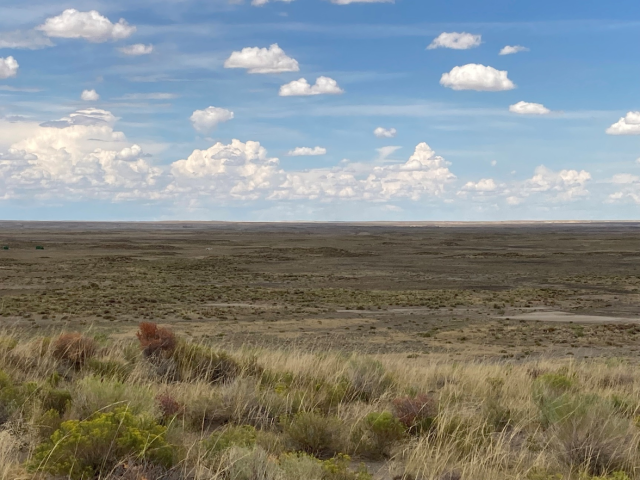
The BLM ran this prairie photo with its September 21, 2026 announcement, since the grants cover deep rock rather than the land surface. (Image: Bureau of Land Management, U.S. government work)
What Do the BLM Right-of-Way Grants Actually Cover?
The grants cover nearly 650,000 acres of federal pore space for permanent CO2 storage. They give no rights to build on the surface.
Pore space is the network of tiny openings inside deep rock formations. Compressed CO2 can fill those openings and stay locked underground. The federal government owns the pore space beneath its lands, so developers need a BLM right-of-way to use it.
Any future well pads, roads, or pipelines on BLM land would need a separate authorization. Each would also need its own environmental review. Neither project has proposed surface facilities on BLM-managed land.

The BLM Kemmerer Field Office administers the Pond Field grant and shares oversight of the Moxa grant with the Rock Springs Field Office. (Image: Bureau of Land Management, U.S. government work)
Kemmerer Field Manager Brandon Teppo framed the offers as a working example of federal-state coordination. "These milestones demonstrate how responsible management of federal resources can support innovative projects while ensuring development moves forward through the appropriate state and federal processes," he said.
He added a second point. "These projects put federally managed pore space to productive use while supporting carbon management infrastructure in Wyoming."
Who Are Moxa Carbon Storage and Pond Field LLC?
Moxa is a Tallgrass storage venture, and Pond Field is a Frontier affiliate. Together they hold all of the acreage in the September 21 offers.
Moxa Carbon Storage LLC is owned by Tallgrass Energy Partners, a midstream energy company. In an April 2024 letter to the BLM, Tallgrass estimated Moxa could sequester about 20 million metric tons of CO2 per year. The same letter cited up to 600 million metric tons over a 30-year injection period.
The BLM's environmental assessment listed possible CO2 sources for Moxa. They include capture infrastructure at planned ammonia production facilities and other potential source points.
Pond Field LLC is an affiliate of Frontier Carbon Solutions, part of Dallas-based Frontier Infrastructure Holdings. Frontier first announced the Sweetwater Carbon Storage Hub in June 2023. In 2025, Frontier said the hub will store over 350 million metric tons of CO2 when fully operational.
| Project | Developer | Federal Pore Space | BLM Approval | Storage Target (Company Estimate) | Class VI Wells |
|---|---|---|---|---|---|
| Southwest Wyoming CO2 Sequestration (Moxa) | Moxa Carbon Storage LLC (Tallgrass Energy Partners) | About 605,091 acres | March 2025 | Up to 600 million metric tons over 30 years | Wyoming DEQ permits required before injection |
| Sweetwater Carbon Storage Hub | Pond Field LLC (Frontier Carbon Solutions affiliate) | About 44,347 acres | May 2025 | Over 350 million metric tons when fully operational | Three wells approved by Wyoming DEQ (December 2023) |
| Southeast Wyoming CO2 Sequestration | Tallgrass Energy | About 480 acres | April 2025 | Not stated by BLM | Permitted and regulated by Wyoming DEQ |
The size gap between the two southwest grants reflects different strategies. Moxa needs a vast federal footprint for a 1 million-acre plan. Frontier's hub mixes federal, state, and private pore space.
>> RELATED: UW to Receive Millions in Federal Funds for Carbon Capture Research
What Has Frontier Already Proven Underground?
Frontier has drilled the deepest Class VI carbon storage well in the United States, at 18,437 feet. That well, J1-15, was completed in September 2025.
Frontier co-leads the hub with the University of Wyoming's School of Energy Resources. The record-depth J1-15 well followed the first characterization well, SCS-1. J1-15 extended down to the Madison Limestone.
That formation already has a track record. The Madison is also used at Shute Creek, a carbon capture and storage operation about 25 miles north of the hub.

"Successfully drilling and testing a second well on this project has confirmed our preliminary interpretation of the reservoir and is a major step forward to validate the region's storage potential."
Robby Rockey, President and Co-CEO, Frontier Infrastructure Holdings
Federal and state money helped fund this work. In June 2023, the U.S. Department of Energy selected the university, with Frontier as partner, for a $40.5 million CarbonSAFE site characterization award.
Frontier and the university also received $9.1 million from the Wyoming Energy Matching Funds program. The Wyoming Energy Authority manages that program.
What Must Happen Before CO2 Injection Can Begin?
Each company must meet Wyoming's requirements and receive a BLM Notice to Proceed before injecting CO2. The right-of-way grant alone does not allow injection.
The wells themselves sit on non-federal land. The Wyoming Department of Environmental Quality permits and regulates them as Class VI wells. The BLM controls only the federal rock where the CO2 ends up.

Federal pore space rights and state well permits move on separate tracks before any CO2 reaches the Wyoming subsurface.
Frontier is further along this path. Wyoming DEQ issued Frontier the state's first three Class VI permits in December 2023. Frontier said those permits made up nearly 20% of Class VI permits issued nationally at the time.
Moxa's next step after its 2025 approval was applying to Wyoming DEQ for underground injection control permits. Reporting on that approval did not confirm CO2 suppliers or transport routes for Moxa.
How Does Wyoming's Class VI Primacy Shape These Projects?
Wyoming became the second state to run its own Class VI program, effective October 9, 2020. That lets Wyoming DEQ review storage wells directly instead of waiting on the U.S. EPA.
North Dakota gained primacy first, in 2018. Louisiana followed in December 2023. West Virginia, Arizona, and Texas all gained primacy in 2025, bringing the total to six states.
States without primacy still route Class VI applications through the EPA. California's first EPA-issued Class VI permits in late 2024 show that federal path in action.
"Securing these permits is a pivotal achievement as Frontier continues to build a premier CCUS platform focused on providing value-added CCUS infrastructure solutions to local and regional emitters."
Robby Rockey, Co-CEO, Frontier Carbon Solutions (December 2023)
Rockey made that comment when Wyoming DEQ issued Frontier's first Class VI permits. Those state permits now pair with a federal pore space grant on the same project.
How Do These Projects Fit Wyoming's Wider CCS Buildout?
The southwest grants landed one day before a third Wyoming storage milestone. On September 22, 2026, the BLM Rawlins Field Office offered Tallgrass Energy a right-of-way grant in Laramie County.
That southeast Wyoming project covers about 480 acres of federal pore space. Rawlins Field Manager Andrew Kauppila said, "The project puts federal lands to productive use while promoting investment and economic growth in Wyoming."
Tallgrass already moves CO2 into that region. Its 392-mile Trailblazer Pipeline, a converted natural gas line, carries CO2 from Midwest ethanol plants to storage in Wyoming's Denver-Julesburg Basin.
Cowboy State Daily reports on the Sweetwater Carbon Storage Hub completing the deepest Class VI carbon storage well in the U.S., drilled to 18,437 feet by Frontier Infrastructure and the University of Wyoming.
Frontier is building a rail route to the Sweetwater hub. Its rail-based carbon platform for ethanol producers uses Union Pacific's network and a planned Granger Carbon Terminal.
Phase I of that terminal is expected by 2027 with 500,000 metric tons of CO2 per year, according to Frontier. Frontier says it could expand to 2 million tons per year, depending on demand.
Local supply exists too. Frontier reported in 2023 that emitters within 25 miles of the hub release 8 million metric tons of CO2 per year. That equals about 15% of Wyoming's roughly 55 million metric tons annually.
Frontier has also offered forward CO2 removal credits tied to its Wyoming storage. That gives buyers a way to support the hub before full-scale injection.
Frequently Asked Questions
Does a BLM right-of-way grant let a company start injecting CO2?
No. The grant covers use of federal pore space only. The company still needs Wyoming DEQ approvals for its Class VI wells and a BLM Notice to Proceed.
Who regulates carbon storage wells in Wyoming?
Wyoming DEQ does. The state has held Class VI primacy since October 9, 2020, so permits do not go through the U.S. EPA.
How much federal pore space did the BLM offer in September 2026?
About 649,438 acres across the two southwest Wyoming grants on September 21. A separate Laramie County grant to Tallgrass on September 22 added about 480 acres.
Wyoming now holds federal pore space rights, state well permits, and new CO2 transport options in one place. The next milestones to watch are Moxa's state permits and each project's BLM Notice to Proceed.
For ongoing coverage of carbon removal, BECCS, and corporate CDR procurement, subscribe to Decarbonfuse.com.
Subscribe to the newsletter
Daily decarbonization data and news delivered to your inbox
Follow the money flow of climate, technology, and energy investments to uncover new opportunities and jobs.
Latest issues
-
Colorado Joins the 7-State CCS Permit Fast Lane
Inside This Issue ⚖️ Colorado Takes Over Class VI Permits: What Changes for CCS? 🏭 Hebei Shoulang Facility Using LanzaTech Technology Achieves World’s First ISCC EU RCF Certification for Ethanol P...
-
The US Hasn't Made Heavy Water Since 1982
Inside This Issue ⚛️ Aternium Completes FEED Studies for US Hydrogen, Heavy Water Project 🐄 Google, McKinsey Strike Brazil Carbon Removal Deal With Silvopasture Project 🔧 Cummins Selects Stargate ...
-
Why Colorado’s Koloma Has Japan’s Largest Utility Hooked
Inside This Issue ⚡ JERA Invests in Koloma to Explore Natural Hydrogen as a Future Low-Carbon Energy 🔬 New CATF Tool Provides Framework for Self-Assessment and Strengthening of Biomass Carbon Remo...
Company Announcements
-
Inside BLM's 650,000-Acre Bet on Wyoming Carbon Storage
The Bureau of Land Management has offered right-of-way grants covering about 649,438 acres of federal pore space in southwest Wyoming. The September 21, 2026 offers went to Moxa Carbon Storage LLC ...
-
NEW YORK, BUSINESS WIRE, SWITCH Maritime (Switch), a leading developer of zero-emission vessels, secured a Design Basis Agreement (DBA) with the United States Coast Guard (USCG) for the SWITCH-150,...
-
Hebei Shoulang New Energy Technology Co., Ltd. (“Hebei Shoulang”) in Tangshan, Hebei Province, China, has achieved ISCC EU Recycled Carbon Fuel (RCF) producer certification ISCC EU certification ver...
-
Toyota Achieves Heavy-Duty Hydrogen Truck Milestones
GARDENA, Calif. and PLANO, Texas , Oct. 20, 2026 /PRNewswire/ -- Toyota Motor North America's Hydrogen Headquarters (H2HQ) division is making steady progress in fueling improvements for heavy-duty ...