
Researchers at the Johns Hopkins Whiting School of Engineering have published a new electrochemical carbon capture architecture that eliminates the need for ion-exchange membranes, a long-standing bottleneck in the field. The system, detailed in a September 2026 paper in Nature Chemical Engineering, delivered stable performance over 75 capture-and-release cycles and projects a 28.9% reduction in capture cost compared to membrane-based designs.
The work comes from the lab of Assistant Professor Yayuan Liu in the Department of Chemical and Biomolecular Engineering, with doctoral candidate Andong Liu as lead author. Funding for the study came from Johns Hopkins University, the National Science Foundation (award 2237096), and the David and Lucile Packard Foundation.
>> In Other News: Global Clean Hydrogen Investment Tops $130 Billion Amid Energy Security Push, Council Says
The Membrane Problem in Electrochemical Carbon Capture
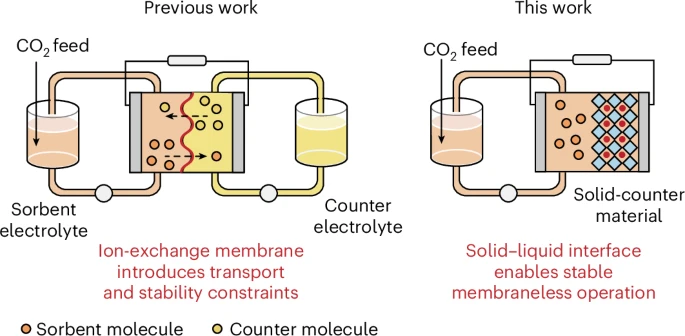
Electrochemical carbon capture works by using electricity to drive molecular sorbents that bind and release CO2 through a redox cycle, offering a lower-energy alternative to conventional thermal amine scrubbing. Most existing systems rely on ion-exchange membranes to separate electrodes during that cycle. Those membranes are expensive, degrade over time under non-aqueous conditions, and complicate scale-up.
The Johns Hopkins team replaced the membrane with solid-state counter-electrodes, creating what they describe as a membraneless architecture. The main technical obstacle in doing so is self-discharge, where sorbent intermediates inadvertently transfer electrons to the counter-electrode, reducing system efficiency. The team found that this process is controlled by solid-state ion diffusion rates rather than thermodynamic driving forces, a finding that revises prior assumptions and gives engineers a clearer materials design target.
Sodium Iron Phosphate as the Key Pairing Material
Using that insight, the researchers identified sodium iron phosphate as the counter-electrode material best suited for pairing with their azopyridine-based sorbent. The combination ran for 75 consecutive capture-and-release cycles spanning 350 hours with stable performance throughout. Critically, the system maintained efficiency under three conditions that reflect real-world deployment: high current density, dilute CO2 feed streams, and aerobic (oxygen-rich) environments.
Oxygen tolerance is a recurring challenge for electrochemical carbon capture. Many organic sorbents degrade on contact with oxygen, limiting these systems to tightly controlled conditions. The fact that this architecture held up in aerobic environments broadens its potential applicability to industrial point-source capture, where feed streams are rarely pure.
Cost Reduction and Scalability
A techno-economic analysis included in the paper projects a 28.9% reduction in capture cost relative to an equivalent membrane-based system. The authors frame the architecture as a generalizable platform, meaning the design principles, particularly the solid-state counter-electrode pairing approach, could extend to other sorbent-electrode combinations beyond azopyridine and sodium iron phosphate.
The research builds on a line of work from the Liu lab that has progressively addressed core limitations in electrochemical carbon capture, including oxygen sensitivity and non-aqueous sorbent stability, across several recent publications in high-impact journals. This latest paper represents the group's most direct push yet toward a system designed explicitly for scalability and commercial relevance.
About Johns Hopkins Whiting School of Engineering
The Johns Hopkins Whiting School of Engineering is located in Baltimore, Maryland, and is home to research spanning chemical engineering, materials science, applied physics, and more. The Liu Research Group, housed in the Department of Chemical and Biomolecular Engineering, focuses on electrochemically mediated carbon capture, water remediation, and energy storage materials. The school is affiliated with the Ralph O'Connor Sustainable Energy Institute, which supports translational clean energy research across Johns Hopkins University.
Subscribe to the newsletter
Daily decarbonization data and news delivered to your inbox
Follow the money flow of climate, technology, and energy investments to uncover new opportunities and jobs.
Latest issues
-
Colorado Joins the 7-State CCS Permit Fast Lane
Inside This Issue ⚖️ Colorado Takes Over Class VI Permits: What Changes for CCS? 🏭 Hebei Shoulang Facility Using LanzaTech Technology Achieves World’s First ISCC EU RCF Certification for Ethanol P...
-
The US Hasn't Made Heavy Water Since 1982
Inside This Issue ⚛️ Aternium Completes FEED Studies for US Hydrogen, Heavy Water Project 🐄 Google, McKinsey Strike Brazil Carbon Removal Deal With Silvopasture Project 🔧 Cummins Selects Stargate ...
-
Why Colorado’s Koloma Has Japan’s Largest Utility Hooked
Inside This Issue ⚡ JERA Invests in Koloma to Explore Natural Hydrogen as a Future Low-Carbon Energy 🔬 New CATF Tool Provides Framework for Self-Assessment and Strengthening of Biomass Carbon Remo...
Company Announcements
-
Citi Closes $72 Million Carbon Removal-Linked Note to Support Applied Carbon Biochar Project
HIGHLIGHTS Citi structured an innovative $72 million carbon removal-linked note to provide upfront capital for Applied Carbon's biochar project, marking a first-of-its-kind "outcome bond" for ver...
-
New platform opens access to the same rigorous project evaluations trusted by the world's leading carbon removal procurement programs Today, Relae (formerly Carbon Direct) launched The Diligence C...
-
Inside BLM's 650,000-Acre Bet on Wyoming Carbon Storage
The Bureau of Land Management has offered right-of-way grants covering about 649,438 acres of federal pore space in southwest Wyoming. The September 21, 2026 offers went to Moxa Carbon Storage LLC ...
-
NEW YORK, BUSINESS WIRE, SWITCH Maritime (Switch), a leading developer of zero-emission vessels, secured a Design Basis Agreement (DBA) with the United States Coast Guard (USCG) for the SWITCH-150,...