
Mitsubishi Heavy Industries (MHI) has expanded its CO2MPACT™ Full-Module lineup from 70,000 to 450,000 metric tons of CO2 per year. The upgrade keeps the same standard modular design concept while reaching a capacity range that once required fully custom-engineered projects. It's a real test of how far standardization can stretch before bespoke engineering reasserts itself.
Key Facts
- Previous CO2MPACT™ Full-Module maximum capacity: 70,000 metric tons of CO2 per year (MHI, August 2026)
- New model maximum capacity: 450,000 metric tons of CO2 per year (MHI, August 2026)
- Module ratio on the new model: over 90%
- Delivery time improvement: approximately six to twelve months shorter than conventional construction (MHI, August 2026)
- Transport method: by trailer on public roads or by train
- MHI CO2 capture plants delivered globally as of August 2026: 18, with 2 more under construction (MHI, August 2026)
- MHI and Kansai Electric Power have co-developed CO2 capture technology since 1990
>> In Other News: Methanol Qualified As A Feedstock For Sustainable Aviation Fuel
What Did MHI Actually Change?
The new CO2MPACT™ Full-Module captures up to 450,000 metric tons of CO2 per year, more than six times the previous 70,000-ton ceiling (MHI, August 2026). This is not a new product line. It extends the same standard design concept that defined the original Full-Module series.
The upgrade is built around a module ratio pushed above 90%. That figure reflects how much of the system is pre-assembled before arriving at a construction site. Higher module ratios move fabrication into controlled factory settings and reduce the on-site work that traditionally drives cost and schedule risk.
MHI says this approach cuts delivery timelines by approximately six to twelve months compared with conventional construction (MHI, August 2026). The units are sized to move by trailer on public roads and by rail, keeping logistics workable even on tight or remote sites.

Modular construction shifts complex fabrication work to factory settings, reducing on-site risk and compressing project timelines.
How Does the Advanced KM CDR Process™ Work?
CO2MPACT™ Full-Module runs on MHI's Advanced KM CDR Process™, co-developed with the Kansai Electric Power Co. since 1990. The solvent offers superior regeneration efficiency and lower deterioration compared with conventional amine systems, which translates to better energy performance and lower operating costs.
As of August 2026, MHI has delivered 18 CO2 capture plants using these processes, with two more under construction (MHI, August 2026). That track record is central to the standardization argument.
MHI is not proposing a theoretical modular concept. It is applying a proven capture process to a pre-engineered, factory-built chassis.
The new model is also designed to handle a wide range of flue gas CO2 concentrations. Cement plants, steel mills, ammonia facilities, and power generators each produce exhaust with different compositions. A standardized system that accommodates that variety without custom engineering is a genuine commercial advantage.

"Carbon neutrality initiatives are increasingly transitioning toward pragmatic approaches that reflect concerns over energy security and the need to maintain industrial competitiveness. The establishment of a CCUS value chain that connects diverse CO2 emission sources with storage and utilization is one of the key solutions for realizing a carbon-neutral society."
Mitsubishi Heavy Industries, Ltd., Official Statement, August 26, 2026
>> RELATED: Entergy, Mitsubishi Aim To Halve CCS Costs in Louisiana
Why the Capacity Jump to 450,000 Tons Matters
The gap between 70,000 and 450,000 tons per year is significant. At the lower end, a system serves smaller industrial emitters. At the higher end, it reaches large power plants, cement kilns, and chemical facilities.
Global CCUS capacity in operation now exceeds 50 million metric tons per year. Reaching 2030 pipeline targets requires more projects in the 200,000-to-500,000-ton range.
Until now, projects at that scale typically required fully customized engineering: longer development timelines, higher upfront costs, and bespoke procurement. A standardized system in this band could change those economics. Hard-to-abate industrial sectors are projected to account for 41% of all captured CO2 by mid-century, and those sectors need capture systems that deploy faster.
| Specification | Earlier CO2MPACT™ Full-Module | New CO2MPACT™ Full-Module |
|---|---|---|
| Max CO2 capture capacity | Up to 70,000 metric tons/year | Up to 450,000 metric tons/year |
| Module ratio | Standard modular | Over 90% |
| Design approach | Standard design concept | Standard design concept (maintained) |
| Delivery time vs. conventional | Reduced vs. conventional | ~6 to 12 months shorter |
| Transport | Modular transport | Trailer (public roads) or rail |
| Flue gas range | Defined range | Wide range of CO2 concentrations |
Can Standardization Hold at This Scale?
That's the real question. Modular capture has clear advantages at smaller scales: volume manufacturing, standardized configurations, repeatable installation. Projects at mature development stages now make up 60% of the global CCUS pipeline, and buyers increasingly want proven, repeatable systems.
At 450,000 tons per year, engineering complexity grows. Site-specific conditions create more opportunities for standard specs to be challenged.
MHI's answer is the 90%-plus module ratio. Pre-assembling the maximum share of the system in factory conditions limits what must be adapted on site.
MHI has already tested this modular discipline in offshore applications. The company completed a study on CO2 capture modules for floating production storage and offloading vessels with SBM Offshore. Offshore deployments impose tight spatial constraints, making them a useful proof point for factory-first methodology.
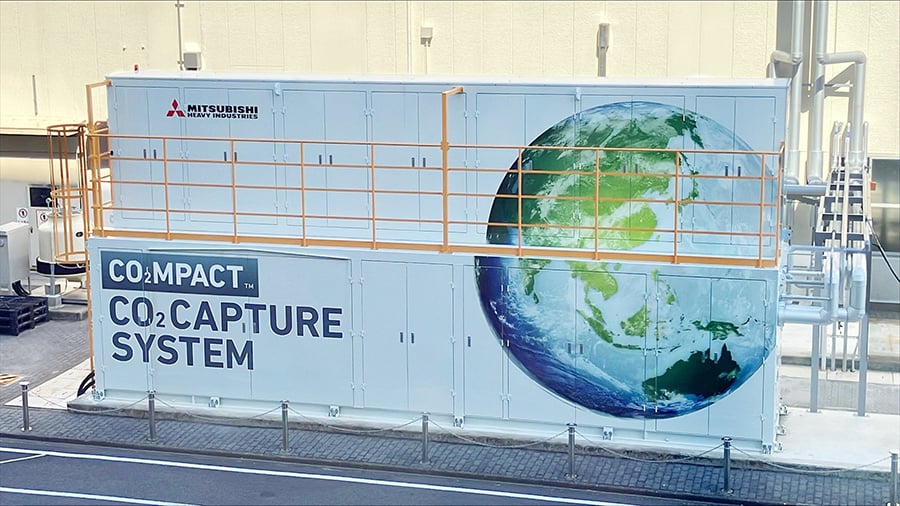
Factory pre-assembly is central to MHI's modular strategy, with the new CO2MPACT™ model exceeding a 90% module ratio.
Where Does This Fit in the Broader CCS Market?
MHI's 18 delivered plants give it a commercial track record that few capture technology providers can match (MHI, August 2026). The global carbon capture market is intensifying. Announced projects target around 430 million metric tons of annual capture capacity by 2030 across the full pipeline.
The CO2MPACT™ expansion targets a middle tier of buyers. They are too large for smaller modular systems but not large enough to justify fully custom engineering.
Cement projects like Heidelberg Materials' Edmonton facility represent exactly this tier. So do industrial CCS projects like LSB Industries' blue ammonia work in Arkansas. Both are hard-to-abate emitters that need proven, standardized capture systems.

"Going forward, MHI Group will continue to proactively promote its CCUS business utilizing its proprietary CO2 capture technologies, contribute as a solutions provider to reducing greenhouse gas emissions on a global scale, and develop further solutions that contribute to environmental protection."
Tatsuto Nagayasu, Head of CCUS, Plants & Infrastructure Systems, Mitsubishi Heavy Industries, Ltd. (MHI, August 2026)
The projects that move fastest in the coming decade will be those that don't require engineering from scratch. Industrial decarbonization needs repeatable solutions. A 450,000-ton-per-year modular system backed by 18 commercial deliveries is as concrete a pitch as the sector has seen at this scale.
Heidelberg Materials UK outlines the Padeswood cement CCS project in North Wales, which will use Mitsubishi Heavy Industries’ Advanced KM CDR Process™ to capture about 800,000 tonnes of CO2 a year — the same capture technology family that underpins MHI’s CO2MPACT™ modular systems.
The Standardization Bet Plays Out in Hardware
With 18 plants delivered and two under construction, MHI has the commercial foundation to back a meaningful capacity expansion (MHI, August 2026). Whether the 90%-plus module ratio holds its advantages at 450,000 tons per year across varied geographies and industrial applications is the next test. If it does, the company will have made a compelling case that standardization in carbon capture can go further than the industry has assumed.
Frequently Asked Questions
What is MHI's CO2MPACT™ Full-Module system?
CO2MPACT™ Full-Module is Mitsubishi Heavy Industries' standardized carbon capture system built on the Advanced KM CDR Process™. The new model captures up to 450,000 metric tons of CO2 per year. That is up from the previous ceiling of 70,000 metric tons per year (MHI, August 2026).
How does a higher module ratio reduce project timelines?
A module ratio above 90% means most of the system is fabricated in a factory before shipping to site. On-site construction, typically the slowest and most variable phase, becomes a smaller portion of total work. MHI states this approach cuts delivery timelines by approximately six to twelve months compared with conventional construction (MHI, August 2026).
What industries can use the new 450,000-ton CO2MPACT™ model?
The new model handles a wide range of flue gas CO2 concentrations. It applies to cement plants, steel mills, chemical facilities, ammonia producers, and gas-fired power plants. These are among the hardest sectors to decarbonize and a growing share of global CCS demand.
For ongoing coverage of carbon capture, CCUS, and industrial decarbonization, subscribe to Decarbonfuse.com.
Subscribe to the newsletter
Daily decarbonization data and news delivered to your inbox
Follow the money flow of climate, technology, and energy investments to uncover new opportunities and jobs.
Latest issues
-
Why Colorado’s Koloma Has Japan’s Largest Utility Hooked
Inside This Issue ⚡ JERA Invests in Koloma to Explore Natural Hydrogen as a Future Low-Carbon Energy 🔬 New CATF Tool Provides Framework for Self-Assessment and Strengthening of Biomass Carbon Remo...
-
LNK Energies Targets $6.50 Hydrogen With No Federal Subsidies
Inside This Issue 🚛 MIT Startup Says It Can Turn Diesel Trucks Into Cheaper Hydrogen Haulers, See It at Disrupt 🏭 Baytown City Council Briefs: ExxonMobil Blue Hydrogen Agreement Approved 🌎 Colorad...
-
Why Gulf Coast CCS Teams Are Watching Liverpool Bay
Inside This Issue 💂 Eni’s Douglas Platform Sets the Offshore CCS Blueprint 🌲 Pacolet Milliken Expands Its Biomass Platform With the Acquisition of Georgia Renewable Power 🧪 Metacon Receives EU Fun...
Company Announcements
-
A new interactive tool from Clean Air Task Force (CATF) provides a practical framework for the self-assessment and strengthening of biomass carbon removal (BiCRS) protocols to help ensure that carb...
-
LanzaJet Secures Financing to Scale SAF Production and Supply Global Customers
CHICAGO, Oct. 15, 2026 (GLOBE NEWSWIRE) -- LanzaJet, Inc., a leading next-gen fuels technology company and fuels producer, today announced fully committed new financing of at least $20 million to s...
-
44.01 and Frontier Advance Permanent CO₂ Storage Through In-Situ Mineralization
44.01's in-situ mineralization (ISM) process turns CO₂ into solid rock underground in a few years, after which the risk of reversal is functionally zero. >> In Other News: JERA Invests in ...
-
JERA Invests in Koloma to Explore Natural Hydrogen as a Future Low-Carbon Energy
JERA Co., Inc. (JERA), through its corporate venture capital arm JERA Ventures, has invested in Koloma, Inc. (Koloma), a U.S.-based natural hydrogen exploration and development company. The invest...