
New Atlas Maps Carbon Storage Opportunities Across Eastern Canada — From Industrial-Scale Hubs to Local CCS Solutions
Published by Todd Bush on April 22, 2026
CALGARY, AB, CANADA – April 21, 2026 – Canadian Discovery Ltd. (CDL) is pleased to announce the upcoming release of the Geological Carbon Storage Atlas of Eastern Canada on April 28, 2026. Co-funded by Natural Resources Canada (NRCan), carbon removal project developer Deep Sky, and CDL, this project was led and delivered by CDL in collaboration with NRCan CanmetENERGY. The Atlas delivers a comprehensive regional assessment of carbon dioxide (CO₂) storage potential across Quebec and Atlantic Canada, providing detailed analysis of storage opportunities, costs, and geological risks to support the development of carbon capture and storage (CCS) projects. While previous studies have examined parts of Eastern Canada, this is the first to provide a fully integrated regional assessment of CO₂ storage in deep saline aquifers and depleted hydrocarbon reservoirs.
Effective CO₂ storage is essential to achieving Canada’s climate objectives, with the International Energy Agency estimating that up to 95% of captured CO₂ worldwide will need to be permanently stored. Recognizing the importance of advancing carbon storage knowledge, the Government of Canada announced more than $11 million in funding for cutting-edge, made-in-Canada carbon utilization and storage projects during the 2025 G7 Presidency. The Geological Carbon Storage Atlas of Eastern Canada was selected as one of the projects supported through this investment.
>> In Other News: GenH2 And FASTECH Awarded Contract To Deliver Zero-Loss Liquid Hydrogen Storage System To Golden Empire Transit District
As Canada seeks solutions to reduce emissions, the research conducted in this Atlas reveals that Eastern Canada possesses meaningful and geologically credible CO₂ storage potential. Across the basins assessed, significant variability was observed in prospective CO₂ storage resource size, sealing capacity, reservoir quality and estimated storage costs. These differences reflect the diverse geological settings, geographical variability and data maturity across the region. Some storage complexes are well suited to large-scale, hub-style CCS developments with substantial capacity and strong containment, while others are better aligned with smaller, bespoke projects targeting localized emitters and more modest storage volumes.
The Atlas provides project developers with geological context to scope appraisal programs, regulators with a scientific reference for evaluating proposed operations, and policymakers with the spatial intelligence needed to design effective incentive frameworks. Equally, by presenting data transparently and accessibly, this Atlas supports inclusive dialogue with Indigenous communities, municipalities, industry, and governments responsible for CCS development demands.
“Quebec and Atlantic Canada represent an enormous opportunity for carbon storage, and this Atlas is a landmark step in unlocking it. By combining comprehensive subsurface analysis with cost and economic modelling, we're giving stakeholders across industry, government, and communities the tools they need to move from ambition to action — and positioning Eastern Canada as a serious player in the global decarbonization landscape.” said Matt Scorah, CDL’s VP of Decarbonization.
“Deep Sky was proud to support this work because rigorous, detailed subsurface data strengthens the entire carbon removal ecosystem. The Atlas provides valuable regional insight for Eastern Canada and helps inform the next phase of site-specific technical assessments required to advance safe, durable carbon storage. This comes at an important time as Québec advances the development of its carbon storage framework,” said Mathieu Bouchard, vice-president of public policy and regulatory affairs for Québec at Deep Sky.
The Atlas is publicly available and can be downloaded from the official project website. The comprehensive datasets and shapefiles compiled and produced during the Atlas’ development can be licensed through CDL upon request.
CDL brings extensive experience in CCS projects across North America and is proud to add the Geological Carbon Storage Atlas of Eastern Canada to this growing body of work. Project findings will be shared through a two-part webinar series on April 28 and May 5, followed by a presentation at GeoConvention in Calgary on May 13. Additional presentations are planned throughout the summer and fall. Details and registration are available at canadiandiscovery.com.
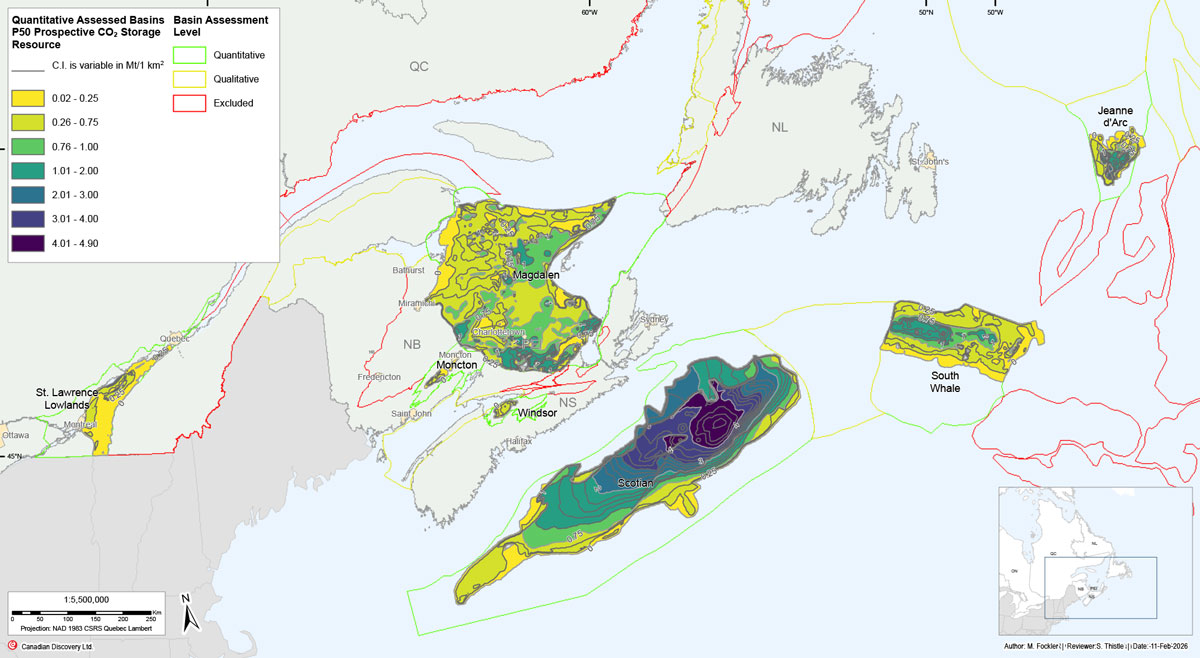
UEBEC and Atlantic Canada Calculated P50 Prospective CO2 Storage Resource
About Canadian Discovery Ltd.
Canadian Discovery Ltd. (CDL) is a global leader in subsurface intelligence, headquartered in Calgary, Alberta. For over 35 years, we've combined geoscience and engineering expertise to deliver reservoir- to basin-scale evaluations — assessing subsurface geology, pressure, fluid flow, fluid chemistry, and geomechanics for clients worldwide.
Today, CDL is at the forefront of the energy transformation, applying our deep subsurface knowledge to Carbon Capture, Utilization and Storage (CCUS), geothermal energy, critical minerals, hydrogen production, and water solutions. We don't just understand what's beneath the surface — we unearth the opportunities within it.
About Deep Sky
Montreal-based Deep Sky is the world's first tech-agnostic carbon removal project developer aiming to remove gigatons of carbon from the atmosphere and permanently store it underground. As a project developer, Deep Sky brings together the most promising direct air carbon capture companies under one roof to bring the largest supply of high-quality carbon credits to the market, commercializing and catalyzing carbon removal and storage solutions like never before. With $130M in funding, Deep Sky is backed by world class investors including Investissement Québec, Brightspark Ventures, Whitecap Venture Partners, OMERS Ventures, BDC Climate Fund, BMO, National Bank of Canada, Breakthrough Energy Catalyst, and more. For more information, visit deepskyclimate.com.
[1] IEA (2021). Net Zero by 2050. https://www.iea.org/reports/net-zero-by-2050
Subscribe to the newsletter
Daily decarbonization data and news delivered to your inbox
Follow the money flow of climate, technology, and energy investments to uncover new opportunities and jobs.
Latest issues
-
Who Bought Gevo’s $50M in 45Z Credits?
Inside This Issue ⛽ Gevo Sells $70M in 45Z Credits to a New Kind of Buyer 🌱 South Pole, Gaïago, and Gold Standard Issue European Soil Carbon Credits, Unlocking Verified Regenerative Agriculture Re...
-
Verra Landed CCP Approval. What Changes for DAC?
Inside This Issue ✅ Verra's CCS Credits Just Got the Integrity Seal Buyers Want 💰 South Korea Unveils $747 Billion Energy Transition Plan Through 2035 💧 Hydrogen and Carbon Capture and Storage in ...
-
Quebec Wood Waste Just Became Jet Fuel
Inside This Issue 🌲 ARC Bio Tests a Refinery Shortcut to Forest-Based SAF 💧 Scientists Just Found a New Way to Make Hydrogen from Water 🤝 How Channel Partnerships Are Helping More Organizations Ta...
Company Announcements
-
Mineral Europa: A Game Changer for Shipping
Antwerp, Oct. 09, 2026 (GLOBE NEWSWIRE) -- Antwerp, 9 October 2026 – CMB.TECH NV (“CMB.TECH” or the “Company”) (NYSE: CMBT, Euronext Brussels: CMBT and Euronext Oslo Børs: CMBTO) today announces th...
-
Download PDF (170.95 KB) Eni CCUS Holding, owned jointly by Eni and Global Infrastructure Partners ("GIP"), part of BlackRock, announces that Liverpool Bay CCS has completed the installation of th...
-
First-of-its-kind project in France and Belgium marks a major breakthrough for carbon credit buyers seeking high-integrity, high-impact regenerative agriculture removals in Europe; providing buyer...
-
Gevo and ClimeFi Complete Carbon Removal Transaction, Advancing Gevo's Growing Carbon Business
Transaction supports Gevo's path toward a carbon business exceeding $30 million in annual revenue from existing operations ENGLEWOOD, Colo., Oct. 08, 2026 (GLOBE NEWSWIRE) -- Gevo, Inc. (NASDAQ: G...