
In a meeting in Wuhan, Brazil, China, the European Union, and eight other countries reached an agreement to accelerate the convergence of regulated national carbon markets.
The 2nd High-Level Meeting of the Open Coalition for Regulated Carbon Markets (OCCCM) approved, this Monday (September 14th), in Wuhan, China, its five-year work plan (until 2030) and the provisional structure of its Secretariat. The meeting consolidated the group's governance and the deliberations of Brazil, China and the European Union, in addition to formalizing the entry of new members and observers into the bloc.
>> In Other News: ExxonMobil Wins Texas Approval for $5bn Carbon Capture Project
Chaired by Brazil until 2027, with China and the European Union co-chairing, the initiative brings together 10 countries and the European Union with regulated national carbon markets that together account for US$49 trillion in global Gross Domestic Product (GDP) and cover 42.2% of greenhouse gas emissions. The group also includes Germany, Canada, France, New Zealand, Norway, Singapore, the United Kingdom, and Turkey, and more members are on the way.
The Open Coalition is the first agreement in history formed by a broad group of countries seeking alignment between regulated carbon markets and interoperability among them. A regulated market is a system in which a country establishes limits on greenhouse gas emissions and progresses towards reducing pollution through the pricing of carbon and its equivalents. This unprecedented multilateral arrangement, open to any country with an established national market, or one in the process of being built, aims to align carbon measurement methodologies in productive activities and criteria for the eligibility of offsets , in line with Article 6 of the Paris Agreement. The Open Coalition seeks to enable long-term interoperability between national markets, boosting decarbonization and emissions pricing, thereby stimulating international cooperation and multilateralism.
For Brazil, presiding over the alliance in its inaugural term contributes to building a bridge between China and the European Union, jurisdictions with the two main regulated carbon markets. Brazilian participation in the bloc places the Brazilian Emissions Trading System (SBCE) at the center of the formulation of global market rules and protects interests through measurement methodologies. The country's leadership contributes to ensuring that national mitigation assets receive international recognition, offer predictability for attracting investments for the ecological transition, and protect the competitiveness of industrial and agricultural exports.
The work plan approved in Wuhan establishes this strategic approach and organizes the technical operations of the working groups into five areas of action. The first area consolidates virtual operational management and personnel allocation in the administrative, technical support, and external coordination divisions, and provides for the post-2027 budget model. The second area develops mutual understanding of pricing instruments through a comparative matrix supported by principles of equity, transparency, and efficiency.
The third work stream focuses on mapping Measurement, Reporting, and Verification (MRV) structures to enable the translation of carbon data across borders, ensuring interoperability and equivalence of carbon measurements between different systems. The fourth stream is dedicated to defining guidelines for the use of high-integrity offsets in compliance systems and aligning domestic rules with Article 6. The fifth and final stream coordinates technical assistance with observer entities and integrates the knowledge platform focused on the commitments of COP31, which will take place in November 2026 in Turkey.
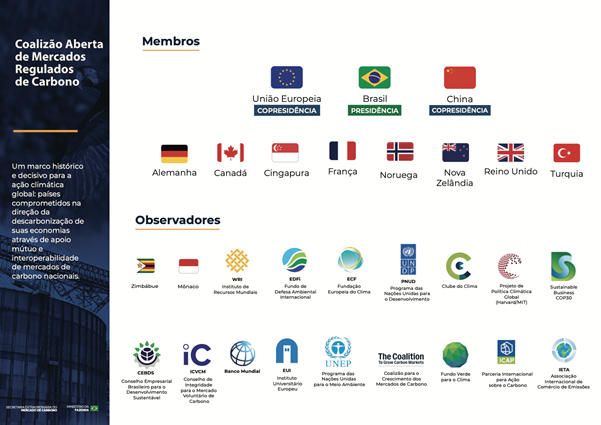
Credit: Ministry of Finance
Launched by Brazil at COP30, the alliance had its Terms of Reference consolidated in May 2026 in Florence, Italy. The Brazilian delegation is on a visit to China until September 19.
Subscribe to the newsletter
Daily decarbonization data and news delivered to your inbox
Follow the money flow of climate, technology, and energy investments to uncover new opportunities and jobs.
Latest issues
-
Origins Hub Will Store 1.5 Million Tonnes of CO2 in Alberta
Inside This Issue 🍁 Enhance Energy's Origins Hub Reshapes Alberta Carbon Storage 🤝 Carbon Unbound Merges East and West Coast Summits Into One Flagship North American CDR Event 🧭 Vortex Energy Enga...
-
Honeywell's Methanol-to-Jet Pathway Just Cleared Its Biggest Gate
Inside This Issue 🛫 Methanol-to-Jet Clears the ASTM Gate. What Changes Now? 🌿 InPlanet Selected as the Brazilian Supplier in Whirlpool Corporation's Durable Carbon Removal Portfolio 🧲 Climeworks A...
-
How Montana Renewables Cut $1B Out of Its SAF Budget
Inside This Issue 🌿 How Montana Renewables Cut MaxSAF Capex 89% 📋 IRS Issues Notice on 45Z Clean Fuel Production Tax Credit to Support Domestic Biofuel Production and American Agriculture 🌊 Natura...
Company Announcements
-
FedEx: Expands Sustainable Aviation Fuel Agreements Across U.S. Air Network
MEMPHIS, Tenn., Sept. 15, 2026 - FedEx is scaling its sustainable aviation fuel (SAF) procurement through new agreements projected to secure more than 20 million gallons of neat SAF across five U.S...
-
Praj and Gevo Forge Landmark Alliance to Advance Bio-IBA in India
The agreement strengthens India's pioneering efforts to develop Bio-IBA as a renewable blending solution for decarbonizing one of the world's largest diesel markets. ENGLEWOOD, Colo and PUNE, Indi...
-
Novel approach addresses both methane and carbon dioxide removal and marks Google's largest carbon removal purchase to date, delivering 1M tonnes of impact by 2030 SAN FRANCISCO & SAO PAULO-- ...
-
AiP acquired after completing risk assessment of CO2 handling operations specific to low-pressure liquefied CO2 carriers and establishing a safety-focused design policy Utilizes the MILES-based st...