
Scientists Suggest Nuclear Waste May Fuel a Clean Energy Revolution
Published by Todd Bush on November 5, 2025

News Provided By University of Sharjah November 05, 2025, 06:21 GMT Share This Article
A new study suggests that nuclear waste, traditionally viewed as a liability, could be repurposed to generate hydrogen on an industrial scale.
SHARJAH, EMIRATE OF SHARJAH, UNITED ARAB EMIRATES, November 5, 2025 /EINPresswire.com/ -- Nuclear waste remains a major environmental hazard due to its long-lasting radioactivity, which can persist for thousands of years. However, new research by University of Sharjah scientists, published in the journal Nuclear Engineering and Design, suggests that nuclear waste could offer a sustainable pathway for long-term hydrogen production.
Hydrogen is currently recognized as a promising clean energy carrier, and scientists are actively pursuing novel methods to produce it. The study explores how nuclear waste, traditionally viewed as a liability, could be repurposed to generate hydrogen on an industrial scale.
Globally, the volume of nuclear waste is piling up. Accounting for varying levels of radioactivity, it is estimated that more than 4 million cubic meters of nuclear waste are currently stored worldwide.
“Utilizing nuclear waste is a novel method of producing hydrogen that transforms a persistent environmental issue into a useful resource,” the researchers note. “Hydrogen has become a promising energy carrier as the need for sustainable and clean energy sources increases globally.”
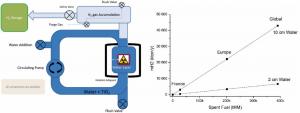
The scientists’ optimism about converting nuclear waste into hydrogen is based on a comprehensive review of currently available innovative technologies that harness radioactivity to split water molecules into hydrogen and oxygen without emitting carbon dioxide.
The researchers write, “Based on the existing research, it was found that nuclear waste can significantly enhance hydrogen generation through a variety of advanced methods, including catalyst-enhanced electrolysis, methane reforming, and thermochemical cycles.
>> In Other News: Chestnut Carbon Has Sold High-Integrity IFM Carbon Removal Credits to TD Bank in Multi-Year Agreement
“Other promising techniques involve radiation-enhanced electrolysis cells, feeding radioactive waste into a heater to generate electricity for powering electrolysis cells, radiolysis, and liquid plasma photocatalysis.”
The research presents a detailed and comprehensive survey of current methods developed to recycle nuclear waste into hydrogen.
Among the most promising, according to the authors, is radiation-enhanced electrolysis. This novel process, the scientists say, can boost hydrogen yield by up to tenfold compared to traditional electrolysis. This technology offers a much faster and more efficient route to hydrogen production from nuclear waste, the scientists claim.
Reassessing previous research, the authors identify uranium-based catalysis as cost-effective, both in terms of material availability and overall expense. “Using uranium-based catalysts reduces the need for rare and expensive metals,” they argue, noting “high cost and scarcity create an urgent need for (the adoption) of more affordable alternatives.”
In uranium-based catalysis as a technique, uranium compounds serve as catalysts – substances that can speed up chemical reactions, particularly in the context of hydrogen from water, a promising path for sustainable energy. This approach is gaining attention in academic circles.
The paper also recommends two additional hydrogen-generating technologies: Methane reforming using uranium-based catalysts, which can reduce carbon buildup and improve hydrogen yield, and liquid-phase plasma photocatalysis, a method that enhances hydrogen production from nuclear wastewater.
The authors critically examine the limitations and challenges associated with these methods, including “the risk of syngas contamination, chemical modification of the catalyst, and stringent regulations that hinder research progress in this field.”
Nevertheless, they emphasize the advantages of the proposed techniques, stating that they “have several advantages, including lowering the amount of radioactive waste, lowering the requirement for long-term storage, and supplying a steady supply of hydrogen.”
The authors present a thorough review that also reveals persistent gaps in the field of hydrogen generation from nuclear waste. These gaps, they say, future scientific research must address. “Research in this area remains limited and scattered, underscoring the need for further investigation,” they stress.
They point to a “significant obstacle” for scientists researching to advance technologies focusing on converting nuclear waste to hydrogen. This barrier, according to the study, is represented in the stringent regulatory framework imposed on accessing and handling radioactive material and radioactive waste.
“Most of the available literature relies on external radiation sources to simulate the effects of radioactive waste, which may compromise the accuracy and real-world applicability of the findings,” they maintain, adding that while regulation was essential, “strict regulations hinder innovation.”
The review systematically examines current approaches to hydrogen production from nuclear waste, including enhanced electrolysis cells, radiolysis processes, thermochemical cycles, radioelectrolysis cells, and methane reforming techniques.
According to the authors, “These methods show promise in increasing the amount of hydrogen produced, decreasing the need for costly and rare elements, and lessening the long-term environmental effects of nuclear waste.”
They further demonstrate that hydrogen output in radiolysis processes is significantly affected by several variables, such as the addition of formic acid (yield increases up to 12-fold), temperature (up to fivefold increase), irradiation duration, and catalyst type, including TiO2 (Rutile phase) and ZrO2, emerging as particularly effective catalysts.
The authors conclude by stressing the importance of collaboration across sectors: “In order to overcome technical, regulatory, and financial obstacles in the future, it will be crucial to promote cooperation between scientific research institutions, legislators, and industry stakeholders.”
Original Source URL: https://doi.org/10.1016/j.nucengdes.2025.114511
Subscribe to the newsletter
Daily decarbonization data and news delivered to your inbox
Follow the money flow of climate, technology, and energy investments to uncover new opportunities and jobs.
Latest issues
-
Europe's First Full-Scale CO2 Storage Is Now Live
Inside This Issue 🌊 EU's First Full-Scale Carbon Storage Site Goes Live as INEOS Greensand Begins Operations ⚡ IRS 45Z Guidance Reshapes U.S. Biofuel Economics 🏭 Avnos Introduces the Avnos HDAC Mo...
-
Mammoth DAC Plant in Iceland Hits 5x Carbon Removal Output
Inside This Issue 🌱 Climeworks Cuts Mammoth DAC Operating Costs by Over 50% 💰 ExxonMobil Wins Texas Approval for $5bn Carbon Capture Project 🌐 Open Coalition Approves Work Plan and Defines Secreta...
-
Origins Hub Will Store 1.5 Million Tonnes of CO2 in Alberta
Inside This Issue 🍁 Enhance Energy's Origins Hub Reshapes Alberta Carbon Storage 🤝 Carbon Unbound Merges East and West Coast Summits Into One Flagship North American CDR Event 🧭 Vortex Energy Enga...
Company Announcements
-
MAX Power Engages Global Technology Leader Kyndryl to Build Commercialization Strategy for MAXX LEMI
Kyndryl Canada has been engaged to deliver a commercialization strategy and go-to-market plan for MAX Power’s proprietary AI-assisted MAXX LEMI platform, built on Canada’s first confirmed subsurfac...
-
Perdue Farms and Arva Intelligence will serve as the first adopters of the Registry as part of a new pioneering organization each is helping to co-found – an environmental board of trade (EBOT) - ...
-
Exomad Green and Carbonfuture Expand Long-Term Supply as Buyers Prioritize Proven Delivery
The world’s largest supplier of delivered durable carbon removal deepens its commercial collaboration with Carbonfuture as buyers prioritize execution, traceability and reliable delivery SANTA CRU...
-
Avnos Introduces the Avnos HDAC™ Module, Its First Factory-Built Product Line
Avnos enters commercial manufacturing with its first standardized HDAC™ module built, tested and ready for deployment. LOS ANGELES -- BUSINESS WIRE--Avnos, developer of infrastructure-scale Hybrid...