
Toyota Achieves Heavy-Duty Hydrogen Truck Milestones
Published by Todd Bush on October 20, 2026
GARDENA, Calif. and PLANO, Texas , Oct. 20, 2026 /PRNewswire/ -- Toyota Motor North America's Hydrogen Headquarters (H2HQ) division is making steady progress in fueling improvements for heavy-duty fuel cell trucks as it works to bring these advancements to Toyota's commercial fleets in the U.S.
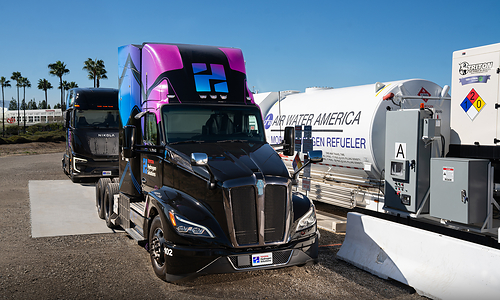
Toyota recently installed two mobile hydrogen fueling devices at North American Parts Center California (NAPCC), its largest parts distribution facility in the U.S. With the tanks and fuel ready, Toyota's commercial logistics fleets plan to use the mobile fuelers to support Toyota operations by fueling heavy-duty fuel cell trucks hauling freight from the Port of Los Angeles to Ontario, and throughout the region. A permanent station is planned to be built on location.
The station will initially fuel heavy-duty trucks commissioned through Hyroad Energy and will later integrate heavy-duty trucks with Toyota's own certified fuel cell powertrain.
Toyota and National Lab of the Rockies Complete Milestone Filling
In a public-private partnership, Toyota is collaborating with the U.S. Department of Energy's National Laboratory of the Rockies (NLR) in Golden, Colorado, to research several initiatives, including 70 MPa high-flow hydrogen fueling for heavy-duty trucks.
High-flow fueling allows trucks to accept hydrogen fuel at speeds up to 300g/s, or about five times faster than the rate of conventional light-duty fueling technology. It allows heavy-duty trucks to carry energy into the vehicle at an equivalent speed of a 20 MW fast charger. Refueling times are comparable to modern diesel-powered, heavy-duty trucks. Unlike a diesel powertrain, however, fuel cells emit only water.
Toyota and NLR engineers and researchers have performed multiple rounds of testing per SAE J2601-5 standards, successfully demonstrating that Toyota-powered heavy-duty trucks can be refueled in about eight minutes for a range of up to 450 miles.
Production Toyota-powered trucks are expected to hit the open road for commercial operations in 2027.
Building the Next Generation of Hydrogen Fueling
Over the next several months, Toyota aims to upgrade its private fueling infrastructure at its H2HQ to the same high-flow standard for testing heavy-duty vehicles. It also plans to install new equipment for light passenger fuel cell electric vehicles in order to evaluate station hardware and share insights intended to improve operations and reliability.
When the publicly available permanent station at NAPCC goes online, Toyota plans to provide conventional and high-flow hydrogen fueling for heavy-duty trucks, along with a separate area for fueling light-duty vehicles.
Toyota continues to develop and refine fuel cell technologies for heavy-duty vehicles, commercial applications, stationary power generation and light-duty passenger vehicles, including supporting past, current and future vehicle development.
About Toyota Hydrogen Headquarters (H2HQ)
Toyota Hydrogen Headquarters (H2HQ) is the lead office in North America for the development, engineering, commercialization and business operations of Toyota's hydrogen fuel cell technologies. Based in Gardena, California, H2HQ works collaboratively with Toyota's R&D offices in Michigan and Texas, as well as business units in Japan and internationally, to create zero-emissions fuel cell technologies that enable energy independence, innovation and the movement of people, goods, energy and information.
For more information about Toyota, visit Toyota Hydrogen Headquarters (H2HQ) – Toyota USA Newsroom.
About Toyota
Toyota (NYSE: TM) has been a part of the cultural fabric in North America for nearly 70 years, and is committed to advancing sustainable, next-generation mobility through our Toyota and Lexus brands, plus our more than 1,800 dealerships.
Toyota directly employs nearly 64,000 people in North America who have contributed to the design, engineering, and assembly of over 50 million cars and trucks at our 14 manufacturing plants. In 2025, Toyota's plant in North Carolina began to assemble automotive batteries for electrified vehicles.
For more information about Toyota, visit www.ToyotaNewsroom.com.
SOURCE Toyota Motor North America
Subscribe to the newsletter
Daily decarbonization data and news delivered to your inbox
Follow the money flow of climate, technology, and energy investments to uncover new opportunities and jobs.
Latest issues
-
The $915M Ethanol Deal Where Carbon Capture Sets the Price
Inside This Issue 🌽 The Andersons Bets $915M on Low-Carbon Ethanol Plants 🌐 Rad Web Hosting Announces Fossil-Free Internet by 2030 Manifesto, Commits 1% of Revenue to Carbon Removal 💶 EU Earmarks ...
-
Which Texas Project Got Verra’s First CCS Credits?
Inside This Issue ✅ Verra Approves First Credits Under CCS Methodology ⚡ Houston-Based Transition Industries Signs EPC Deal for 210 MW Electrolyzer at Pacifico Mexinol 🏗️ Investing in Wyoming’s In...
-
CRC Vows to Fight Kern County CCS Ruling
Inside This Issue ⚖️ Court Sets Aside Kern County Approval of California’s First Carbon Storage Project, Carbon TerraVault I 🌲 The Integrity Council Approves Methodologies for Coal Transition and ...
Company Announcements
-
Survey to add new gravity measurements west of the Cloverleaf target and within the eastern block ahead of 3D inversion and 2D seismic-profile modelling VANCOUVER, British Columbia, Nov. 10, 2026 ...
-
Greene Tweed Introduces PFAS-Free Sealing Material Built for Hydrogen and CCUS Reliability
EPM 893 reduces sealing tradeoffs by combining low-temperature performance, decompression resistance, and chemical compatibility LANSDALE, PA, UNITED STATES, November 10, 2026 /EINPresswire.com/ -...
-
Aemetis Biogas Receives CARB Approval for Six Dairy RNG Pathways
CUPERTINO, Calif., Nov. 10, 2026 (GLOBE NEWSWIRE) -- Aemetis, Inc. (NASDAQ: AMTX), a renewable natural gas and biofuels company, announced today that the California Air Resources Board (CARB) has a...
-
Syklea’s ALIUM technology will address carbon emissions for the industrial sectors in the U.S. with its new headquarters and laboratory in Vineland, New Jersey VINELAND, N.J., Nov. 10, 2026 (GLOBE...