
Toyota, NREL Collaborate to Advance Megawatt-Scale Fuel Cell Systems
Published by Todd Bush on August 24, 2022
Cooperative research project will study the scaling and integration of fuel cell systems for stationary power generation
PLANO, Texas, Aug. 24, 2022 /PRNewswire/ -- Toyota Motor North America (Toyota) is collaborating with the U.S. Department of Energy's (DOE's) National Renewable Energy Laboratory (NREL) to build, install and evaluate a 1-megawatt (MW) proton exchange membrane (PEM) fuel cell power generation system at NREL's Flatirons Campus in Arvada, Colorado.
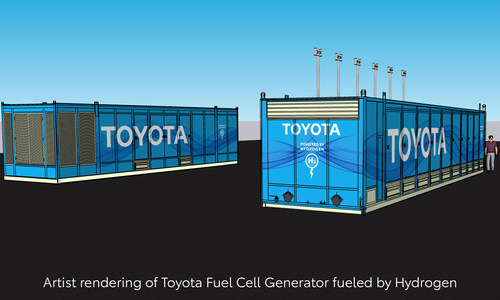
This 3-year, $6.5 million collaboration is funded in part by DOE's Hydrogen and Fuel Cell Technologies Office in the Office of Energy Efficiency and Renewable Energy and supports DOE's H2@Scale vision for clean hydrogen across multiple applications and economic sectors.
The 1-MW fuel cell system integrates multiple Toyota fuel cell modules into a larger system to provide responsive stationary power. Through a previous collaboration, NREL has demonstrated the use of an automotive fuel cell system to provide carbon-free power for a data center. This new system is at a significantly larger scale, generating about 15 times more power and capable of direct current and alternating current output.
Toyota leveraged its over 25 years of fuel cell development experience as it designed the 1-MW system, expanding on expertise from the light duty fuel cell electric vehicle market. Toyota is providing the fuel cell modules and is working with systems integrator, Telios, for the design, balance-of-plant and build of the system for delivery to NREL. Toyota has developed an integrated control system to manage operation of the fuel cell modules to maximize efficiency and system life. The system demonstrates a simplified design as a drop-in replacement to a conventional generator.
"Achieving carbon neutrality requires all of us to explore new applications of zero-emission technology, including how that technology will integrate with other systems, which the project with NREL will identify," said Christopher Yang, group vice president, Business Development, Fuel Cell Solutions, Toyota. "The application of our modules in deployments of this magnitude shows the scalability of Toyota's fuel cell technology, whether it is a single fuel cell module for one passenger vehicle or multiple systems combined to power heavy-duty equipment."
NREL researchers will push the operational boundaries of the fuel cell system design to identify performance limitations and degradation over time, generating valuable real-world data to aid with development of future applications. Research and development will also include assessing how the system performs when integrated with energy storage and renewable energy generation systems, such as solar photovoltaic and wind.
"We will study the scaling of PEM fuel cell systems for stationary power generation to understand what the performance, durability and system integration challenges are," said Daniel Leighton, an NREL research engineer and principal investigator on the project. "This fuel cell generator system also creates a new megawatt-scale fuel cell research capability at NREL."
The fuel cell generator is part of the Advanced Research on Integrated Energy Systems (ARIES) megawatt-scale hydrogen system being designed and commissioned at NREL's Flatirons Campus. The flexible system — which includes a 1.25-MW PEM electrolyzer, 600-kg hydrogen storage system and 1-MW fuel cell generator — provides a platform to demonstrate direct renewable hydrogen production, energy storage, power production and grid integration at the megawatt scale.
The fuel cell generator system will be installed this summer, and the full system will be commissioned later in 2022.
About Toyota
Toyota (NYSE:TM) has been a part of the cultural fabric in the U.S. for more than 60 years, and is committed to advancing sustainable, next-generation mobility through our Toyota and Lexus brands, plus our nearly 1,500 dealerships.
Toyota directly employs more than 39,000 people in the U.S. who have contributed to the design, engineering, and assembly of nearly 32 million cars and trucks at our nine manufacturing plants. By 2025, Toyota's 10th plant in North Carolina will begin to manufacture automotive batteries for electrified vehicles. With the more electrified vehicles on the road than any other automaker, a quarter of the company's 2021 U.S. sales were electrified.
To help inspire the next generation for a career in STEM-based fields, including mobility, Toyota launched its virtual education hub at www.TourToyota.com with an immersive experience and chance to virtually visit many of our U.S. manufacturing facilities. The hub also includes a series of free STEM-based lessons and curriculum through Toyota USA Foundation partners, virtual field trips and more. For more information about Toyota, visit www.ToyotaNewsroom.com.
MEDIA CONTACT
Toyota Motor North America
Josh Burns
[email protected]
SOURCE Toyota Motor North America
Subscribe to the newsletter
Daily decarbonization data and news delivered to your inbox
Follow the money flow of climate, technology, and energy investments to uncover new opportunities and jobs.
Latest issues
-
North America's RNG Food Waste Giant Just Got Bigger
Inside This Issue ♻️ Vanguard Renewables and Generate Upcycle Unite to Create North America's Largest Food Waste-to-RNG Platform 🌍 Google Is Buying Climate Impact on Two Clocks at Once ✈️ Infinium...
-
Europe's First Full-Scale CO2 Storage Is Now Live
Inside This Issue 🌊 EU's First Full-Scale Carbon Storage Site Goes Live as INEOS Greensand Begins Operations ⚡ IRS 45Z Guidance Reshapes U.S. Biofuel Economics 🏭 Avnos Introduces the Avnos HDAC Mo...
-
Mammoth DAC Plant in Iceland Hits 5x Carbon Removal Output
Inside This Issue 🌱 Climeworks Cuts Mammoth DAC Operating Costs by Over 50% 💰 ExxonMobil Wins Texas Approval for $5bn Carbon Capture Project 🌐 Open Coalition Approves Work Plan and Defines Secreta...
Company Announcements
-
Brazil's Mombak Raises New Fund, Adds Salesforce as Carbon Credit Buyer
SAO PAULO, Sept 21 (Reuters) - Brazilian carbon removal startup Mombak said on Monday it secured the first close of its second reforestation fund and signed a new carbon credit purchase agreement ...
-
Valmet Selected for Louisiana Green Fuels Carbon-Negative Power Project
Company's technology to support development of Louisiana Green Fuels as a commercial-scale carbon-negative power facility Valmet, a leading global developer and supplier of process technologies, a...
-
Infinium Launches mSAF Platform, Extending Its Commercial Product Offerings to Methane Feedstocks
SACRAMENTO, Calif., Sept. 21, 2026 /PRNewswire/ -- Infinium today introduced its mSAF product offering, a new methane-derived sustainable aviation fuel (SAF) platform which converts renewable natur...
-
Vaulted Deep Secures $35 Million in Debt Financing to Expand Nationwide
New financing from Mediobanca and facilitated by CFP Energy will support new waste disposal sites across the country and continued investment in technology to accelerate site development HOUSTON, ...