Transform Materials Optimizes Low-Carbon Acetylene for Lithium-Ion Battery Production
Published by Todd Bush on November 9, 2023
As demand for battery energy storage systems accelerates, manufacturers are looking to secure a supply of low-carbon raw materials; Transform Materials emerges as the sole provider of dedicated mass-production technology for low-carbon acetylene.
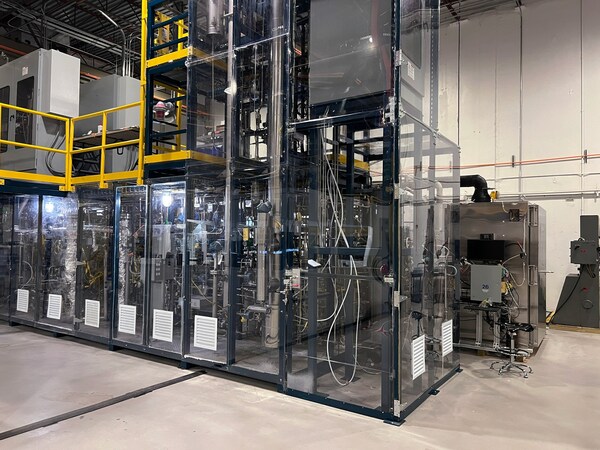
RIVIERA BEACH, Fla., Nov. 9, 2023 /PRNewswire/ -- Industrial electrification is driving major value creation opportunities for industrial companies across the value chain. Transform Materials, a sustainable chemical company that uses microwave plasma technology to convert hydrocarbons and natural gas into acetylene and hydrogen, has made significant progress in its mission to establish itself as a key enabler of industrial electrification — specifically for battery energy storage systems.
Global demand for batteries is increasing, driven largely by the imperative to reduce climate change through electrification of mobility and the broader energy transition. In its recent Battery 2030 report, McKinsey & Company's Battery Insights team projects that the entire lithium-ion (Li-ion) battery chain, from mining through recycling, could grow by over 30 percent annually from 2022 to 2030, when it would reach a value of more than $400 billion and a market size of 4.7 TWh.¹
Further, McKinsey warns that, "To avoid shortages, battery manufacturers must secure a steady supply of both raw material and equipment. They must also channel their investment to the right areas and execute large-scale industrialization efficiently."
Acetylene black is a key component of lithium-ion batteries, demand for which has skyrocketed with the emergence of EVs (and EV mobility in general) and energy storage for solar PV panels. In fact, acetylene black is so essential to produce lithium-ion batteries that the Japanese government has deemed it crucial to ensure a reliable domestic supply of the gas.
To that end, in August of this year, Transform Materials' customer Denka, a large Japanese chemical manufacturer , announced that a Japanese government agency, the New Energy and Industrial Technology Development Organization, will grant Denka a subsidy of up to 3.3 billion yen to accelerate the development of mass-production technology for low-carbon acetylene.
This move underscores the strategic importance of Denka's agreement with Transform Materials to install acetylene and hydrogen production facilities based on Transform's plasma technology at its Omuta, Fukuoka Plant (Omuta City, Fukuoka Prefecture).
Transform Materials' value proposition for Li-ion battery producers
Acetylene is a diverse compound that can be used in a broad range of applications. It can be used as a chemical feedstock for polymer and carbon-based applications, and for specialty carbon solids. One such specialty carbon solid is acetylene black, which requires a pure form of acetylene as an input.
"Acetylene black is an essential component of lithium-ion batteries, and battery producers are looking for sources of low-carbon acetylene to boost production," said Kenn Flessner, CEO at Transform Materials. "Transform Materials offers the only solution for emission-free acetylene production. Our process changes the carbon equation by fully utilizing the carbon in hydrocarbon streams, and ensuring no carbon is released into the atmosphere in the form of CO2. This enables the lowest possible carbon intensity acetylene black in the industry."
Until now, Denka has relied on calcium carbide to produce acetylene, and over the past 100 years has successfully optimized the carbide chain for acetylene production (such as acetylene black), achieving lowest-possible carbon intensity when using coal-based feedstocks. By using Transform's plasma technology, Denka can obtain acetylene with even lower carbon intensity.
"Transform has helped us understand how microwave plasma technology makes it possible to produce acetylene gas with large volumes of hydrogen. The project with Transform Materials is one of the most significant transformations in our company history since we started our business," said Toshio Imai, CEO of Denka. "We are always trying to change the world and society for the better by utilizing advances in chemistry. Transform Materials' technology is attractive to achieve a reduction of CO2 and fits our process — which is why we chose Transform Materials," he added.
About Transform Materials
Transform Materials LLC, founded in 2014, has developed a ground-breaking technology that uses microwave-generated plasma to energize natural gas to form acetylene and hydrogen without any CO2 emissions. Transform's patented technology and systems are compact and modular, thus readily scalable to match customer needs, whether for large plants or small industrial applications, integrating with existing systems and architecture to minimize adoption costs. To learn more, visit transformmaterials.com.
SOURCE Transform Materials LLC
Subscribe to the newsletter
Daily decarbonization data and news delivered to your inbox
Follow the money flow of climate, technology, and energy investments to uncover new opportunities and jobs.
Latest issues
-
Quebec Wood Waste Just Became Jet Fuel
Inside This Issue 🌲 ARC Bio Tests a Refinery Shortcut to Forest-Based SAF 💧 Scientists Just Found a New Way to Make Hydrogen from Water 🤝 How Channel Partnerships Are Helping More Organizations Ta...
-
How Vaulted Deep Turned Offtakes Into $35M Debt
Inside This Issue 🏦 How Carbon Removal Offtakes Are Starting to Unlock Commercial Debt 🌉 California Opens the Door to a Three-Way Carbon Market 🧪 New Material Developed at Oregon State Provides Bo...
-
Canada Wants Foreign Buyers for Its Carbon Removals
Inside This Issue 🍁 Canada Explores Article 6 Path to Global Carbon Buyers 🌲 ARC Bio Demonstrates Canadian Forest Residue Pathway to Sustainable Aviation Fuel 🌾 Business, Forestry and Agriculture ...
Company Announcements
-
MEXICO CITY--BUSINESS WIRE--In the framework of today's World Habitat Day, here is an invitation to reflect on building more sustainable communities, where Mexico is moving firmly toward the energy...
-
Vortex Energy Commissions Hydrogen and Helium Study at Robinsons River Salt Project
Desktop Study Will Use Existing Geological, Geophysical and Well Data to Assess Natural Hydrogen and Helium Potential VANCOUVER, British Columbia, Oct. 05, 2026 (GLOBE NEWSWIRE) -- Vortex Energy C...
-
How Channel Partnerships Are Helping More Organizations Take Action
Organizations of all sizes are looking for credible ways to address their carbon emissions. But to help high-integrity Carbon Dioxide Removal (CDR) solutions reach small-to-medium-sized organizatio...
-
Uniper signs capacity reservation agreement for future SAF supply from Syzygy Plasmonics' NovaSAF™ platform This agreement reflects growing market momentum in biogas to SAF technology and provides...