
U.S. Sustainable Aviation Fuel Production Takes Off as New Capacity Comes Online
Published by Todd Bush on May 6, 2025
The Chicago-based carrier has partnered with a number of clean-tech startups in recent months in a renewed effort to meet its climate goals
Sustainable aviation fuel (SAF) production is growing in the United States as new capacity comes online. U.S. production of Other Biofuels, the category we use to capture SAF in our Petroleum Supply Monthly, approximately doubled from December 2024 to February 2025.
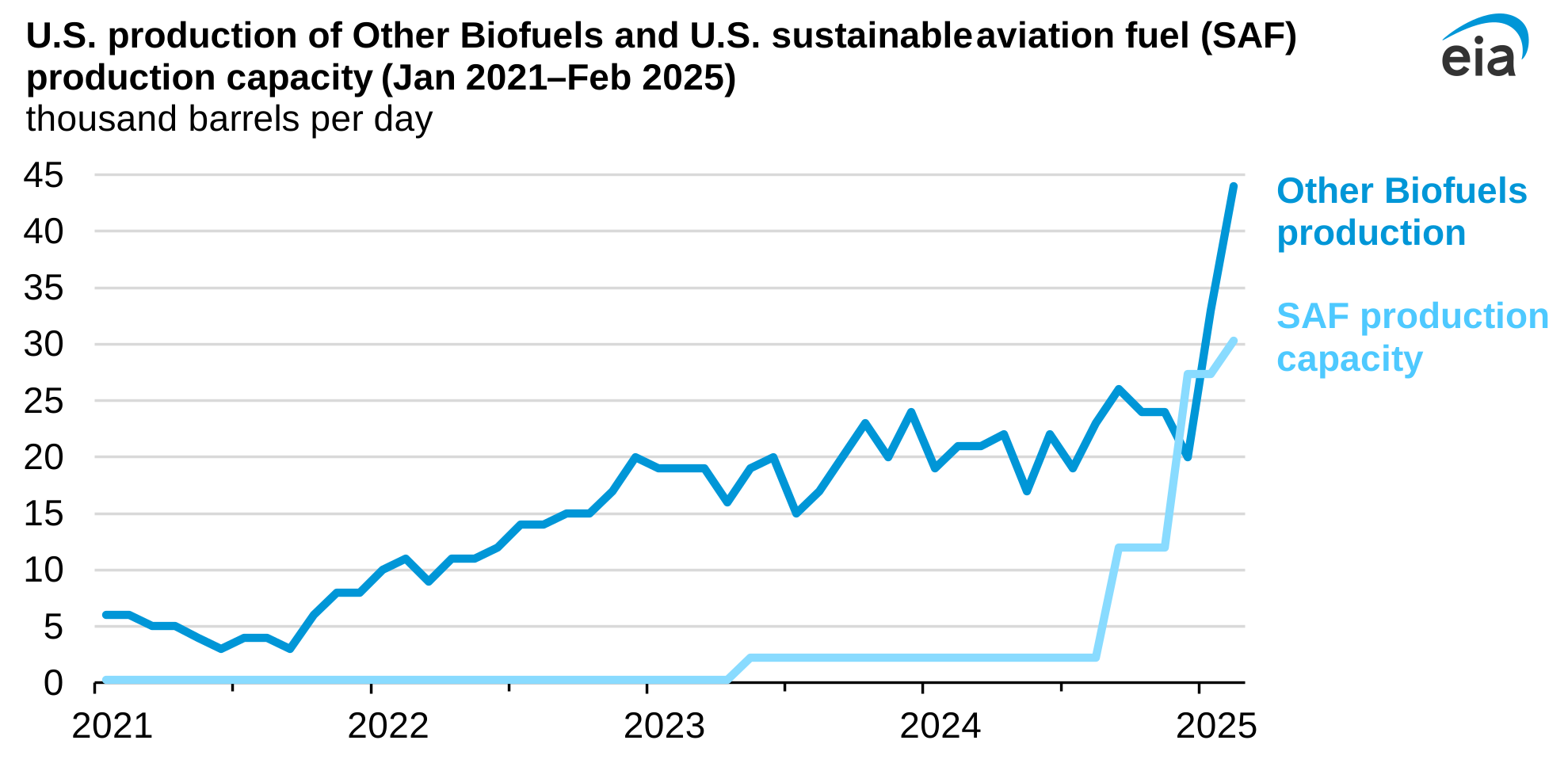
Data source: U.S. Energy Information Administration, Petroleum Supply Monthly; company announcements and trade press Note: Other Biofuels includes sustainable aviation fuel (SAF), renewable heating oil, renewable naphtha, renewable propane, renewable gasoline, and other emerging biofuels that are in various stages of development and commercialization. SAF production capacity is an estimate based on company announcements and trade press and only includes hydroprocessed esters and fatty acids (HEFA) SAF. We do not publish SAF production capacity data.
>> In Other News: Wheels Up Launches New Sustainable Aviation Fuel Program, Setting a New Industry Standard
SAF is an alternative to petroleum jet fuel. It’s produced from agricultural and waste feedstocks and is consumed in blends with petroleum jet fuel. Investments in SAF have increased because of the U.S. Environmental Protection Agency’s Renewable Fuel Standard (RFS), federal tax credits, and state programs and tax credits incentivizing use of the fuel.
In addition to SAF, our Other Biofuels category includes renewable heating oil, renewable naphtha, renewable propane, renewable gasoline, and other emerging biofuels that are in various stages of development and commercialization.
Prior to 2025, renewable naphtha and renewable propane, which are byproducts of renewable diesel production, made up most of Other Biofuels production and was growing because of growing renewable diesel production. SAF made up only a small portion of Other Biofuels production because of limited production capacity. At the beginning of 2024, U.S. SAF production capacity was only around 2,000 barrels per day (b/d), with just two plants capable of producing SAF: World Energy’s plant in Paramount, California, and Montana Renewables’ plant in Great Falls, Montana.
U.S. SAF production capacity increased by about 25,000 b/d in late 2024. Phillips 66 completed its 10,000-b/d SAF project in Rodeo, California, in the third quarter of 2024 (3Q24), before temporarily halting production in 4Q24. Diamond Green Diesel completed its 15,000-b/d SAF project in Port Arthur, Texas, in 4Q24.
A couple of smaller projects will bring additional SAF production capacity online in 2025. New Rise Renewables announced it began SAF production at its plant in Reno, Nevada, in February 2025, adding up to 3,000 b/d of SAF production. Par Pacific plans to begin SAF production at its plant in Kapolei, Hawaii, in the second half of the year, adding about 2,000 b/d of SAF production capacity.
With SAF production capacity now around 30,000 b/d and growing in 2025, SAF will likely drive significant growth in Other Biofuels production and make up most of U.S. Other Biofuels production.
In January, U.S. production of Other Biofuels reached 33,000 b/d, nearly 30% more than the previous record high set in September 2024. Production increased another 30% in February to 44,000 b/d. In our latest Short-Term Energy Outlook, we forecast that U.S. production of Other Biofuels will more than double between 2024 and 2025 and increase by about another 20% in 2026. Although we do not publish a forecast for each fuel that makes up the category, we expect increased SAF production to drive most of that growth. Despite strong growth in SAF on a percentage basis, the absolute volumes will remain relatively low, making up less than 2% of about 1.7 million b/d of U.S. jet fuel consumption in 2025 and about 2% in 2026.
Subscribe to the newsletter
Daily decarbonization data and news delivered to your inbox
Follow the money flow of climate, technology, and energy investments to uncover new opportunities and jobs.
Latest issues
-
Why Is Wyoming Giving 650,000 Acres to Carbon Storage?
Inside This Issue 🪨 Inside Blm's 650,000-Acre Bet on Wyoming Carbon Storage 🏭 California Advances Carbon Capture and Removal Regulations Under SB 905 ⚡ Why a Japanese Power Giant Is Betting on Den...
-
Colorado Joins the 7-State CCS Permit Fast Lane
Inside This Issue ⚖️ Colorado Takes Over Class VI Permits: What Changes for CCS? 🏭 Hebei Shoulang Facility Using LanzaTech Technology Achieves World’s First ISCC EU RCF Certification for Ethanol P...
-
The US Hasn't Made Heavy Water Since 1982
Inside This Issue ⚛️ Aternium Completes FEED Studies for US Hydrogen, Heavy Water Project 🐄 Google, McKinsey Strike Brazil Carbon Removal Deal With Silvopasture Project 🔧 Cummins Selects Stargate ...
Company Announcements
-
Citi Closes $72 Million Carbon Removal-Linked Note to Support Applied Carbon Biochar Project
HIGHLIGHTS Citi structured an innovative $72 million carbon removal-linked note to provide upfront capital for Applied Carbon's biochar project, marking a first-of-its-kind "outcome bond" for ver...
-
New platform opens access to the same rigorous project evaluations trusted by the world's leading carbon removal procurement programs Today, Relae (formerly Carbon Direct) launched The Diligence C...
-
Inside BLM's 650,000-Acre Bet on Wyoming Carbon Storage
The Bureau of Land Management has offered right-of-way grants covering about 649,438 acres of federal pore space in southwest Wyoming. The September 21, 2026 offers went to Moxa Carbon Storage LLC ...
-
NEW YORK, BUSINESS WIRE, SWITCH Maritime (Switch), a leading developer of zero-emission vessels, secured a Design Basis Agreement (DBA) with the United States Coast Guard (USCG) for the SWITCH-150,...