
The U.S. Geological Survey (USGS) has released a groundbreaking map showcasing potential locations for naturally occurring hydrogen gas reserves across the contiguous United States.
This discovery has the potential to revolutionize the energy sector by identifying vast stores of this clean energy source beneath American soil.
>> RELATED: USGS Releases First-ever Map of Potential for Geologic Hydrogen in U.S.
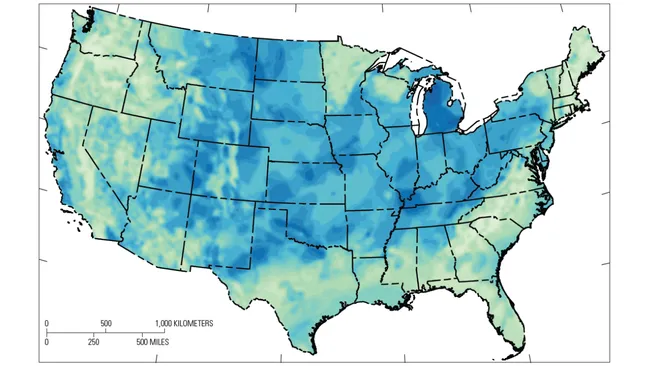
A map depicting regions in the U.S. with low potential for hydrogen reserves (white to light blue) and areas with high potential (blue to dark blue). (Image credit: U.S. Geological Survey)
A Breakthrough in Hydrogen Mapping
The interactive map, available on the USGS website, marks a critical step in understanding geologic hydrogen, often referred to as “gold” hydrogen.
It identifies regions where hydrogen gas may exist in large, extractable quantities, challenging the previous belief that naturally occurring hydrogen reserves were too sparse for practical use.
Hydrogen gas forms underground through natural chemical reactions, often involving the splitting of water molecules into hydrogen and oxygen.
According to the USGS, three conditions must align for these reserves to form: a reliable hydrogen source, porous reservoir rocks, and natural seals to trap the gas. Until recently, scientists assumed these conditions were rare, but this new map suggests otherwise.
“For decades, the conventional wisdom was that naturally occurring hydrogen did not accumulate in sufficient quantities to be used for energy purposes,” said Sarah Ryker, Associate Director for Energy and Mineral Resources at USGS. “This map is tantalizing because it shows that several parts of the U.S. could have a subsurface hydrogen resource after all.”
Where Are the Reserves?
The map reveals promising hydrogen prospects across at least 30 U.S. states. Key regions identified as highly prospective (marked in dark blue on the map) include:
- Michigan, which shows significant potential across most of the state.
- Eastern Kentucky and southern North Dakota, both marked as hotspots for exploration.
- Parts of Kansas, Colorado, Wyoming, Iowa, and Oklahoma.
Additional areas along the California coast and the Eastern Seaboard also exhibit potential, making hydrogen a geographically diverse resource in the U.S. Large swathes of the Midwest, in particular, appear to offer ideal geological conditions for hydrogen accumulation, further solidifying the region’s role as a future energy hub.

>> In Other News: Nel ASA: Receives Purchase Order for 5 MW of Containerized PEM Electrolysers
Hydrogen: The Energy of the Future?
Hydrogen is increasingly seen as a cornerstone of the clean energy transition, offering a sustainable alternative to fossil fuels.
According to the International Energy Agency (IEA), hydrogen demand is expected to grow fivefold by 2050, accounting for up to 30% of the energy supply in certain sectors, such as transportation and heavy industry.
To put its potential into perspective, a 2023 study estimated Earth’s total buried hydrogen reserves at 6.2 trillion tons (5.6 trillion metric tons).
If just 2% of that reserve were tapped, it could power the entire world’s energy needs for 200 years. However, identifying reserves that are both accessible and extractable is critical.
“In the previous study, we showed there is a significant potential for geologic hydrogen as an emerging energy resource,” said Sarah Gelman, a geologist at the USGS Central Energy Resources Science Center. “The logical next step was to find where it might be in the United States.”
What the Map Means for Exploration
The significance of the map goes beyond simply identifying where hydrogen may exist. It provides a foundation for future exploration and investment in cleaner energy solutions.
Developing the technology to safely and efficiently extract geologic hydrogen is now the focus of researchers and energy companies alike.
The map reveals a clear path for exploring domestic hydrogen resources, reducing dependence on imported energy.
Additionally, the accessibility of hydrogen reserves in multiple states could pave the way for more localized and resilient energy networks.
Hydrogen's environmental benefits are substantial. When burned or used in fuel cells, hydrogen produces zero carbon emissions, releasing only water as a byproduct. This makes it an ideal solution for meeting global climate goals while transitioning away from traditional fossil fuels.
Challenges and Opportunities Ahead
While the map offers exciting possibilities, there are still challenges to overcome. Extracting hydrogen from underground reserves requires advanced technologies, some of which are still in the early stages of development.
Additionally, researchers need to evaluate the economic and environmental feasibility of large-scale hydrogen production.
The potential rewards, however, are immense. The clean energy market is projected to grow to $1.4 trillion by 2030, according to BloombergNEF.
Hydrogen’s role in this market could expand dramatically as companies and governments invest in its development. Already, major energy firms and startups are eyeing geologic hydrogen as a game-changing resource.
The Road Ahead for Hydrogen Energy
The first-of-its-kind USGS map represents a major step forward in identifying domestic energy opportunities.
It highlights regions with high hydrogen potential and underscores the importance of investing in cleaner, more sustainable energy sources.
As exploration and technology advance, hydrogen could become a cornerstone of the U.S. energy strategy.
Could hydrogen reserves lurking beneath the surface be the key to achieving energy independence and sustainability? With this new map, researchers are one step closer to finding out.
Subscribe to the newsletter
Daily decarbonization data and news delivered to your inbox
Follow the money flow of climate, technology, and energy investments to uncover new opportunities and jobs.
Latest issues
-
Why Colorado’s Koloma Has Japan’s Largest Utility Hooked
Inside This Issue ⚡ JERA Invests in Koloma to Explore Natural Hydrogen as a Future Low-Carbon Energy 🔬 New CATF Tool Provides Framework for Self-Assessment and Strengthening of Biomass Carbon Remo...
-
LNK Energies Targets $6.50 Hydrogen With No Federal Subsidies
Inside This Issue 🚛 MIT Startup Says It Can Turn Diesel Trucks Into Cheaper Hydrogen Haulers, See It at Disrupt 🏭 Baytown City Council Briefs: ExxonMobil Blue Hydrogen Agreement Approved 🌎 Colorad...
-
Why Gulf Coast CCS Teams Are Watching Liverpool Bay
Inside This Issue 💂 Eni’s Douglas Platform Sets the Offshore CCS Blueprint 🌲 Pacolet Milliken Expands Its Biomass Platform With the Acquisition of Georgia Renewable Power 🧪 Metacon Receives EU Fun...
Company Announcements
-
A new interactive tool from Clean Air Task Force (CATF) provides a practical framework for the self-assessment and strengthening of biomass carbon removal (BiCRS) protocols to help ensure that carb...
-
LanzaJet Secures Financing to Scale SAF Production and Supply Global Customers
CHICAGO, Oct. 15, 2026 (GLOBE NEWSWIRE) -- LanzaJet, Inc., a leading next-gen fuels technology company and fuels producer, today announced fully committed new financing of at least $20 million to s...
-
44.01 and Frontier Advance Permanent CO₂ Storage Through In-Situ Mineralization
44.01's in-situ mineralization (ISM) process turns CO₂ into solid rock underground in a few years, after which the risk of reversal is functionally zero. >> In Other News: JERA Invests in ...
-
JERA Invests in Koloma to Explore Natural Hydrogen as a Future Low-Carbon Energy
JERA Co., Inc. (JERA), through its corporate venture capital arm JERA Ventures, has invested in Koloma, Inc. (Koloma), a U.S.-based natural hydrogen exploration and development company. The invest...