
American Airlines and Google have signed the largest publicly announced sustainable aviation fuel certificate agreement ever recorded between an airline and a single corporate customer. The three-year deal unlocks 35 million gallons (132 million liters) of SAF, cutting nearly 300,000 metric tons of CO2 equivalent emissions, and sets a concrete new standard for corporate climate action in aviation.
Key Facts
- 35 million gallons (132 million liters) of SAF committed over three years
- Nearly 300,000 metric tons of CO2 equivalent emissions reductions expected
- Largest publicly announced SAFc agreement between an airline and a single corporate customer, as of June 2026
- Fuel produced from waste feedstocks, primarily used cooking oil
- Physical delivery through existing infrastructure at Chicago O'Hare International Airport (ORD)
- Illinois SAF tax credit made the deal financially viable
- Agreement triggered a new long-term SAF offtake contract between American Airlines and Valero Marketing and Supply Company
- SAF can reduce lifecycle greenhouse gas emissions by up to 80% compared to conventional jet fuel
- Aviation supports 87 million jobs globally and generates $4.1 trillion in economic activity, per the ATAG Aviation Benefits Beyond Borders report
>> In Other News: Isometric Launches CORSIA Insurance RFP With Howden
What Makes This Agreement a Record-Breaker?
American Airlines and Google announced the deal on June 9, 2026. It is the largest publicly disclosed sustainable aviation fuel certificate (SAFc) agreement between any airline and a single corporate buyer on record.
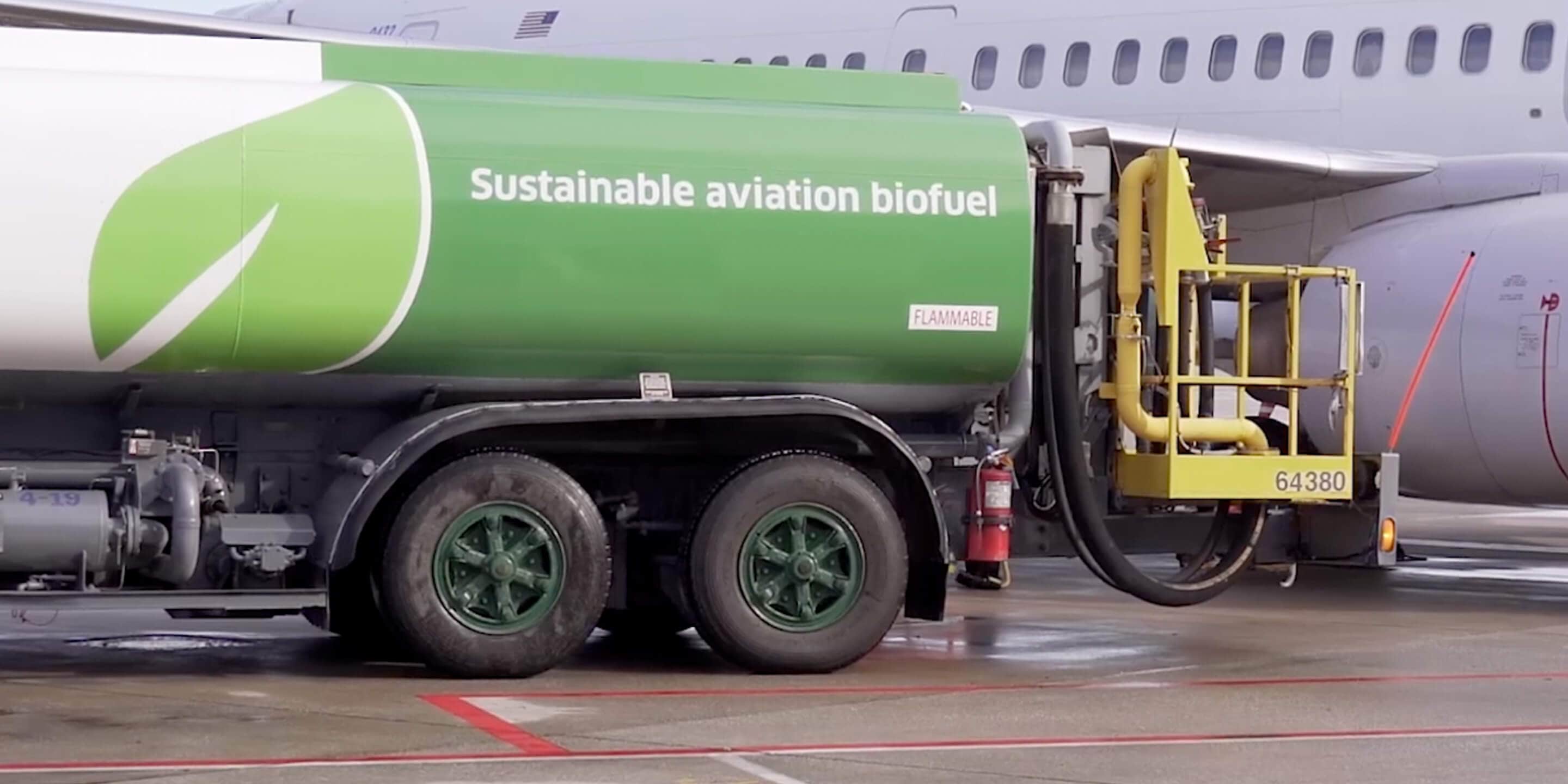
Under the arrangement, American purchases and takes physical delivery of the fuel at Chicago O'Hare International Airport. The SAF portion is produced from waste-based feedstocks, primarily used cooking oil. Google does not receive the physical fuel. Instead, it receives the corresponding environmental credits through the SAFc Registry, a book-and-claim system that lets corporate buyers claim verified emissions reductions even when the fuel flows through a different aircraft or location.

"Our industry-leading agreement with Google is a critical step forward in reducing emissions from our operations. By working with leaders like Google who share our commitment to innovation, we're helping to grow demand for SAF and support the development of a stronger, more resilient market."
Jill Blickstein, Chief Sustainability Officer, American Airlines
Those credits go toward addressing emissions from Google's employee business travel, a category that has grown harder to offset as corporate air miles have rebounded strongly since the pandemic.
The deal also triggered a separate long-term SAF offtake agreement between American and Valero Marketing and Supply Company, a San Antonio-based energy company. That supply chain commitment is what gives this agreement staying power beyond a single corporate purchase.

SAFc book-and-claim separates the environmental value of sustainable aviation fuel from the physical fuel, allowing buyers to support SAF demand and claim verified emissions reductions through a registry.
How Does the SAFc Book-and-Claim System Work?
The SAFc Registry is what makes the deal structurally possible. A book-and-claim model decouples the physical fuel from its environmental benefits. American purchases and burns the SAF at O'Hare. Google receives the certificates, which are logged, tracked, and verified through the registry to prevent double-counting.
This removes a major logistical barrier for corporate SAF buyers. Companies no longer need to arrange flights on SAF-equipped routes to participate in the market. They can purchase certificates tied to real fuel volumes, claim the verified emissions reductions, and apply them to their corporate sustainability reporting.
For the SAF market to scale, producers need long-term, bankable demand commitments that justify new production investment. A three-year, 35-million-gallon commitment from a company like Google delivers exactly that kind of signal.
| Feature | Conventional Jet Fuel | SAF (Waste-Based HEFA) |
|---|---|---|
| Primary feedstock | Crude petroleum | Used cooking oil, waste fats |
| Lifecycle GHG reduction | Baseline (0%) | Up to 80% (American Airlines Newsroom, 2026) |
| Drop-in compatibility | Yes | Yes — no engine modifications needed |
| Share of global aviation fuel (2025) | Approx. 99.3% | 0.7% (IATA, 2025) |
| Global production (2025 est.) | Dominant | 2 million metric tonnes (IATA, June 2025) |
>> RELATED: SAF Output Doubled, So Why Is IATA Sounding Alarms?
Why Illinois and O'Hare Are Central to This Deal
The agreement would not have been financially viable without state-level policy support. Illinois Governor JB Pritzker and the Illinois General Assembly enacted a SAF tax credit specifically designed to attract high-volume fuel commitments to Chicago O'Hare.
"This strategic collaboration with American Airlines demonstrates how companies can work together to scale critical sustainability technologies. By entering into this long-term commitment, we are sending a vital demand signal to catalyze investment and bring more SAF to market."
Kate Brandt, Chief Sustainability Officer, Google
O'Hare handled 84.85 million passengers in 2025, per airport authority data, making it one of the highest-leverage deployment points for sustainable fuel in the country. Bringing large SAF volumes into an airport at that scale multiplies the climate impact of every gallon purchased.
The Illinois credit changed the economics enough to pull together four separate parties: an airline, a technology company, a fuel supplier, and a major airport hub. That kind of coordinated outcome is exactly what well-designed SAF policy is supposed to produce, and Illinois just showed how it works in practice.
Where Does This Fit in the Broader SAF Market?
SAF currently accounts for less than 1% of total aviation fuel consumed globally. IATA projected global SAF production would reach 2 million metric tonnes in 2025, covering just 0.7% of the aviation industry's total fuel needs. The gap between supply and demand remains enormous.
On the supply side, the U.S. made rapid infrastructure progress. American domestic SAF production capacity reached approximately 30,000 barrels per day in 2025, up from just 2,000 barrels per day at the start of 2024, as new facilities in California, Texas, and Nevada came online backed by federal incentives and state-level programs.
The American Airlines and Google agreement adds a significant volume commitment to that growing supply base. Thirty-five million gallons (132 million liters) over three years is large enough to anchor a dedicated supply chain, as the Valero offtake deal confirms.
Aviation generates approximately 2 to 3% of global CO2 emissions and supports 87 million jobs globally while contributing $4.1 trillion in economic activity, according to the ATAG Aviation Benefits Beyond Borders report. Decarbonizing the sector requires long-term, scalable fuel commitments. This deal is a concrete step in that direction.
Is This Google's First SAF Commitment?
No. Google has been building out its SAF portfolio for several years. In 2023, it joined the Avelia book-and-claim SAF program run by Amex GBT and Shell Aviation, and extended that agreement in March 2026. In February 2026, it also participated in a Singapore government-backed centralized SAF procurement trial alongside Singapore Airlines and Changi Airport Group.
The American Airlines agreement is Google's largest single SAF commitment to date. Its scale and three-year duration make it a different kind of market signal than prior purchases.
For American Airlines, the deal aligns with its centennial year in 2026. The airline operates more than 6,000 daily flights to over 350 destinations in 60-plus countries, serving more than 200 million customers annually. American also reported a statistically significant 62% reduction in contrail formation during a 2025 16-week trial conducted with Google, Contrails.org, and Flightkeys that integrated contrail avoidance into its flight planning processes.
American is also a founding member of the oneworld alliance, whose members have been focused on supporting new SAF technologies that can scale production at competitive prices while minimizing other environmental impacts.
Discover how Sustainable Aviation Fuel (SAF) works as a drop-in alternative made from waste-based and renewable feedstocks like used cooking oil, beef tallow, and agricultural residues. It reduces lifecycle emissions by up to 80% versus conventional jet fuel, requires no engine modifications, and is already powering flights today—highlighting the real-world impact of major corporate commitments like the American Airlines-Google SAFc agreement.
What This Signals for Corporate SAF Demand
When a company like Google signs a three-year, 35-million-gallon SAFc agreement, it validates the book-and-claim model for the entire corporate sector. Other large buyers of business travel — financial firms, consultancies, and technology companies — now have a clear, high-profile precedent to follow.
They can participate in the SAF market through the SAFc Registry without restructuring their travel programs or limiting employees to specific routes. That reduces one of the most practical barriers to corporate SAF adoption at scale.
IATA has noted that the SAF industry has not yet attracted the investment required to scale production at prices competitive with conventional jet fuel. Long-term corporate offtake agreements like this one directly address that investment gap by giving producers the revenue certainty needed to build new capacity.
The nearly 300,000 metric tons of CO2 equivalent reductions committed in this agreement — approximately 100,000 metric tons per year across three years — represent a meaningful and verifiable emissions impact tied to real fuel volumes and a traceable certificate system.
The Demand Signal That Changes the Math
The biggest barrier to SAF scaling right now is not technology. It is the absence of long-term, bankable demand that justifies new production investment. American Airlines and Google have delivered that with this agreement.
SAF's ability to cut lifecycle greenhouse gas emissions by up to 80% compared to conventional jet fuel remains its core advantage. It is a drop-in fuel — airlines do not need new engines, new fueling infrastructure, or new aircraft to use it. The challenge has always been cost and supply. Agreements of this scale, supported by state-level tax credits and long-term supply contracts, directly address both.
The combination of a record-volume commitment, verified tracking through the SAFc Registry, a locked-in supply chain through Valero, and enabling policy from Illinois makes this one of the most structurally sound corporate decarbonization agreements in aviation to date.
Frequently Asked Questions
What is a sustainable aviation fuel certificate (SAFc)?
A SAFc is a tradable environmental credit representing the greenhouse gas reductions generated when SAF is used in place of conventional jet fuel. Through a book-and-claim system like the SAFc Registry, the buyer of the certificate receives the environmental benefit even if the physical fuel flows through a different aircraft or airport. Credits are logged and verified to prevent double-counting.
How much can SAF reduce aviation emissions?
SAF reduces lifecycle greenhouse gas emissions by up to 80% compared to conventional petroleum-based jet fuel, according to American Airlines and corroborated by industry sources. The reduction comes from using lower-carbon feedstocks such as used cooking oil and waste fats, which carry a significantly smaller carbon footprint than crude-derived kerosene across the full production and combustion cycle.
What role did Illinois policy play in this deal?
The Illinois SAF tax credit, enacted by Governor JB Pritzker and the Illinois General Assembly, reduced the cost gap between SAF and conventional jet fuel at Chicago O'Hare. Without it, the economics of committing 35 million gallons over three years at this specific airport would not have been workable. The credit demonstrates how targeted state-level policy can unlock large-scale private-sector climate investment.
For ongoing coverage of sustainable aviation fuel, carbon markets, and aviation decarbonization, subscribe to Decarbonfuse.com.