
Avnos has switched on Project Brighton, its largest Hybrid Direct Air Capture (HDAC) deployment to date, at its Bridgewater, New Jersey campus. The facility captures 450 metric tons of CO2 per year and produces 475,000 gallons of clean water annually. Brighton isn't commercially important because of how much CO2 it removes. It matters because it's the essential validation step between Avnos' technology development work and its larger Project Cedar deployment.
Key Facts
- Brighton captures up to 450 metric tons of CO2 per year (Avnos, September 2026)
- Brighton produces approximately 475,000 gallons of clean water annually
- Funded by the U.S. Office of Naval Research (ONR) under contract N00014-23-C-1011
- HDAC technology reduces energy consumption by more than 50% compared to conventional DAC (Avnos, November 2023)
- For every 1 metric ton of CO2 captured, HDAC produces 5 tons of distilled-quality water
- Project Cedar, next in line, targets 3,000 metric tons of CO2 per year using four HDAC modules
- Cedar is backed by up to $17 million in financing from Shell and Mitsubishi Corporation (Americas)
- Avnos has secured more than $100 million in combined public and private funding to date
>> In Other News: Fortera and MLC Sign Development Agreement for First Full-Scale Commercial ReAct Cement Plant
What Does Brighton Actually Do?
Brighton is a technology validation platform, not a commercial-scale facility. Developed under U.S. Office of Naval Research contract N00014-23-C-1011, it's built to confirm that Avnos' HDAC system can operate continuously under real-world conditions. It also generates the performance data Avnos needs before moving to Cedar.
The facility sits alongside Avnos' 20,000-square-foot Technology Development Center on Milltown Road in Bridgewater. That co-location is deliberate. It combines R&D, prototyping, and pilot-scale testing in one place. Avnos CEO Will Kain described the intent directly at the Global Direct Air Capture Conference earlier this year.
"Brighton is our largest operating deployment to date and demonstrates our ability to deliver infrastructure at increasing scale. It also provides the operational experience and real-world performance data that will help accelerate future commercial deployments, while helping customers address interconnected energy, water and emissions challenges."
Will Kain, Founder and CEO, Avnos
Brighton's 450 metric tons per year of CO2 capacity is modest by design. For context, that's one-seventh the capacity of Project Cedar's planned 3,000 metric tons per year. Cedar, in turn, represents a small fraction of what genuinely commercial-scale direct air capture operations will eventually require. The honest framing here is that Brighton is an intermediate step, not a breakthrough.

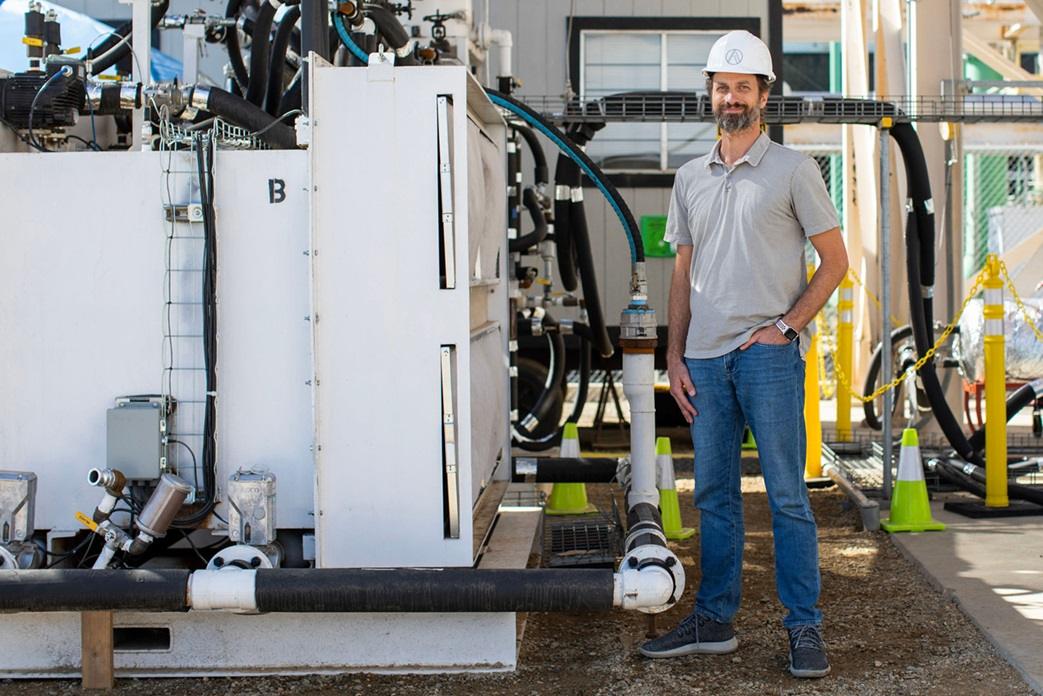
Industrial infrastructure for carbon capture and processing. Brighton operates on a smaller validation scale ahead of Project Cedar's commercial build-out.
How Does HDAC Actually Work?
Most conventional DAC systems rely on high-temperature thermal regeneration to release captured CO2 from an adsorbent material. That heat input is expensive and energy-intensive. Avnos eliminates it entirely.
HDAC works differently from the start. Ambient air enters the system and first passes through an atmospheric water extraction stage, which pulls moisture from the airstream. That drier air then flows across a moisture-swing CO2 adsorbent, which captures atmospheric CO2. The key mechanism: when that adsorbent is later exposed to moisture (the water Avnos already extracted), it releases the CO2. No external heat is needed.
The result is a fully electric system that produces 5 tons of distilled-quality water for every 1 metric ton of CO2 it removes (Avnos, November 2023). Most conventional DAC approaches, by comparison, consume between 5 and 20 tons of water per ton of CO2 removed. That inversion is what Avnos calls "water-positive" DAC. It reduces total energy consumption by more than 50% relative to conventional thermal systems, according to the company.
Will Kain, Founder and CEO of Avnos, explains the HDAC technology, its water-positive design, and the company's commercialization path in this May 2025 interview from the Carbon Removal series "This Is CDR."
Why Is the Navy Funding a Carbon Capture Facility?
The U.S. Office of Naval Research has a straightforward strategic reason to care about DAC-to-fuel technology. Synthetic fuels produced from captured CO2 and green hydrogen reduce dependence on conventional fuel supply chains, which are vulnerable in contested environments. That logic has driven the Department of Defense's broader interest in electrofuel production for years.
Brighton's role in that context is to pilot the CO2 supply side of the equation. Avnos is partnering with the ONR to demonstrate that DAC-sourced CO2 can serve as feedstock for sustainable aviation fuel (SAF) production. The facility doesn't produce SAF directly. Brighton is supplying the CO2 and generating performance data for the DAC-to-SAF pathway. The next steps in that chain involve conversion processes that Avnos is piloting alongside its ONR partnership.
The Navy's involvement also signals something practical for DAC developers: defense-backed validation of real-world performance carries weight with commercial partners who need proof that systems can operate reliably over time.
| Project | CO2 Capacity (tonnes/year) | Status | Key Backer |
|---|---|---|---|
| Project Alpine (Bakersfield, CA) | ~30 | Operational since Sept. 2023 | U.S. DOE |
| Project Brighton (Bridgewater, NJ) | 450 | Operational as of Sept. 2026 | U.S. Office of Naval Research |
| Project Cedar (U.S. location TBA) | 3,000 | Targeting late 2026 online | Shell, Mitsubishi Corporation (Americas) |
What Brighton Needs to Demonstrate Before Cedar Can Proceed
Cedar isn't a guaranteed next step. It's built on the assumption that Brighton delivers usable validation data. The specific outputs Avnos needs from Brighton include continuous operation reliability, adsorbent durability over extended cycles, and CO2 output quality that can serve as feedstock for fuel synthesis.
Cedar will deploy four HDAC modules designed for faster build times and more repeatable project delivery. That modular approach only works if Brighton confirms the underlying system performs predictably at the larger scale. If adsorbent degradation, energy consumption figures, or continuous operation metrics come in off-target at Brighton, Cedar's configuration could require adjustment.
Avnos has secured up to $17 million in project financing from Shell US Gas and Power and Mitsubishi Corporation (Americas) to build Cedar. That financing is structured in phases, giving both investors a checkpoint before capital is fully deployed. Brighton's operational data is a key input into that process.
>> RELATED: Avnos’ Hybrid Direct Air Capture: The Future of Carbon Removal and Water Production
HDAC technology is fully electric, making colocation with renewable energy sources a natural fit for future commercial deployments like Project Cedar.
How Avnos Compares to the Broader DAC Landscape
Brighton's 450 metric tons per year is 15 times larger than Project Alpine, Avnos' first Bakersfield pilot, operational since September 2023. Cedar at 3,000 metric tons per year is roughly 100 times Alpine's capacity. That's real progress, but for comparison, Climeworks' Mammoth facility in Iceland targets 36,000 metric tons per year. DOE-backed commercial DAC hub targets sit in the hundreds of thousands of tonnes range. Brighton and Cedar together don't approach those numbers, but they're building what the broader industry still needs: a replicable, modular, heat-free system with verified water-positive output.
Avnos has been selected as a technology provider for four U.S. federally funded DAC hub programs, backed by more than $100 million in combined public and private funding from NextEra Energy Resources, ConocoPhillips, JetBlue Ventures, Shell, and Mitsubishi Corporation (Avnos, January 2026). Brighton activating puts the company in a stronger position to serve those hub contracts when they need hardware in the ground.

"Project Brighton reflects the kind of investment Somerset County, and New Jersey more broadly, works hard to attract: technology companies building real infrastructure at scale. Avnos has been part of our business community for several years now, and it's great to see this project reach operational status."
Chris Edwards, President and CEO, Somerset County Business Partnership
The Water Co-Product: Useful or Overstated?
Avnos consistently leads with its water-positive story, and there's a real technical basis for it. HDAC produces 5 tons of distilled-quality water for every 1 metric ton of CO2 removed, a figure integral to how the adsorbent releases CO2, not an incidental byproduct. At Brighton's capacity, that's roughly 475,000 gallons per year.
The commercial value of that water depends on location. At a future facility co-located with a carbon storage hub or SAF production site in a water-stressed region, it becomes an economic asset. That geographic flexibility is why Avnos frames HDAC as infrastructure rather than just a carbon removal tool. One caveat: "water-positive" describes the system's output. Whether every operating condition produces a fully positive water balance varies. What's clearly established is that HDAC generates far more water than it consumes.
Frequently Asked Questions
Is Project Brighton a commercial-scale direct air capture plant?
No. Brighton is an advanced demonstration hub designed to validate Avnos' HDAC technology under continuous real-world operating conditions. Its 450 metric tons per year of CO2 capacity is intended to generate the performance data needed to build Project Cedar, which at 3,000 metric tons per year will be Avnos' first commercial-scale deployment. Brighton's importance is what it proves, not how much CO2 it removes.
Why does the U.S. Navy care about direct air capture technology?
The U.S. Office of Naval Research is interested in DAC because atmospheric CO2 can serve as a feedstock for synthetic fuels, including sustainable aviation fuel. Producing fuel from captured CO2 and green hydrogen reduces dependence on conventional fuel supply chains in remote or contested operating environments. Brighton is piloting the CO2 supply side of that pathway under ONR contract N00014-23-C-1011.
How does HDAC differ from conventional direct air capture systems?
Conventional DAC systems use high-temperature thermal regeneration to release captured CO2, which is energy-intensive. Avnos' HDAC system replaces that heat step with a moisture-swing mechanism: water extracted from the air triggers CO2 release from the adsorbent, eliminating the need for external heat entirely. This reduces energy consumption by more than 50% and produces 5 tons of distilled-quality water per ton of CO2 captured, compared to 5 to 20 tons of water consumed per ton of CO2 in conventional systems.
From Alpine to Cedar: The Scale-Up That Actually Matters
Avnos' technology progression is: Alpine at 30 metric tons per year proved the concept in the field. Brighton at 450 metric tons per year validates continuous operation and system integration at the campus scale. Cedar at 3,000 metric tons per year will demonstrate whether HDAC can repeat across four modules with faster build times. That sequence is how this kind of hardware moves from lab to market.
Brighton isn't the story. Cedar is. Brighton is what has to work first. With operations now active in Bridgewater and more than $100 million in backing from partners including Shell, Mitsubishi Corporation, NextEra Energy Resources, ConocoPhillips, JetBlue Ventures, the DOE, and the Department of Defense, Avnos has the commercial weight behind it to close that gap. The next milestone that will matter is whether Cedar comes online on schedule by late 2026, and what the first year of multi-module HDAC operation actually looks like at scale.
For ongoing coverage of carbon removal, BECCS, and corporate CDR procurement, subscribe to Decarbonfuse.com.
Subscribe to the newsletter
Daily decarbonization data and news delivered to your inbox
Follow the money flow of climate, technology, and energy investments to uncover new opportunities and jobs.
Latest issues
-
Colorado Joins the 7-State CCS Permit Fast Lane
Inside This Issue ⚖️ Colorado Takes Over Class VI Permits: What Changes for CCS? 🏭 Hebei Shoulang Facility Using LanzaTech Technology Achieves World’s First ISCC EU RCF Certification for Ethanol P...
-
The US Hasn't Made Heavy Water Since 1982
Inside This Issue ⚛️ Aternium Completes FEED Studies for US Hydrogen, Heavy Water Project 🐄 Google, McKinsey Strike Brazil Carbon Removal Deal With Silvopasture Project 🔧 Cummins Selects Stargate ...
-
Why Colorado’s Koloma Has Japan’s Largest Utility Hooked
Inside This Issue ⚡ JERA Invests in Koloma to Explore Natural Hydrogen as a Future Low-Carbon Energy 🔬 New CATF Tool Provides Framework for Self-Assessment and Strengthening of Biomass Carbon Remo...
Company Announcements
-
Citi Closes $72 Million Carbon Removal-Linked Note to Support Applied Carbon Biochar Project
HIGHLIGHTS Citi structured an innovative $72 million carbon removal-linked note to provide upfront capital for Applied Carbon's biochar project, marking a first-of-its-kind "outcome bond" for ver...
-
New platform opens access to the same rigorous project evaluations trusted by the world's leading carbon removal procurement programs Today, Relae (formerly Carbon Direct) launched The Diligence C...
-
Inside BLM's 650,000-Acre Bet on Wyoming Carbon Storage
The Bureau of Land Management has offered right-of-way grants covering about 649,438 acres of federal pore space in southwest Wyoming. The September 21, 2026 offers went to Moxa Carbon Storage LLC ...
-
NEW YORK, BUSINESS WIRE, SWITCH Maritime (Switch), a leading developer of zero-emission vessels, secured a Design Basis Agreement (DBA) with the United States Coast Guard (USCG) for the SWITCH-150,...