
Ballard Power Systems agreed to acquire GeoPura for a total enterprise value near 400 million U.S. dollars, turning the Canadian fuel cell maker into a vertically integrated hydrogen power provider. The deal folds GeoPura's production, leasing, and stationary power business into Ballard, bringing customers like Disney, Microsoft, and the UK Ministry of Defence along with it.
Key Facts
- Total transaction enterprise value: 301.1 million pounds, approximately 400 million U.S. dollars
- Upfront consideration: 275 million pounds, split between 82.5 million pounds cash and about 50.8 million new Ballard shares
- Contingent consideration: up to 27.5 million pounds tied to future financial milestones
- GeoPura shareholders expected to hold roughly 14.4 percent of Ballard post-close
- GeoPura's projected 2026 revenue: approximately 38 million pounds
- Projected annual EBITDA synergies: 25 million U.S. dollars
- Deal expected to close in the second half of 2026, pending UK National Security and Investment Act clearance and TSX approval
>> In Other News: MAX Power Mobilizes for Commercial Validation Program at Canada’s First Natural Hydrogen Discovery
How Big Is the Ballard-GeoPura Deal, Exactly?
The total transaction enterprise value comes to 301.1 million British pounds, or approximately 400 million U.S. dollars, based on the June 23, 2026 announcement. That figure includes GeoPura's assumed net debt and excludes any future contingent payments.
The upfront equity purchase price is 275 million pounds. Ballard is funding 82.5 million pounds of that in cash on hand. The rest comes through roughly 50.8 million newly issued Ballard shares, priced at 5.02 U.S. dollars each using Ballard's 30-day volume-weighted average share price.
Ballard will also owe up to 27.5 million pounds in contingent consideration if GeoPura hits specific financial milestones after the deal closes. Once the transaction wraps, GeoPura shareholders are expected to own roughly 14.4 percent of Ballard.
Why Is a Fuel Cell Maker Buying a Power Generation Company?
Ballard Power Systems, a Vancouver-based supplier of PEM fuel cells for buses, trucks, trains, and stationary power, has spent decades selling components to other companies that build the finished product. This deal changes that. Ballard President and CEO Marty Neese is positioning the company as an energy-as-a-service operator with control over hydrogen production, distribution, logistics, refueling, and the generators themselves.
That shift matters because component sales are a single transaction. A bundled offering, hydrogen supply plus the power unit plus ongoing service, captures revenue at every stage. Ballard expects this to raise revenue per megawatt deployed and shift more of its business toward recurring income, a pattern already playing out across the broader fuel cell market as providers chase steadier revenue streams.

"This is a truly transformative acquisition that establishes Ballard as a leading, fully integrated hydrogen ecosystem provider and positions us to capitalize on the accelerating global energy transition and increasing demand for energy resilience."
Marty Neese, President and CEO, Ballard Power Systems
Who Is GeoPura, and Why Do Its Customers Matter?
GeoPura, founded in 2019 by CEO Andrew Cunningham and based in the UK, builds and leases Hydrogen Power Units, containerized generators that run on green hydrogen instead of diesel. The company also holds a 50 percent stake in the HyMarnham hydrogen production facility, giving it its own supply chain rather than dependence on outside producers.

"When your work powers film and live television, hospitals, defence, essential infrastructure, and construction with reliable off-grid and grid-support systems, your engine supplier is central to your success. For GeoPura, Ballard has stood head and shoulders above the rest."
Andrew Cunningham, Founder and CEO, GeoPura
GeoPura's customer list is the real proof point here. It includes Disney, Microsoft, Netflix, the BBC, Balfour Beatty, Aggreko, Sunbelt Rentals, and the UK Ministry of Defence. These are organizations replacing diesel generators on film sets, construction sites, and defense installations, a use case similar to how Toyota has targeted diesel replacement in heavy-duty transport rather than passenger vehicles.
What Does the Deal Structure Look Like Side by Side?
Ballard is spreading the cost across cash, new stock, and a milestone-based payment rather than one lump sum. Here's how the components break down.
| Component | Amount |
|---|---|
| Cash on hand | 82.5 million pounds |
| New Ballard shares issued | ~50.8 million shares at $5.02 each |
| Contingent consideration | Up to 27.5 million pounds |
| Total enterprise value | 301.1 million pounds (~$400 million) |
>> RELATED: Chart Industries and Flowserve Corporation to Combine in All-Stock Merger
What Does This Mean for Ballard's Finances?
The share issuance dilutes existing Ballard shareholders, and the stock has moved sharply since the announcement. Management is betting the long-term math works: roughly 25 million U.S. dollars in projected annual EBITDA synergies, and reinforcement of Ballard's existing target to reach profitability by 2028.
GeoPura brings its own revenue engine to that goal. The company expects approximately 38 million pounds in 2026 revenue, generated through HPU leasing, hydrogen sales, and logistics. It also holds the UK government's first Hydrogen Allocation Round contract, which guarantees hydrogen production revenue for fifteen years, adding a layer of visibility that companies chasing new hydrogen hub funding in the U.S. don't currently have.
Ballard isn't new to stationary power. The company has previously supplied fuel cells for zero-emission stationary power systems and for rail applications like its Sierra Northern Railway locomotive conversion. GeoPura gives Ballard a direct stake in how those systems get built, financed, and operated, rather than just supplying the engine inside them.
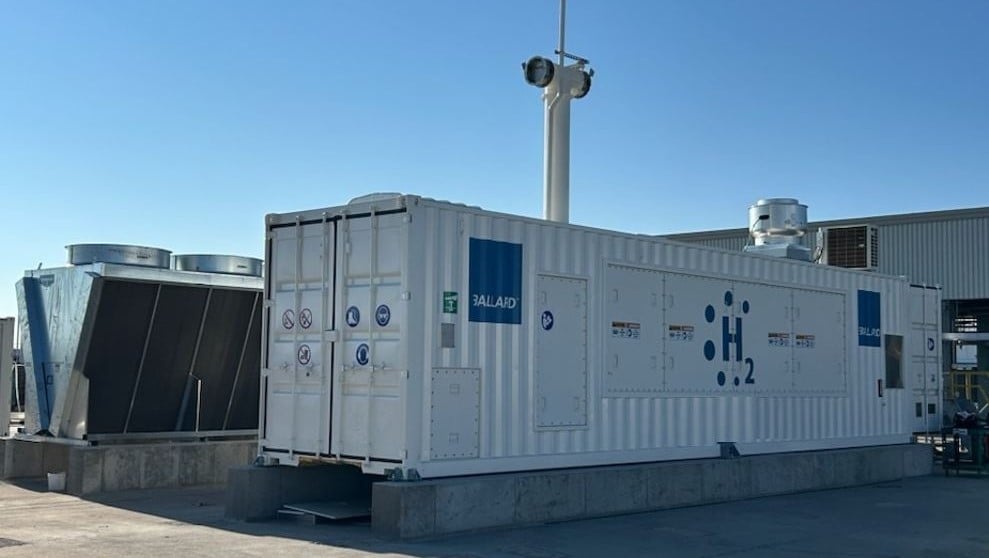
Ballard Power Systems demonstrates its containerized 200 kW fuel cell solution for stationary and marine applications, showcasing the integrated hydrogen power technology central to its expansion into full hydrogen ecosystem solutions via the GeoPura acquisition.
How Does This Fit the Broader Hydrogen Investment Picture?
This deal lands amid a wave of hydrogen sector consolidation and capital raising. Companies across the value chain, from Chevron's dual hydrogen projects in Texas and California to HyAxiom's 150 million dollar private placement, are betting on stationary and industrial power as the near-term growth path, rather than passenger vehicles. Bloom Energy's rollout of its Series 10 fuel cell offering reflects the same shift toward flexible, contract-based power products for data centers and commercial customers.
GeoPura Chairman Lord Richard Harrington, the former UK Business and Industry Minister who now also chairs Make UK, called the deal proof that Ballard trusts British manufacturing enough to bet on it. He framed the acquisition as validation for GeoPura's UK production base and its Siemens Energy manufacturing partnership, technology he expects to now scale internationally.
Frequently Asked Questions
How much did Ballard pay for GeoPura?
The total transaction enterprise value is 301.1 million pounds, approximately 400 million U.S. dollars, including 275 million pounds in upfront consideration and up to 27.5 million pounds in future milestone payments.
Why did Ballard buy a power company instead of just supplying fuel cells?
Owning production, logistics, and the generators lets Ballard capture more revenue per megawatt and build recurring income, instead of a single equipment sale.
When does the deal close?
The transaction is expected to close in the second half of 2026, pending UK National Security and Investment Act clearance and Toronto Stock Exchange approval for the new share issuance.
Ballard's board sees GeoPura's blue-chip customer base and its own fuel cell expertise as a combination worth the dilution. Whether that pays off comes down to execution over the next two years, as the company works toward its 2028 profitability target with a business model it hasn't run before.
For ongoing coverage of carbon removal, BECCS, and corporate CDR procurement, subscribe to Decarbonfuse.com.
Subscribe to the newsletter
Daily decarbonization data and news delivered to your inbox
Follow the money flow of climate, technology, and energy investments to uncover new opportunities and jobs.
Latest issues
-
Why Is Wyoming Giving 650,000 Acres to Carbon Storage?
Inside This Issue 🪨 Inside Blm's 650,000-Acre Bet on Wyoming Carbon Storage 🏭 California Advances Carbon Capture and Removal Regulations Under SB 905 ⚡ Why a Japanese Power Giant Is Betting on Den...
-
Colorado Joins the 7-State CCS Permit Fast Lane
Inside This Issue ⚖️ Colorado Takes Over Class VI Permits: What Changes for CCS? 🏭 Hebei Shoulang Facility Using LanzaTech Technology Achieves World’s First ISCC EU RCF Certification for Ethanol P...
-
The US Hasn't Made Heavy Water Since 1982
Inside This Issue ⚛️ Aternium Completes FEED Studies for US Hydrogen, Heavy Water Project 🐄 Google, McKinsey Strike Brazil Carbon Removal Deal With Silvopasture Project 🔧 Cummins Selects Stargate ...
Company Announcements
-
Citi Closes $72 Million Carbon Removal-Linked Note to Support Applied Carbon Biochar Project
HIGHLIGHTS Citi structured an innovative $72 million carbon removal-linked note to provide upfront capital for Applied Carbon's biochar project, marking a first-of-its-kind "outcome bond" for ver...
-
New platform opens access to the same rigorous project evaluations trusted by the world's leading carbon removal procurement programs Today, Relae (formerly Carbon Direct) launched The Diligence C...
-
Inside BLM's 650,000-Acre Bet on Wyoming Carbon Storage
The Bureau of Land Management has offered right-of-way grants covering about 649,438 acres of federal pore space in southwest Wyoming. The September 21, 2026 offers went to Moxa Carbon Storage LLC ...
-
NEW YORK, BUSINESS WIRE, SWITCH Maritime (Switch), a leading developer of zero-emission vessels, secured a Design Basis Agreement (DBA) with the United States Coast Guard (USCG) for the SWITCH-150,...