
Capture6 has launched Project Tortuga near Perth, Western Australia, to test whether desalination brine can lower the cost of direct air capture. Eight containerized units now turn waste brine into freshwater and a CO2-absorbing solvent. The data will shape Project Monarch, its integrated facility with Palmdale Water District in Southern California.
Most direct air capture (DAC) plants rely on carbon credit sales to cover their costs. Tortuga tests a model that could also earn value from freshwater, avoided brine disposal, and chemical co-products.
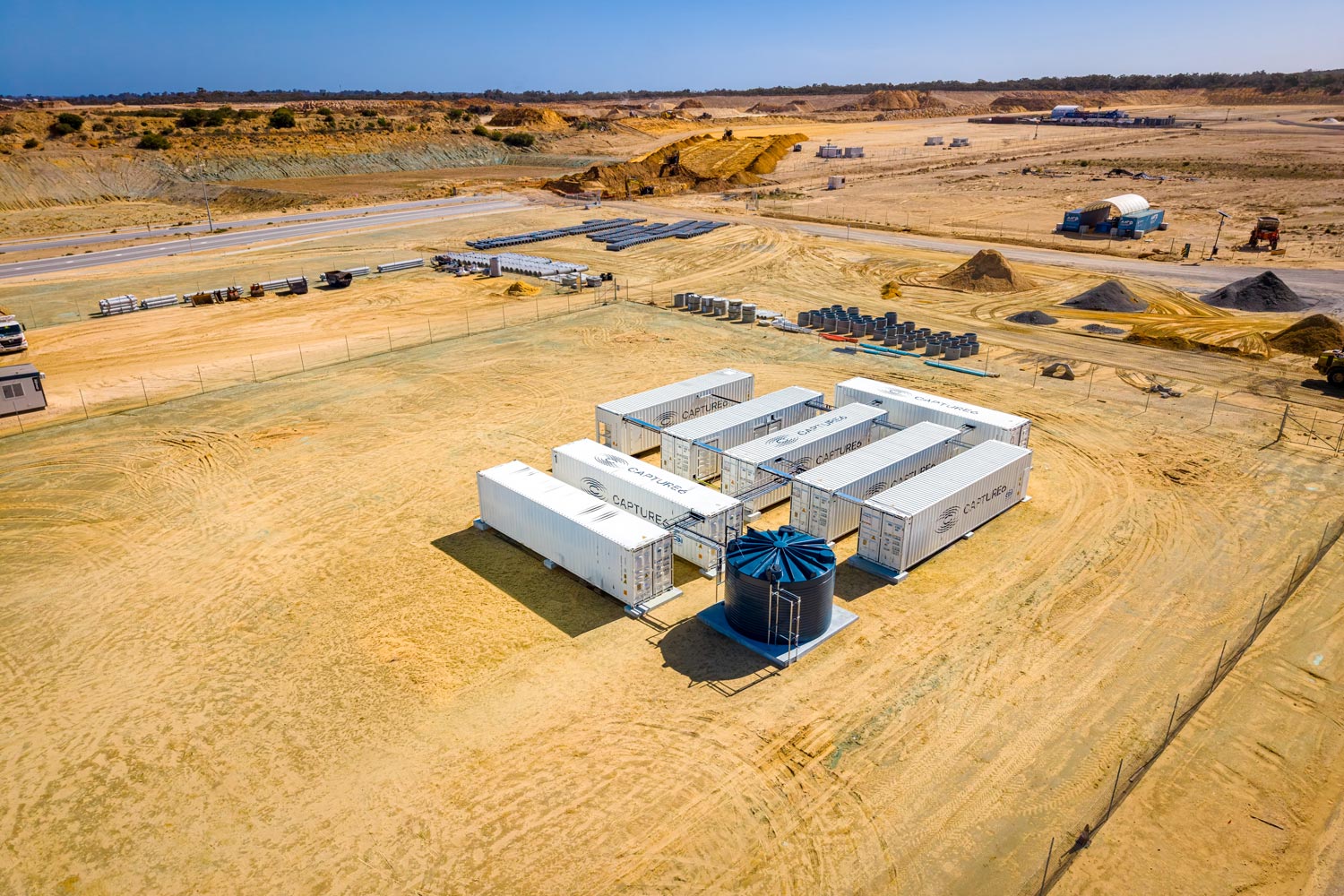
Project Tortuga's eight containerized units run Capture6's integrated water recovery and carbon removal process under live operating conditions near Perth.
What Is Capture6's Project Tortuga?
Capture6 formally launched Project Tortuga on October 12, 2026, according to the company's launch announcement. The site runs eight containerized units as one connected system at the Australian Automation and Robotics Precinct near Perth.
Capture6 is a public benefit corporation based in California's San Francisco Bay Area and New Zealand. Its September 14, 2026 update confirmed Tortuga was already operating before the formal launch. CB&I, the engineering and construction firm, is the project's lead partner.
Tortuga is Phase 1 of Project Wallaby, Capture6's Western Australian program developed through a joint development agreement with Pilot Energy. Pilot Energy won a A$6.5 million grant for the Capture6 pilot through Australia's Carbon Capture Technologies Program in July 2024.
Every unit runs on commercially available equipment. That means scaling up comes down to adding more containers, not redesigning the plant.
Key Facts
- Launch: Capture6 formally launched Project Tortuga on October 12, 2026 (Capture6 launch announcement).
- Scale: 8 containerized units operate as one integrated system near Perth (Capture6, September 2026).
- Water context: Perth's dams averaged 420 billion liters of streamflow a year before the mid-1970s, down about 80% since (WA Government, 2022).
- National potential: Capture6 estimates Australia produces up to 950 gigaliters of brine a year, which could support up to 470 gigaliters of freshwater and 15 million metric tonnes of CO2 removal annually. These are company estimates, not Tortuga's output.
- US link: Project Monarch treats about 0.68 million gallons (roughly 2.6 million liters) of brine per day at Palmdale Water District (Capture6).
- Savings: Palmdale's full-scale project could save up to 40% in lifetime costs and avoid up to 100 acres of brine ponds (Capture6 and Palmdale Water District).
- Monarch Phase 2 targets: 25,000 tonnes of CO2 removal and 400,000 cubic meters of freshwater a year (Capture6).
- Funding: Capture6 closed a $27.5 million Series A in March 2025, led by Tetrad Corp.
>> In Other News: [x](x)
Why Test Brine-Based Carbon Removal in Perth?
Perth's dams averaged 420 billion liters of streamflow a year before the mid-1970s, according to the Western Australian Government. Lower rainfall has since cut that streamflow by about 80 percent.
Water Corporation, the state's water utility, now relies on climate-independent sources like seawater desalination. Its Kwinana and Binningup desalination plants can supply up to half of Perth's drinking water.
Desalination works, but it leaves behind concentrated brine. That brine is the exact feedstock Capture6's process is built to use.

"Climate change is creating water insecurity for much of the world's population, driving up demand for freshwater worldwide, and exacerbating the root problem as current methods of water treatment are carbon intensive."
Ethan Cohen-Cole, CEO and Co-Founder, Capture6
Ethan Cohen-Cole made that point when Capture6 closed its Series A in March 2025. Tortuga puts that idea to work in a city already leaning on desalination.
>> RELATED: Capture6 Secures $27.5 Million to Scale Carbon Removal and Water Recovery
How Is Capture6 Different from Conventional Direct Air Capture?
Capture6 turns waste brine into its own carbon capture solvent, so it doesn't need a separate CO2 release step. The captured carbon ends up as a stable mineral.
According to Capture6, brine first passes through nanofiltration, ion exchange, and reverse osmosis. Electrodialysis with bipolar membranes then splits the salt into sodium hydroxide and hydrochloric acid. The sodium hydroxide reacts with CO2 in the air to form sodium carbonate.

Capture6's process recovers freshwater from brine and uses the same salt to make the solvent that captures CO2 from the air.
Conventional DAC works differently. Climeworks uses solid sorbents, while 1PointFive's Stratos facility in Texas uses a liquid solvent. Both use heat to release concentrated CO2 for underground storage.
| Feature | Conventional DAC (Climeworks, 1PointFive) | Capture6 (Brine-Integrated) |
|---|---|---|
| Inputs | Ambient air and energy | Ambient air, saline brine, and energy |
| Capture medium | Solid sorbent or liquid solvent, regenerated with heat | Sodium hydroxide made from brine, used once |
| CO2 end state | Concentrated gas sent to geological storage | Mineralized carbonate |
| Potential revenue | Carbon removal credits | Credits, freshwater, avoided brine disposal, green chemicals |
| Siting | Dedicated facility near storage | Co-located with water treatment or desalination |
Revenue is the real difference. Corporate buyers like Microsoft have signed DAC credit deals to support standalone plants. Capture6 is betting that water value can carry part of that cost.
What Does Tortuga Still Need to Prove?
Tortuga's main job is producing the operating data that buyers, investors, and partners need. That includes water treatment performance, energy use, product quality, and system reliability.
Carbon removal and verified carbon credits aren't the same thing. Credits need measurement, independent verification, and lifecycle accounting. Capture6 signed with Isometric in July 2025 to certify credits from Project Wallaby under Isometric's Direct Air Capture Protocol.
"Partnering with Isometric is a key step toward bringing Capture6's Direct Air Capture credits to market. By applying Isometric's DAC Protocol to our Project Wallaby facility, we can ensure that every tonne of carbon dioxide we remove meets the highest standards of transparency and scientific rigor."
Ethan Cohen-Cole, CEO and Co-Founder, Capture6
Demand is already lined up. Respira announced plans to buy up to 50,000 DAC credits from Capture6 in 2023. Rothschild & Co signed a multi-year removal purchase in November 2024.
How Does Tortuga Shape Project Monarch in California?
Capture6 says Tortuga's lessons feed directly into Project Monarch, which uses the same technology. Monarch sits inside Palmdale Water District's Pure Water Antelope Valley demonstration facility, north of Los Angeles.
The purification plant produces about 0.68 million gallons of brine a day, according to Capture6. That's roughly 2.6 million liters that would otherwise go to land-hungry evaporation ponds.
Palmdale expects the full-scale project to cut lifetime costs by up to 40 percent. It would also avoid up to 100 acres of brine ponds.
CNBC and industry coverage show how Capture6’s brine-integrated process at sites like Project Monarch recovers most of the water that would otherwise be wasted while mineralizing CO₂ and cutting brine management costs.
Palmdale's Scott Rogers told CNBC in June 2025 that the system recovers 94 to 98 percent of water that would normally be wasted. In May 2026, Capture6 secured project financing from RSF and iBank for Monarch Phase 2.
That phase targets 25,000 tonnes of CO2 removal and 400,000 cubic meters of freshwater a year. For North America, Monarch is where Tortuga's data turns into commercial operations.
How Big Is the Brine Opportunity?
Capture6 estimates Australia generates up to 950 gigaliters of brine every year. In a full-treatment scenario, that could yield up to 470 gigaliters of extra freshwater annually.
The same scenario points to as much as 15 million metric tonnes of CO2 removal a year. These are theoretical company figures, not Tortuga's current output.
Capture6's pipeline also includes a desalination project with K-water and BKT Water in South Korea. It's advancing plans with an industrial partner in the US Midwest and sites across the Gulf region.
The company's $27.5 million Series A backs that pipeline. Tetrad Corp. led the round, joined by Hyundai Motor Group's ZER01NE Ventures, Energy Capital Ventures, and Elemental Impact.
Other developers are scaling too. Heirloom is building two DAC facilities in Louisiana, and Canada has drafted a federal offset protocol for DAC with storage.
Frequently Asked Questions
Is Project Tortuga generating carbon credits yet?
Tortuga is a demonstration that collects operating data. Capture6 has partnered with Isometric to certify credits from Project Wallaby, and that process needs measured, verified removal data.
What will Project Monarch deliver at scale?
Monarch Phase 2 targets 25,000 tonnes of CO2 removal and 400,000 cubic meters of freshwater a year. Capture6 secured project financing for that phase in May 2026.
What does Capture6 produce besides carbon removal?
The process recovers freshwater from brine. It also produces green chemicals, including hydrochloric acid and carbonates that water facilities can use.
Perth Writes the Playbook, Palmdale Puts It to Work
Tortuga's eight units are now building the performance record that brine-based DAC needs. If that record holds, Monarch's 2.6 million liters of daily brine could become a North American template for water utilities everywhere.
For ongoing coverage of carbon removal, BECCS, and corporate CDR procurement, subscribe to Decarbonfuse.com.
Subscribe to the newsletter
Daily decarbonization data and news delivered to your inbox
Follow the money flow of climate, technology, and energy investments to uncover new opportunities and jobs.
Latest issues
-
Why Colorado’s Koloma Has Japan’s Largest Utility Hooked
Inside This Issue ⚡ JERA Invests in Koloma to Explore Natural Hydrogen as a Future Low-Carbon Energy 🔬 New CATF Tool Provides Framework for Self-Assessment and Strengthening of Biomass Carbon Remo...
-
LNK Energies Targets $6.50 Hydrogen With No Federal Subsidies
Inside This Issue 🚛 MIT Startup Says It Can Turn Diesel Trucks Into Cheaper Hydrogen Haulers, See It at Disrupt 🏭 Baytown City Council Briefs: ExxonMobil Blue Hydrogen Agreement Approved 🌎 Colorad...
-
Why Gulf Coast CCS Teams Are Watching Liverpool Bay
Inside This Issue 💂 Eni’s Douglas Platform Sets the Offshore CCS Blueprint 🌲 Pacolet Milliken Expands Its Biomass Platform With the Acquisition of Georgia Renewable Power 🧪 Metacon Receives EU Fun...
Company Announcements
-
A new interactive tool from Clean Air Task Force (CATF) provides a practical framework for the self-assessment and strengthening of biomass carbon removal (BiCRS) protocols to help ensure that carb...
-
LanzaJet Secures Financing to Scale SAF Production and Supply Global Customers
CHICAGO, Oct. 15, 2026 (GLOBE NEWSWIRE) -- LanzaJet, Inc., a leading next-gen fuels technology company and fuels producer, today announced fully committed new financing of at least $20 million to s...
-
44.01 and Frontier Advance Permanent CO₂ Storage Through In-Situ Mineralization
44.01's in-situ mineralization (ISM) process turns CO₂ into solid rock underground in a few years, after which the risk of reversal is functionally zero. >> In Other News: JERA Invests in ...
-
JERA Invests in Koloma to Explore Natural Hydrogen as a Future Low-Carbon Energy
JERA Co., Inc. (JERA), through its corporate venture capital arm JERA Ventures, has invested in Koloma, Inc. (Koloma), a U.S.-based natural hydrogen exploration and development company. The invest...