
Cardinal Glass Industries has committed to what it describes as the world's first carbon capture installation at a float glass manufacturing facility. Working with Italian technology firm K2-CO2, Cardinal plans to capture approximately 130,000 metric tons of CO2 per year at its Winlock, Washington, plant.
That is equivalent to the carbon sequestered by planting approximately 1.6 million trees and growing them for a decade, according to Cardinal Glass Industries. Operations are planned for Q1 2029. Purchase orders and deposits on critical long-lead equipment are already placed.
Key Facts
- Location: Cardinal FG float glass facility, Winlock, Washington
- Projected CO2 capture: approximately 130,000 metric tons per year (Cardinal Glass Industries, August 10, 2026)
- Capture rate: up to 95% of CO2 from targeted float glass process streams
- Technology partner: K2-CO2, Padova, Italy. Hot Potassium Carbonate process.
- Target operations date: Q1 2029
- Government funding: the project is not currently receiving government funding (Cardinal Glass Industries, August 10, 2026)
- Project status: feasibility, design, and engineering complete. Purchase orders and deposits placed on critical and long-lead items.
>> In Other News: China Targets 440 Million Tonnes of Oil, Gas Supply by 2030
Why Is Float Glass So Hard to Decarbonize?
Float glass sits in one of manufacturing's toughest decarbonization spots. The process must run continuously at extremely high temperatures. It also generates CO2 from two separate sources at the same time.
The first source is energy. Furnaces require intense heat to melt raw materials.
The second source is the raw materials themselves. Carbonates in the batch decompose during melting and release CO2 no matter what fuel powers the furnace. You cannot solve that second source with electrification or fuel switching alone.
That dual-source challenge explains why float glass has received far less CCS developer attention than cement, steel, refining, or power generation. K2-CO2's approach addresses both sources. Its Hot Potassium Carbonate process strips CO2 from flue gas. The system is engineered to draw all heating and cooling from the flue gas stream itself, without external heat input.
"Cardinal has always approached environmental performance as an engineering discipline, not simply as an aspiration. With the feasibility, design and engineering phases now complete, we are moving toward installation of this carbon capture system at our Winlock facility. This is an important milestone for Cardinal, for our customers, and for the future of lower-carbon float glass manufacturing worldwide."
Kelly Busch, President, Cardinal FG
Cardinal and K2-CO2 have also jointly patented a system that enables use of additional gases from the resulting flue gas. That adds further value to the captured stream beyond the CO2 itself.

Cardinal FG's Winlock, Washington, facility is the planned site of the world's first carbon capture installation at a float glass manufacturing plant. The photograph shows the existing facility and does not show installed carbon capture equipment.
Credit: Courtesy of Cardinal Glass Industries.
How Does the K2-CO2 System Work?
K2-CO2 is a carbon capture specialist based in Padova, Italy. The company focuses on high-volume industrial environments where conventional capture approaches are hard to integrate. Its core technology is the Hot Potassium Carbonate process. This is licensed from Giammarco Technologies, a Venice-based provider active since the 1950s with more than 400 HPC references worldwide.
The system absorbs CO2 from flue gas using a potassium carbonate solvent. The CO2-loaded solvent passes through a stripping column for separation. The solvent is then recirculated. The captured CO2-rich gas moves on for use or storage. Because the system draws its energy from the flue gas itself, it avoids the steam penalty that makes conventional amine-based capture expensive for industrial facilities.
Cardinal confirmed that controls and measurement instruments are being integrated into the operating facility to monitor system performance continuously. Cardinal has also achieved minor-source status for regulated emissions across much of its float glass network. That establishes an existing baseline of emissions discipline that the Winlock project builds on directly.
K2-CO2’s Hot Potassium Carbonate system is engineered for high-volume industrial flue gas streams like those from float glass furnaces, targeting high capture rates without external heat input.
What Does Winlock Mean for the Glass Industry?
Cardinal describes Winlock as the first project in a broader roadmap. Once operating, Cardinal plans to use its performance data to evaluate deployment across additional float glass lines. That roadmap depends entirely on what Winlock proves at commercial scale. Bowie Neumayer, President of Cardinal Glass Industries, framed the stakes directly.
"This is not a one-time announcement; it is part of a broader roadmap. The Winlock project gives us a defined first installation, a concrete operations target and the opportunity to generate the performance data needed to evaluate future deployment across additional float glass lines."
Bowie Neumayer, President, Cardinal Glass Industries
That replication argument is what separates Winlock from a simple demonstration project. The IEA has reported that more than half of new CCS projects expected to be operational by 2030 are now in hard-to-abate industrial sectors. Float glass had not been among them until now.
The global flat glass market spans dozens of large-scale float facilities in North America, Europe, and Asia. A verified capture rate of 130,000 metric tons of CO2 per year at one plant makes the technology available for evaluation everywhere else. That is the commercial prize Winlock is positioned to unlock.
>> RELATED: Steel and Cement Just Became the Carbon Capture Story
Can the Economics Work Without Federal Funding?
Cardinal confirmed that Winlock is not currently receiving government funding. That matters because it tests whether certain hard-to-abate industrial CCS investments can proceed on commercial and regulatory economics alone, without depending on federal grants.
Several factors could support the business case. The federal 45Q tax credit was maintained at up to $85 per metric ton for qualifying industrial point-source capture. It was preserved under the One Big Beautiful Bill Act, signed July 4, 2025. The credit is also transferable. That provision benefits first-of-kind projects by letting developers sell credits to investors who can use them.
Washington state's Cap-and-Invest program also creates direct financial pressure. The program requires large industrial emitters to hold allowances for their emissions. Reducing CO2 output at Winlock directly lowers Cardinal's compliance cost exposure.
In March 2026, Washington released a draft linkage agreement with the Western Climate Initiative. That agreement would connect the state's market with California and Quebec, potentially stabilizing and increasing allowance values over time.
Cardinal says it is exploring potential future markets for the captured CO2. Whether that means geologic carbon storage, utilization, or sale to third parties remains unconfirmed. That decision will affect both the project's climate accounting and its eligibility for the 45Q credit.
| Potential Revenue or Value Driver | Status at Winlock | Notes |
|---|---|---|
| Federal 45Q tax credit (up to $85 per metric ton) | Not confirmed. Depends on CO2 disposition pathway. | Maximum theoretical value: approx. $11 million per year at 130,000 metric tons |
| Washington Cap-and-Invest avoided compliance cost | Applicable to covered industrial emitters in Washington state | Reduces direct carbon compliance cost for Cardinal FG at Winlock |
| Captured CO2 markets (utilization or geologic storage) | Under exploration (Cardinal Glass Industries, August 2026) | No pathway confirmed. Outcome affects 45Q eligibility and climate accounting. |
| Lower embodied carbon glass premium | Expected once system operates and performance is validated | Supports green building procurement and lower-embodied-carbon project specifications |
What Is the Downstream Value for Building Products?
Cardinal points to a product benefit that extends beyond the captured CO2. Once the system operates and performance is validated, the reduction in Cardinal float glass embodied carbon should help customers meet lower-embodied-carbon building requirements.
This matters because embodied carbon in building materials is now an active focus of green building standards across North America. Glass is a significant component of modern building envelopes. Lower-embodied-carbon glass can contribute directly to LEED credits and whole-life-carbon requirements that architects and developers are increasingly specifying.
Cardinal's customer base includes OEM window and door manufacturers, builders, and design partners who are already navigating embodied carbon reporting. A verified reduction in Cardinal float glass embodied carbon would give those customers a measurable, documentable product advantage. The broader industrial CCS buildout has concentrated on cement, steel, refining, and chemicals. Float glass has been largely absent. Winlock is the first serious attempt to change that.
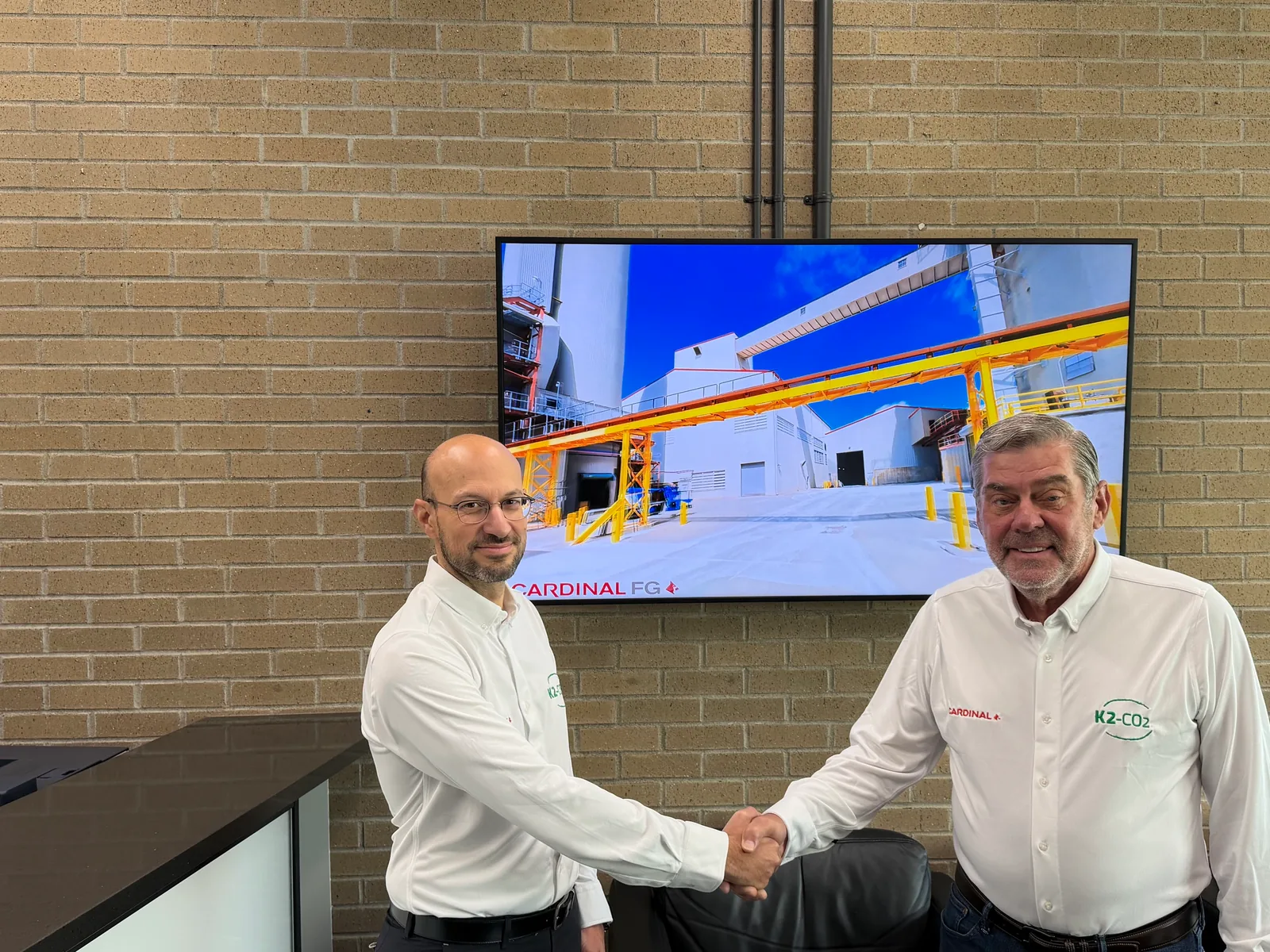
Alessandro Monteforte, CEO of K2-CO2 (left), and Kelly Busch, President of Cardinal FG, mark Cardinal's commitment to the Winlock carbon capture installation.
Credit: Courtesy of Cardinal Glass Industries.
What Milestones Decide Whether Winlock Scales?
Cardinal expects to provide updates as installation, commissioning, and validation milestones are reached between now and Q1 2029. Three questions will largely determine whether the technology moves beyond a single facility.
Capture Performance
The 95% CO2 removal rate from targeted process streams is a design target. Real-world operation of a continuously running float glass furnace introduces variables that must be managed and verified over time. Consistent performance data from Winlock is what makes replication credible.
CO2 Disposition
Where the captured CO2 ultimately goes affects both the project's climate accounting and its economics. Cardinal is currently exploring options. A confirmed pathway before or shortly after commissioning would significantly clarify the business case for future installations.
Replication Cost
The engineering, integration, and controls work developed for Winlock will directly shape the cost of deploying the same system at a second or third facility. Repeatable installation costs are what converts a first-of-kind project into an industry model.
Alessandro Monteforte, CEO of K2-CO2, stated what the two companies are trying to demonstrate.

"This program builds on years of work between Cardinal and K2-CO2 to evaluate, engineer and adapt carbon capture technology for float glass manufacturing. The Winlock installation will be an important demonstration of how carbon capture can be integrated into one of the most demanding industrial manufacturing environments."
Alessandro Monteforte, CEO, K2-CO2
The U.S. carbon capture sector now includes more than 270 publicly announced projects representing $77.5 billion in capital investment (2025). Almost none of that investment targets glass manufacturing. Winlock's planned 130,000 metric tons of annual capture is not large by the standards of major industrial CCS projects. But scale is not the point.
The test is whether this first-of-kind installation can generate the operating evidence needed to convert a single retrofit into a repeatable model. It would be the first time hard-to-abate manufacturing beyond the usual four sectors gets a proven CCS template to follow.
Frequently Asked Questions
Why has carbon capture not been applied to float glass manufacturing before?
Float glass furnaces run continuously at very high temperatures and cannot be stopped for integration work without disrupting production. Emissions come from two sources simultaneously: energy combustion and the decomposition of raw materials during melting. That combination made conventional CCS approaches difficult to adapt. The sector has received far less developer attention than cement, steel, or power generation as a result.
Is 130,000 metric tons per year a meaningful scale for industrial CCS?
It is meaningful as a commercial-scale proof point for a sector with no existing CCS infrastructure. Larger projects in cement, steel, and chemicals capture more. But Winlock's importance is not its raw tonnage. It is the operating data, the validated integration engineering, and the replication potential it creates for every other float glass facility worldwide.
What happens to the CO2 captured at the Winlock facility?
Cardinal says it is exploring potential future markets for the captured CO2, as stated in the August 10, 2026, press release. No permanent storage site or utilization pathway has been publicly confirmed. The CO2 disposition decision will affect the project's climate accounting and its eligibility for the federal 45Q tax credit.
The core question is not simply whether Cardinal can capture 130,000 metric tons of CO2 annually at one Washington plant. It is whether the performance data from Winlock are strong enough to convert a first installation into a repeatable model for float glass globally. Everything between now and Q1 2029 will contribute to that answer.
For ongoing coverage of industrial carbon capture, hard-to-abate sectors, and the global CCS buildout, subscribe to Decarbonfuse.com.
Subscribe to the newsletter
Daily decarbonization data and news delivered to your inbox
Follow the money flow of climate, technology, and energy investments to uncover new opportunities and jobs.
Latest issues
-
113 CCS Projects: What's Driving the Surge?
Inside This Issue 🏭 Global CCS Hits 113 Projects as Americas Lead Capacity 💰 We're Moving $2M+ to Climate Solutions 💧 China Launches World's First Semi-submersible Offshore Wind-to-hydrogen Platfo...
-
Why Is Wyoming Giving 650,000 Acres to Carbon Storage?
Inside This Issue 🪨 Inside Blm's 650,000-Acre Bet on Wyoming Carbon Storage 🏭 California Advances Carbon Capture and Removal Regulations Under SB 905 ⚡ Why a Japanese Power Giant Is Betting on Den...
-
Colorado Joins the 7-State CCS Permit Fast Lane
Inside This Issue ⚖️ Colorado Takes Over Class VI Permits: What Changes for CCS? 🏭 Hebei Shoulang Facility Using LanzaTech Technology Achieves World’s First ISCC EU RCF Certification for Ethanol P...
Company Announcements
-
China Launches World's First Semi-Submersible Offshore Wind-to-Hydrogen Platform
The world's first semi-submersible offshore wind-to-hydrogen platform has floated in Jiangmen, south China's Guangdong Province, opening a new avenue for the development and utilization of clean ma...
-
We’re Moving $2M+ to Climate Solutions
New companies, new ways to back existing ones, and every purchase built to pull in more capital We’re adding new companies to our portfolio and getting creative with how we put more money behind e...
-
Citi Closes $72 Million Carbon Removal-Linked Note to Support Applied Carbon Biochar Project
HIGHLIGHTS Citi structured an innovative $72 million carbon removal-linked note to provide upfront capital for Applied Carbon's biochar project, marking a first-of-its-kind "outcome bond" for ver...
-
New platform opens access to the same rigorous project evaluations trusted by the world's leading carbon removal procurement programs Today, Relae (formerly Carbon Direct) launched The Diligence C...