
A photocatalyst has been created that can turn plastic waste into hydrogen and value-added chemicals. Moreover, the reaction repurposes car battery acid, creating a synergistic, sustainable strategy to recycle polymers like polyurethane, polyethylene-terephthalate (PET) and nylon.
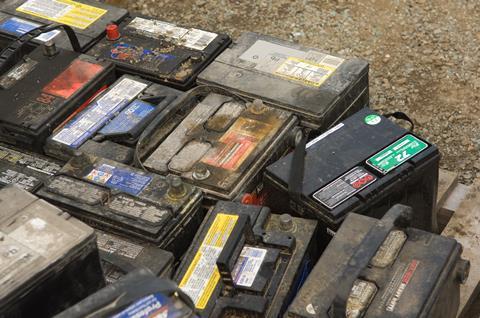
Source: © Jupiterimages/Getty Images
The acid from old car batteries could still find a use helping to recycle plastics
Solar reforming is an emerging technology to transform waste products, such as plastics, into clean chemicals using sunlight, explains lead author Erwin Reisner from the Yusuf Hamied chemistry department and St John’s College at the University of Cambridge. Until now, breaking polymers into their basic building blocks presented a problem. ‘The depolymerisation process currently relies on unsustainable alkaline conditions or slow enzymatic degradation,’ explains Reisner. However, this new molybdenum–cobalt photocatalyst is stable in acid, which improves the performance over past approaches.
Moreover, it makes waste valorisation versatile. Whereas previous photoreforming focused on PET, this process expands the scope to other condensation polymers, including polyurethane and nylon. ‘Plastics are a precious resource, which contain key building blocks to build molecules,’ says Reisner. ‘We want to unlock this … to access the circular production of clean chemicals for a defossilised industry.’
‘PET, polyurethane and nylon are common plastics in packaging, coatings and textiles, respectively,’ explains Alexandra Barth, an expert in photocatalysis at North Carolina State University in the US. But despite the ubiquity of plastics, approaches to recycling remain underused and plastic pollution is a persistent problem. Nowadays, ‘most material is non-selectively incinerated’, adds Barth. ‘Approaches to activate [plastics] for polymer recycling, chemical manufacturing and fuel production are highly desirable.’
>> In Other News: SunHydrogen Opens European Headquarters as Global Hydrogen Demand Accelerates
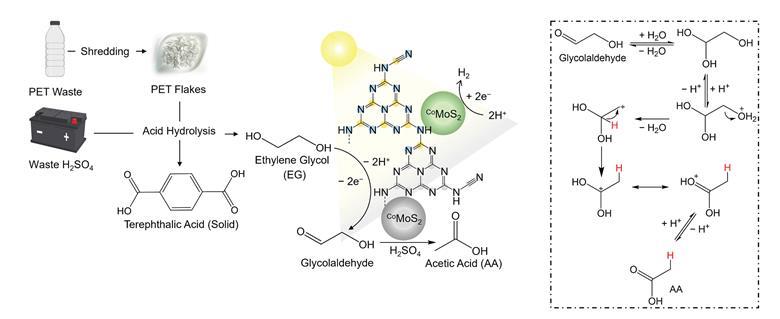
The process starts when battery acid is used to break down plastics such as PET into ethylene glycol. Light-activated oxidation of the ethylene glycol to glycolaldehyde then occurs. The proposed reaction pathway that the molybdenum-cobalt catalyst takes to convert glycolaldehyde into acetic acid is shown on the right
Source: © 2026 Papa K Kwarteng et al/Cell Press
The process starts when battery acid is used to break down plastics such as PET into ethylene glycol. Light-activated oxidation of the ethylene glycol to glycolaldehyde then occurs. The proposed reaction pathway that the molybdenum-cobalt catalyst takes to convert glycolaldehyde into acetic acid is shown on the right
In the study, researchers first use acidic depolymerisation to break plastics down into their constituent monomers. Then, they ‘transform these intermediates into high-value products, including hydrogen and acetic acid’, says Barth. The molybdenum–cobalt catalyst is interesting, because it’s based on abundant materials and driven by visible light, says Barth. ‘Using spent streams of battery acid [also] offers a valuable proof of concept.’ The cobalt catalyst tolerates contaminants and works with recycled sources of sulfuric acid, ‘which is advantageous’, she says.
Nevertheless, the method still has some issues. The process runs with concentrated acid, constant irradiation and temperatures around 140ºC making the process hazardous and energy intensive. Plus, until this approach is prepared to repurpose polyolefins like polyethylene and polypropylene, which make up most of the waste, its impact will be limited.
The team has also carried out technoeconomic analyses demonstrating critical creation of value, particularly with the production of feedstock chemicals. ‘We are currently investigating the use of hydrogen in fuel cells … and [have] established partnerships with plastic recyclers,’ he says. The team is patenting the process and exploring its potential ‘with the tech-transfer arm of the university, Cambridge Enterprise’. Reisner also co-founded Protonera, a University of Cambridge spin-out focused on solar reforming. He’s confident this plastic repurposing process holds ‘significant promise … to create valuable and circular chemicals products’.
References
P K Kwarteng et al, Joule, 2026, 10, 102347 (DOI: 10.1016/j.joule.2026.102347)
Subscribe to the newsletter
Daily decarbonization data and news delivered to your inbox
Follow the money flow of climate, technology, and energy investments to uncover new opportunities and jobs.
Latest issues
-
Why Is Wyoming Giving 650,000 Acres to Carbon Storage?
Inside This Issue 🪨 Inside Blm's 650,000-Acre Bet on Wyoming Carbon Storage 🏭 California Advances Carbon Capture and Removal Regulations Under SB 905 ⚡ Why a Japanese Power Giant Is Betting on Den...
-
Colorado Joins the 7-State CCS Permit Fast Lane
Inside This Issue ⚖️ Colorado Takes Over Class VI Permits: What Changes for CCS? 🏭 Hebei Shoulang Facility Using LanzaTech Technology Achieves World’s First ISCC EU RCF Certification for Ethanol P...
-
The US Hasn't Made Heavy Water Since 1982
Inside This Issue ⚛️ Aternium Completes FEED Studies for US Hydrogen, Heavy Water Project 🐄 Google, McKinsey Strike Brazil Carbon Removal Deal With Silvopasture Project 🔧 Cummins Selects Stargate ...
Company Announcements
-
Citi Closes $72 Million Carbon Removal-Linked Note to Support Applied Carbon Biochar Project
HIGHLIGHTS Citi structured an innovative $72 million carbon removal-linked note to provide upfront capital for Applied Carbon's biochar project, marking a first-of-its-kind "outcome bond" for ver...
-
New platform opens access to the same rigorous project evaluations trusted by the world's leading carbon removal procurement programs Today, Relae (formerly Carbon Direct) launched The Diligence C...
-
Inside BLM's 650,000-Acre Bet on Wyoming Carbon Storage
The Bureau of Land Management has offered right-of-way grants covering about 649,438 acres of federal pore space in southwest Wyoming. The September 21, 2026 offers went to Moxa Carbon Storage LLC ...
-
NEW YORK, BUSINESS WIRE, SWITCH Maritime (Switch), a leading developer of zero-emission vessels, secured a Design Basis Agreement (DBA) with the United States Coast Guard (USCG) for the SWITCH-150,...