
Langh Tech Debuts Onboard Carbon Capture System
Published by Todd Bush on November 28, 2024
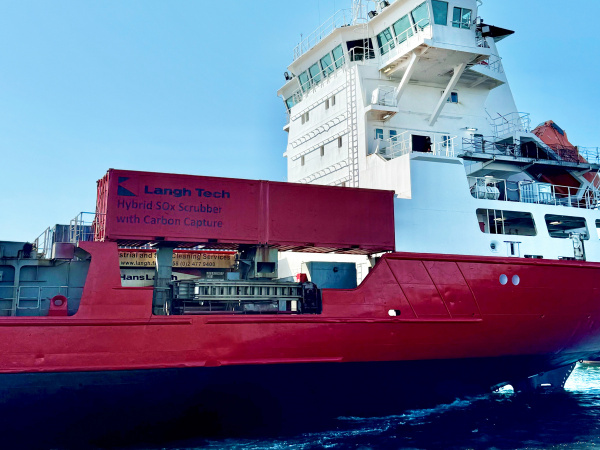
Finnish green tech company Langh Tech has launched a new system for onboard carbon capture (OCC), expanding its portfolio of exhaust gas treatment solutions for ships. The system will soon be installed on four bulk carriers.
Apart from reducing CO2 emissions from ship operations, the system offers the possibility to sell and utilize the sodium carbonate, which results at the end of the chemical process, for diverse applications in other industries.
Thus, Langh Tech said it combines the environmental benefits of decarbonization with creating additional value by selling and utilizing the waste product, making a contribution to creating a circular economy.
>> In Other News: The Climate Trust Partners with Burnett County, WI to Develop Carbon Project on 95,000 Acres of Forestland
As informed, a pilot project with an OCC installation onboard a ship operated by Lang Tech’s sister company Langh Ship was successfully run in test-mode during 2024. The pilot plant has shown that it is possible to capture rates over 80% from the exhaust gas flow coming into the system. The overall CO2 emissions can be reduced at least by 20 to 30%, depending on the available space, and other ship and product specifications.
The first commercial installations will take place early in 2025 onboard four bulk carriers, the company revealed.
Langh Tech has sold the OCC components to Dutch shipbuilding major Damen Shipyards Group, which will carry out the installation onboard the bulk carriers. The ships will be equipped with a hybrid scrubber and an additional onboard carbon capture system from Langh Tech.
"The decision to choose Langh Tech was simple. CO2 capturing is the only economic way to drastically reduce emissions as of now. My main concern was the value of the CO2 end product being created onboard the ship. Langh Tech delivered on every front: a high capture rate, a high-value CO2 end product, and a significant reduction in emissions. From a commercial perspective, it made perfect sense. On a personal note, we share the same vision and goal: to greenify the global fleet," Rutger van Dam, Business Development Manager of Damen Shipyards Group, explained.
The installations by Langh Tech are part of a project between Atal Solutions, BAM Shipping, and Damen Shipyards Group. The project aims at retrofitting ships with different technologies to reduce fuel consumption, achieving a maximum reduction in CO2, SOx, and NOx emissions while using traditional fuels.The ultimate project goal is to bring CO2 emissions down by up to 60% with onboard carbon capture. This could be achieved through the continuous development of the system itself, as well as optimizing other limiting factors, such as installation size and onboard space, ship efficiency, loading and operations, or voyage planning.
"This partnership with Damen Shipyard Group and Langh Tech showcases how innovative collaboration drives meaningful change. Atal’s vision and willingness to embrace bold solutions demonstrate how we can address the challenges of decarbonization while unlocking economic and environmental benefits for the maritime sector. By investing in Langh Tech’s onboard carbon capture technology, we’re not just setting a new benchmark for sustainable shipping—we’re also paving the way for future projects and ongoing transformation in the industry. It’s a big leap, but one that aligns with our shared commitment to building a more sustainable future," Edwin Sieswerda, Founder and CEO of Atal Solutions, said.
Carbon capture as a vital tool for decarbonizing shipping
Carbon capture is emerging as a key technology in the transition of shipping towards net zero as it provides a cost-effective addition to other decarbonization options. Langh Tech is said to be one of the first movers within the industry.
Already in 2021, the Finnish firm started researching the possibility of carbon capture onboard vessels.
"Our onboard carbon capture solution gives shipowners and operators the possibility to decarbonize and balance their costs. The scarcity and significantly higher costs of carbon-neutral fuels are a substantial hurdle to the decarbonisation of shipping. It will take time until those fuels can be widely used and afforded. We are here to bridge this gap and help companies to decarbonize efficiently and according to their abilities," Laura Langh-Lagerlöf, Commercial Director of Langh Tech, highlighted.
"At the same time, it is important to emphasize that the captured CO2 can also be used in the production of biofuels and synthetic fuels. Thus, our technology – if applied smartly – contributes to a green-fuel transition by setting up a circular economy."
Specifically, Langh Tech’s onboard carbon capture system uses a post-combustion technique. In short, the ship’s exhaust gases containing CO2 are directed into a capture unit. CO2 dissolves into the liquid phase through a counter-currently flowing aqueous NaOH solution. A maximized surface area ensures "the highest possible" carbon capture rates. As a result of several consecutive reactions, CO2 is chemically bound into a thermodynamically stable product of sodium carbonate.
Subscribe to the newsletter
Daily decarbonization data and news delivered to your inbox
Follow the money flow of climate, technology, and energy investments to uncover new opportunities and jobs.
Latest issues
-
Colorado Joins the 7-State CCS Permit Fast Lane
Inside This Issue ⚖️ Colorado Takes Over Class VI Permits: What Changes for CCS? 🏭 Hebei Shoulang Facility Using LanzaTech Technology Achieves World’s First ISCC EU RCF Certification for Ethanol P...
-
The US Hasn't Made Heavy Water Since 1982
Inside This Issue ⚛️ Aternium Completes FEED Studies for US Hydrogen, Heavy Water Project 🐄 Google, McKinsey Strike Brazil Carbon Removal Deal With Silvopasture Project 🔧 Cummins Selects Stargate ...
-
Why Colorado’s Koloma Has Japan’s Largest Utility Hooked
Inside This Issue ⚡ JERA Invests in Koloma to Explore Natural Hydrogen as a Future Low-Carbon Energy 🔬 New CATF Tool Provides Framework for Self-Assessment and Strengthening of Biomass Carbon Remo...
Company Announcements
-
Citi Closes $72 Million Carbon Removal-Linked Note to Support Applied Carbon Biochar Project
HIGHLIGHTS Citi structured an innovative $72 million carbon removal-linked note to provide upfront capital for Applied Carbon's biochar project, marking a first-of-its-kind "outcome bond" for ver...
-
New platform opens access to the same rigorous project evaluations trusted by the world's leading carbon removal procurement programs Today, Relae (formerly Carbon Direct) launched The Diligence C...
-
Inside BLM's 650,000-Acre Bet on Wyoming Carbon Storage
The Bureau of Land Management has offered right-of-way grants covering about 649,438 acres of federal pore space in southwest Wyoming. The September 21, 2026 offers went to Moxa Carbon Storage LLC ...
-
NEW YORK, BUSINESS WIRE, SWITCH Maritime (Switch), a leading developer of zero-emission vessels, secured a Design Basis Agreement (DBA) with the United States Coast Guard (USCG) for the SWITCH-150,...