
In the 1920s, the Hot and Arid Elk Hills West of Bakersfield Were Embroiled in the Teapot Dome Oil Lease Scandal That Ultimately Tarnished the Reputation of President Warren Harding. a Century Later, Controversy Over Another Energy Project Has Returned to the Region.
California’s first carbon capture and storage facility became operational in Kern County’s Elk Hills oil field in May, with the aim of eventually entombing millions of tons of carbon dioxide deep underground. The California Resources Corporation (https://www.crc.com/)'s Carbon TerraVault 1 could become the first of many such facilities proposed for the state, including the Bay Area, and is intended to play a major role in California’s goal of achieving carbon neutrality by 2045. But the project is also facing a lawsuit from local and environmental groups, who are charging the county with failing to address pollution, health and safety concerns before officials allowed the project to move forward.
>> In Other News: EKPO Stacks Power zepp.solutions’ New Generation of Stationary Energy Systems
Chris Gould, executive vice president and chief sustainability officer at CRC, the state’s largest oil and gas company, said in a statement that the technology is safe and that any spill or leak of carbon dioxide or air pollutants like nitrogen oxides would be “unacceptable.” Citing Gov. Gavin Newsom’s support and a Stanford University and Energy Futures Initiative report from 2020, Gould said that carbon capture and storage in California could reduce emissions in the state by as much as 15%.
“CCS has been safely used around the world for decades to capture CO2 and safely store it underground,” he said. (CRC issued a statement in lieu of granting SFGATE an interview with a company representative.)
Carbon TerraVault 1 centers on a pair of depleted oil and gas reservoirs in the Elk Hills field, where carbon dioxide is collected from a cryogenic gas plant and transported via pipelines to a nearby storage facility and shot some 6,000 feet underground through multiple high-pressure injection wells. Its current rate amounts to injecting 100,000 metric tons of carbon dioxide per year, the company says, while at its peak, the complex could sequester 750,000 metric tons per year. Though that’s a lot compared with carbon capture facilities built elsewhere, it would remove a small portion of California’s annual emissions of 360 million metric tons.
The below-ground cavern, which is a depleted oil reservoir, is capable of housing up to a total of 46 million metric tons over a lifetime of three decades. That’s about equal to the emissions of 400,000 (gas-guzzling) cars, according to the company’s figures. If that mark were achieved, TerraVault 1 would become one of the biggest carbon capture operations in the world.
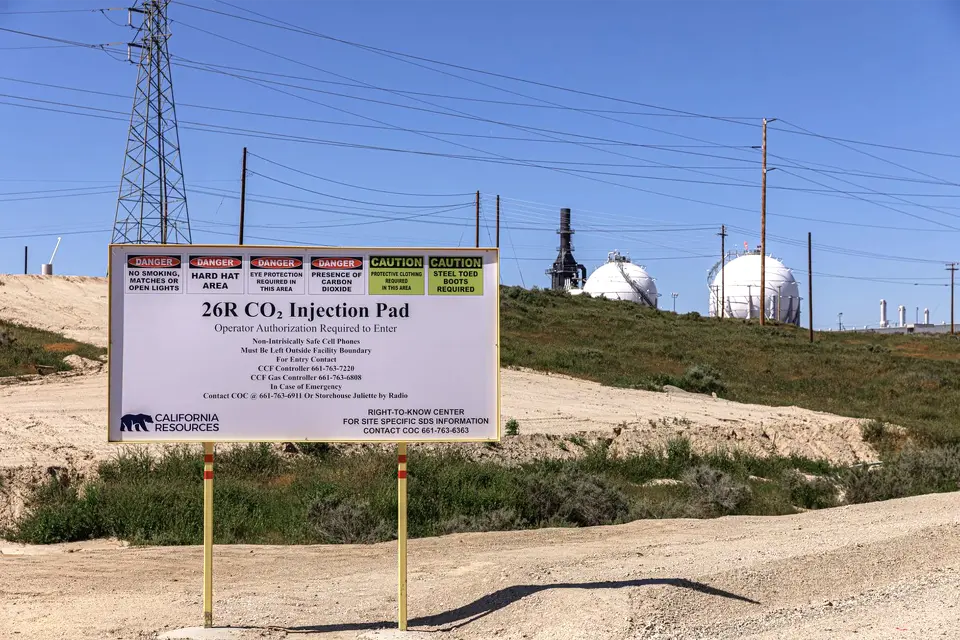
California Resources Corporation’s carbon dioxide injection site. Courtesy of CRC
Local Resistance
At the southern end of the San Joaquin Valley, Elk Hills and neighboring sites have long been some of the country’s most productive oil fields outside of Texas. They’re surrounded by small towns such as Taft, Shafter and Arvin, with largely low-income, Latino populations.
In some communities, public opinion about the project is mixed, especially in areas where livelihoods depend on oil and gas, Ileana Navarro, a community organizer and air quality specialist at the Central California Environmental Justice Network, told SFGATE. “Communities not working with the oil fields are predominantly opposed to it and know that with oil and gas comes respiratory issues and air pollution,” Navarro said.
Even if all the carbon dioxide is safely secured underground, locals have concerns about potential leaks of other pollutants such as soot, sulfur dioxide, nitrogen oxides and ozone, all of which can affect public health, says Michelle Ghafar, an attorney at Earthjustice (https://earthjustice.org/), a nonprofit environmental law organization. Recent studies have revealed that oil fields can be risky sites for carbon capture and storage, she points out, as the areas are pockmarked with holes, numerous decades-old wells that could release harmful gases.
“When you have high-pressure injection over the course of 30 years, in a part of California that has 8,000 pinholes coming out of the ground, and where there are a lot of earthquakes already, that risks wells leaking or collapsing,” Ghafar said.
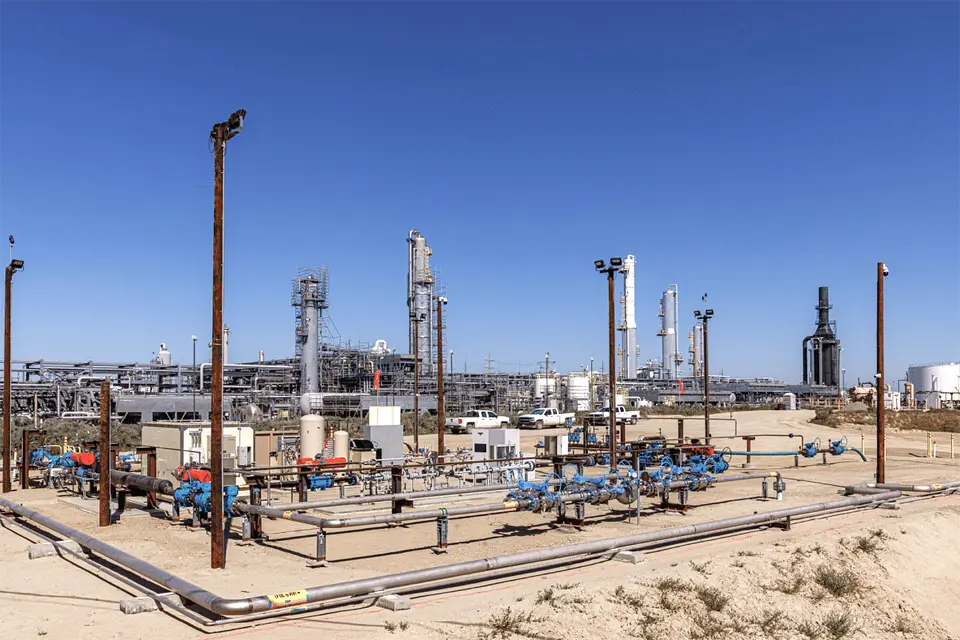
Capture facility and metering site for the Carbon TerraVault 1 project. Courtesy of CRC
In 2024, Earthjustice filed a lawsuit challenging the county’s approval of Carbon TerraVault 1, with the support of local advocacy groups such as the Committee for a Better Shafter, Delano Guardians and Comité Progreso de Lamont. David Pettit, an attorney at Center for Biological Diversity (https://www.biologicaldiversity.org/), which is also a plaintiff in the case, believes a lot’s at stake in the suit.
“This is the biggest carbon capture and storage project now in the books in California,” he said. “This could be a bellwether case that could lead the way for what’s going to happen for other projects like this.”
In their lawsuit, Pettit, Ghafar and their colleagues argue that the county’s analysis of the project was insufficient and didn’t comply with the California Environmental Quality Act, by producing an environmental impact report that didn’t properly consider a raft of potential impacts by TerraVault 1. These include “numerous significant and unavoidable impacts to air quality, greenhouse gases, energy use, local geology, pipeline safety, water supply, and biological resources, among other issues,” the filing states.
The groups argued their case at a Superior Court hearing in Bakersfield in June, and they expect a decision on the lawsuit within the next couple of months. If the judge decides in their favor and halts Carbon TerraVault 1, CRC could appeal.
Erin Briscoe-Clarke, a Kern County spokesperson, declined to comment on the litigation. “Environmental stewardship has guided every phase of the Carbon TerraVault I project,” she told SFGATE in an email. “The project underwent a thorough public review process, and in 2024, Kern County granted its approval after careful evaluation of all environmental considerations.”
Carbon TerraVault 1 aims to make a dent in carbon emissions from industrial sources, which make up some 22% of the state’s total emissions, second only to transportation. The facility is on track to store around 2 million metric tons of carbon dioxide, extracted from a cryogenic gas plant. Though that’s a small fraction of California’s emissions, CRC plans to build out its operations, inviting other carbon-emitting industries to set up their own facilities nearby, such as steel production, cement plants and hydrogen plants, all of which could potentially benefit from CRC’s carbon capture infrastructure.
California’s Carbon Capture Trend
Carbon TerraVault 1 is also part of a larger plan, as CRC pivots and expands beyond traditional oil and gas extraction, which remains the core of its business. The company is proposing at least six more Carbon TerraVaults in Kern County and elsewhere in California. Aera Energy (http://www.aeraenergy.com/), a subsidiary of CRC, is planning a carbon storage facility of its own in the Belridge oil field near Elk Hills. CRC is also expanding in other industries, proposing a 600,000-square-foot data center campus in Elk Hills.
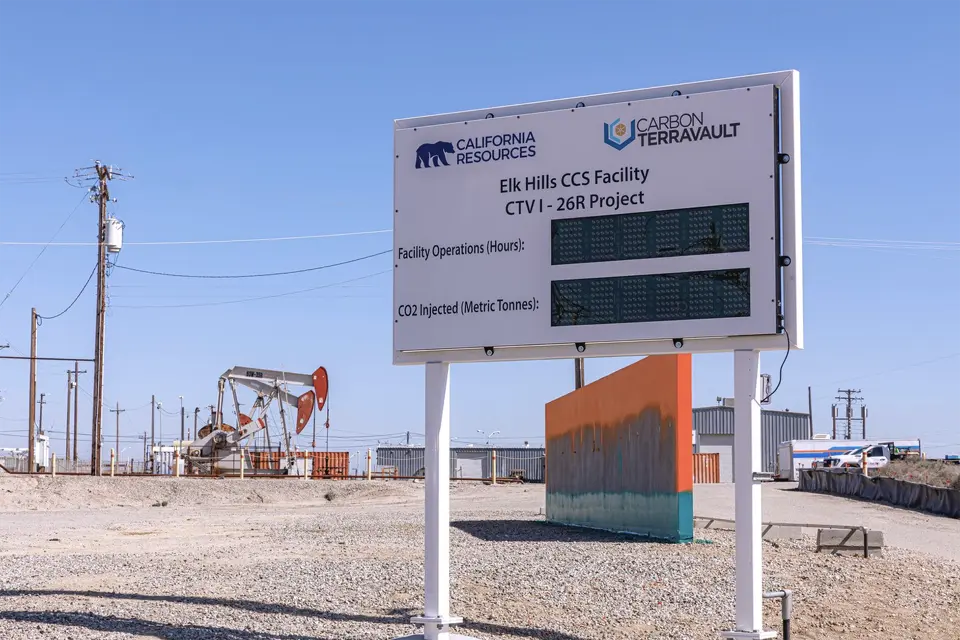
Outside the Carbon TerraVault 1 carbon capture and storage facility, which is now operational. Courtesy of CRC
CRC is just the largest and first mover in the state to push for carbon capture and storage infrastructure. Partly driven by tax credits and incentives first established by the Biden administration’s 2022 Inflation Reduction Act, other companies are exploring similar projects. In the Bay Area, Montezuma Carbon is planning a 40-mile pipeline that would submerge carbon dioxide in aquifers below the Montezuma Wetlands in Solano County.
California and other states previously instituted a moratorium on such projects following a burst pipeline filled with liquified carbon dioxide near Satartia, Mississippi, in 2020, which forced hundreds of people to evacuate. But last fall, Newsom signed a state Senate bill lifting the moratorium and paving the way for carbon capture projects and pipelines. At the time he said, “I’m signing this legislation to put our state on the leading edge of an emerging 21st Century industry that will not only help us address the climate crisis but create good paying, skilled jobs.”
Carbon TerraVault 1 is expected to create only 10 full-time jobs, according to Navarro; however, CRC told SFGATE there will be “approximately 100 positions that currently support CTV in some capacity.”
Another environmental group, Food & Water Watch (https://www.foodandwaterwatch.org/), criticizes carbon capture and storage while also proposing public health-friendly regulations, such as more transparency about exactly where pipelines are being built, adding an odorant to the carbon dioxide to make it more detectable, and providing monitors and air respirators to communities. But those protections were not adopted by the state, said Isabel Penman, the group’s Northern California organizer.
Penman is concerned that carbon capture and storage projects are examples of “greenwashing,” burnishing the image of carbon-emitting industries with environmentally friendly projects that ultimately don’t amount to much. It allows carbon-emitting business as usual to continue, ultimately making it an ineffective climate solution, she argues.
Subscribe to the newsletter
Daily decarbonization data and news delivered to your inbox
Follow the money flow of climate, technology, and energy investments to uncover new opportunities and jobs.
Latest issues
-
Verra Landed CCP Approval. What Changes for DAC?
Inside This Issue ✅ Verra's CCS Credits Just Got the Integrity Seal Buyers Want 💰 South Korea Unveils $747 Billion Energy Transition Plan Through 2035 💧 Hydrogen and Carbon Capture and Storage in ...
-
Quebec Wood Waste Just Became Jet Fuel
Inside This Issue 🌲 ARC Bio Tests a Refinery Shortcut to Forest-Based SAF 💧 Scientists Just Found a New Way to Make Hydrogen from Water 🤝 How Channel Partnerships Are Helping More Organizations Ta...
-
How Vaulted Deep Turned Offtakes Into $35M Debt
Inside This Issue 🏦 How Carbon Removal Offtakes Are Starting to Unlock Commercial Debt 🌉 California Opens the Door to a Three-Way Carbon Market 🧪 New Material Developed at Oregon State Provides Bo...
Company Announcements
-
Gevo and ClimeFi Complete Carbon Removal Transaction, Advancing Gevo's Growing Carbon Business
Transaction supports Gevo's path toward a carbon business exceeding $30 million in annual revenue from existing operations ENGLEWOOD, Colo., Oct. 08, 2026 (GLOBE NEWSWIRE) -- Gevo, Inc. (NASDAQ: G...
-
ZeroMe Launches OffsetC App to Bring Transparency and Personal Agency to Carbon Offsetting
NEW YORK, Oct. 07, 2026 (GLOBE NEWSWIRE) -- ZeroMe, Inc. today announced the launch of the OffsetC carbon offset app, designed to make buying carbon credits more transparent, more accessible, and e...
-
CALGARY, AB, Oct. 8, 2026 /CNW/ - Gas Liquids Engineering Ltd. (GLE) is pleased to announce the successful completion of its detailed engineering scope for Enhance Energy Inc.'s Origins Carbon Capt...
-
Ballard Secures 4.8MW Order From Siemens Mobility to Power Hydrogen Trains in Romania
24 FCrail™ fuel cell modules will power 12 Mireo Plus H trains, Romania’s first hydrogen fleet and the platform’s largest deployment to date. VANCOUVER, CANADA and MUNICH, GERMANY – Ballard Power ...