
Maersk, which controls around 14% of the global container shipping market, has been testing ethanol blends aboard its vessel Laura Maersk. The trials started in late 2025 with a 10% ethanol blend, moved to 50/50, and full 100% ethanol tests are next. If successful, this could open a massive new demand channel for North American corn ethanol.
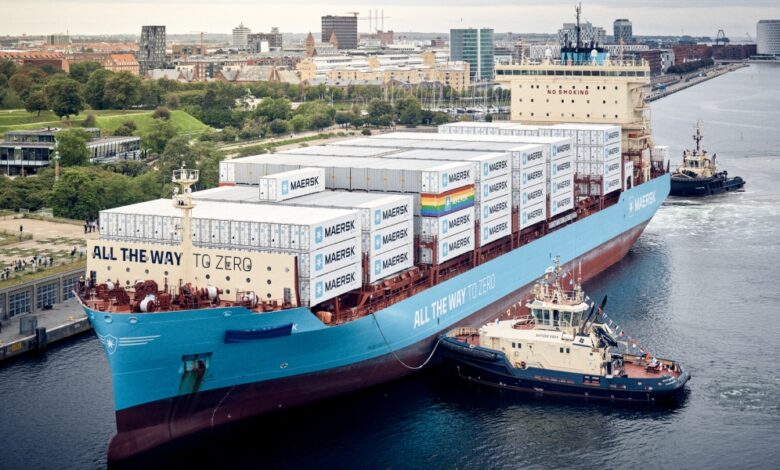
Laura Maersk Becomes a Floating Fuel Lab
Laura Maersk made history in 2023 as the world's first container vessel to run on green methanol. Now, the 2,100 TEU ship is serving as a testbed for ethanol-methanol blends that could reshape how shipping sources low-emission fuels.
The initial trial confirmed that ethanol integrates safely into dual-fuel methanol engines without compromising ignition, combustion, or lubricity. Results were positive enough for Maersk to immediately escalate testing.

"If all the upside is only in China, then some countries will object. But if the upside is more evenly distributed, then more countries will support it."
Vincent Clerc, CEO, A.P. Moller-Maersk
Clerc's comment cuts to the strategic heart of this move. China dominates green methanol production, and Maersk has struggled to secure reliable supply. The U.S. and Brazil produce 80% of the world's ethanol, with growing policy support for expanded ethanol use.

Key statistics highlight the growing adoption of ethanol in the maritime industry, including the Maersk fleet's use of dual-fuel vessels, record-high U.S. ethanol production and exports, and the potential for global demand to reach 50 billion liters annually, all aimed at reducing shipping's contribution to greenhouse gas emissions.
North America's Ethanol Surplus Meets a New Market
Here's what makes this relevant for U.S. producers: domestic ethanol consumption has been flat. Nearly all gasoline sold in the U.S. is blended at E10, and while E15 is gaining bipartisan momentum, the growth ceiling for road fuel is visible.
Meanwhile, U.S. ethanol production set records heading into 2026. Exports are absorbing the surplus, but the industry needs new demand channels.
Maritime fuel could be that channel. The shipping sector consumes massive volumes of fuel, and the IMO's net-zero-by-2050 target is forcing companies to find cleaner alternatives. Ethanol fits the profile.
| Ethanol Demand Sector | Status | Growth |
|---|---|---|
| Road Fuel (E10/E15) | Flat consumption | Moderate |
| Sustainable Aviation Fuel | ETJ scaling | High |
| Marine Fuel | Active trials | High |
| Exports | Record highs | Strong |
>> RELATED: Clean Fuels, Clear Skies: How Maritime Shipping Is Turning to Hydrogen, Ammonia, and Carbon Capture
From Corn Belt to Shipping Lane: CCS Is the Differentiator
What gives U.S. ethanol a competitive edge isn't just volume. It's carbon intensity. Midwest producers are pairing production with carbon capture and sequestration, creating some of the lowest-carbon liquid fuels commercially available.
Green Plains made headlines in late 2025 when all three of its Nebraska plants began capturing biogenic CO2, sending it through the Tallgrass Trailblazer pipeline to permanent storage in Wyoming. The company also received its first 45Z clean fuel tax credit payment of approximately $14 million.
"Our success in Nebraska shows that we're executing on our low-carbon strategy with purpose and precision. With each step forward, we're unlocking new value and advancing our low-carbon platform."
Chris Osowski, President and CEO, Green Plains
This is what makes U.S. ethanol attractive to Maersk. Low-carbon ethanol with CCS delivers meaningful lifecycle emissions reductions, and the $77.5 billion wave of North American CCS investment is expanding infrastructure to support it.
The same ethanol-CCS combination fuels the sustainable aviation fuel market, where ethanol-to-jet technology from Honeywell and LanzaJet converts ethanol into drop-in jet fuel. Adding marine demand strengthens the business case for producers to invest in decarbonization.

The Geopolitical Fuel Play
There's a geopolitical layer worth noting. Maersk's methanol strategy has been complicated by dependence on Chinese supply, and the company has faced engine reliability issues with its methanol fleet.
Ethanol diversifies supply toward the U.S. and Brazil, supporting American farmers with bipartisan appeal. The Trump administration has pushed for the highest renewable volume obligations in history and championed year-round E15.
The U.S. Gulf Coast is already building out cleaner marine fuel capacity. Galveston LNG Bunker Port and TOTE Services recently partnered to develop bunker vessels at a new Texas City terminal, targeting 2029 operations. While focused on LNG, it signals Gulf Coast ports are preparing for a multi-fuel future.
What Happens When Everyone Wants the Same Barrel
The road ahead isn't without tension. If marine demand materializes alongside growing SAF production and higher blending mandates, U.S. producers face a supply allocation challenge they haven't dealt with before.
Maersk's trials are still early-stage. The company targets net-zero by 2040, and ethanol is one tool in a broader fuel flexibility strategy. But the signal is clear: the shipping industry is watching American ethanol with new eyes.
For Midwest producers already investing in CCS and low-carbon pathways, the ocean might just be the next frontier.
Subscribe to the newsletter
Daily decarbonization data and news delivered to your inbox
Follow the money flow of climate, technology, and energy investments to uncover new opportunities and jobs.
Latest issues
-
113 CCS Projects: What's Driving the Surge?
Inside This Issue 🏭 Global CCS Hits 113 Projects as Americas Lead Capacity 💰 We're Moving $2M+ to Climate Solutions 💧 China Launches World's First Semi-submersible Offshore Wind-to-hydrogen Platfo...
-
Why Is Wyoming Giving 650,000 Acres to Carbon Storage?
Inside This Issue 🪨 Inside Blm's 650,000-Acre Bet on Wyoming Carbon Storage 🏭 California Advances Carbon Capture and Removal Regulations Under SB 905 ⚡ Why a Japanese Power Giant Is Betting on Den...
-
Colorado Joins the 7-State CCS Permit Fast Lane
Inside This Issue ⚖️ Colorado Takes Over Class VI Permits: What Changes for CCS? 🏭 Hebei Shoulang Facility Using LanzaTech Technology Achieves World’s First ISCC EU RCF Certification for Ethanol P...
Company Announcements
-
China Launches World's First Semi-Submersible Offshore Wind-to-Hydrogen Platform
The world's first semi-submersible offshore wind-to-hydrogen platform has floated in Jiangmen, south China's Guangdong Province, opening a new avenue for the development and utilization of clean ma...
-
We’re Moving $2M+ to Climate Solutions
New companies, new ways to back existing ones, and every purchase built to pull in more capital We’re adding new companies to our portfolio and getting creative with how we put more money behind e...
-
Citi Closes $72 Million Carbon Removal-Linked Note to Support Applied Carbon Biochar Project
HIGHLIGHTS Citi structured an innovative $72 million carbon removal-linked note to provide upfront capital for Applied Carbon's biochar project, marking a first-of-its-kind "outcome bond" for ver...
-
New platform opens access to the same rigorous project evaluations trusted by the world's leading carbon removal procurement programs Today, Relae (formerly Carbon Direct) launched The Diligence C...