
Samsung E&A officially broke ground on its Wabash Low-Carbon Ammonia Project on January 5, 2026. The plant is located in West Terre Haute, Indiana. Developed with Wabash Valley Resources, the facility will produce 500,000 metric tons of ammonia annually, per Samsung E&A's official announcement. It will also capture 1.67 million metric tons of CO2 each year. That scale places this among the largest CCS projects in U.S. history.
Key Facts
- Project name: Wabash Low-Carbon Ammonia Project, West Terre Haute, Indiana
- Annual ammonia output: 500,000 metric tons (Samsung E&A, January 2026)
- Annual CO2 captured: 1.67 million metric tons, close to 100% of plant output
- EPF contract value: KRW 680 billion (~USD 475 million), signed October 2025
- Total project investment: USD 2.6 billion
- DOE loan: USD 1.5 billion, Energy Dominance Financing, closed October 2025
- Technology partners: Honeywell UOP, Baker Hughes, Casale
- Target completion: 2029
What Is the Wabash Low-Carbon Ammonia Project?
Samsung E&A is a South Korean engineering firm. It provides total solutions for the global energy industry. In October 2025, the company signed a KRW 680 billion contract with Wabash Valley Resources. That contract, worth approximately USD 475 million, covers engineering, procurement, and fabrication work. Construction is now underway, with a target completion date of 2029.
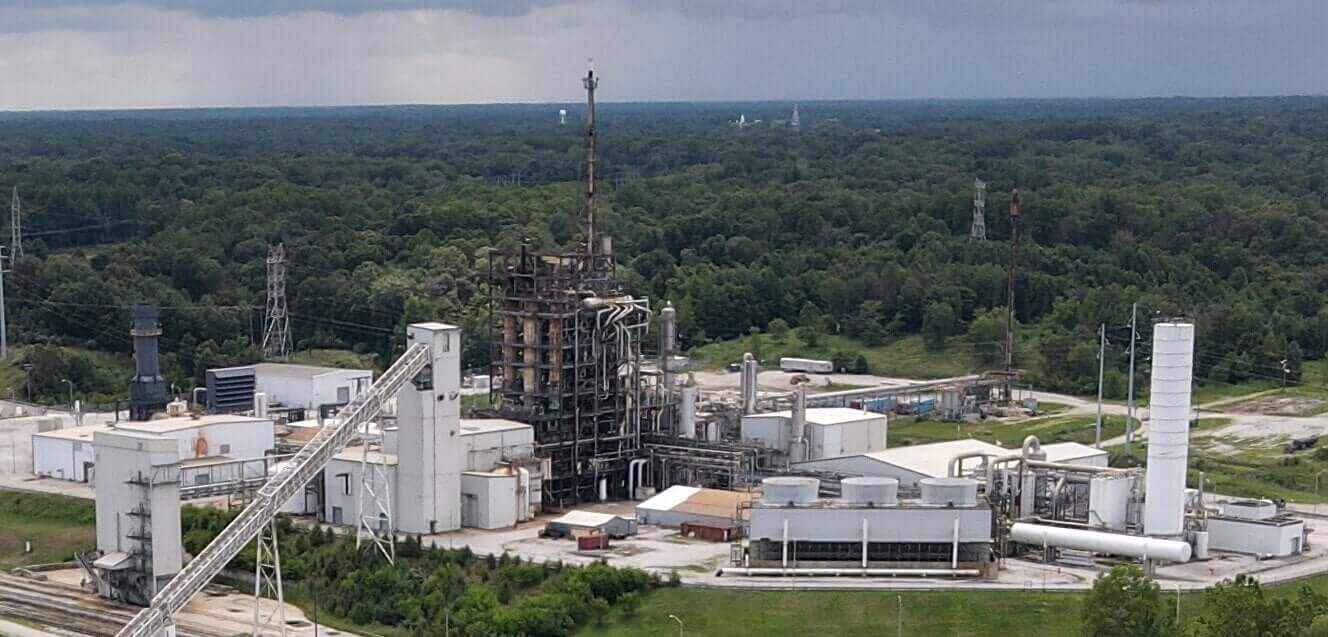
Wabash Valley Resources acquired a world-scale gasification plant in West Terre Haute in 2016. The site sat idle for nearly a decade before the company began its conversion. The plant transforms petroleum coke, a refinery byproduct, into low-carbon ammonia through gasification technology. The result is 500,000 metric tons of domestically produced clean ammonia per year.
Casale's proprietary N-LOOP process enables production of 1,630 metric tons of ammonia per day, according to Casale's project disclosures. Fertilizer plants globally account for approximately 2% of total CO2 emissions, according to industry data. The Wabash project embeds carbon capture directly into the ammonia production process to address that challenge at source.
>> RELATED: $400M Bet on Blue Ammonia: Industry Giants Push Carbon Capture in Louisiana
How Is the Plant Capturing 1.67 Million Tons of CO2?
The facility is designed to capture 1.67 million metric tons of CO2 every year, per Samsung E&A's project filings. That is equivalent to removing more than 360,000 passenger vehicles from U.S. roads annually. This figure is based on the EPA's established benchmark of 4.6 metric tons of CO2 per passenger vehicle per year. The plant covers close to 100% of its total carbon output.

"With this financial close, we move from planning to progress. This milestone marks the beginning of construction and the realisation of a shared vision—putting people to work, revitalising this site, and delivering lasting value to America’s farm communities."
Simon Greenshields, Chairman of the Board, Wabash Valley Resources
Captured CO2 will be stored approximately 7,000 feet underground. It will be injected into the Mount Simon Sandstone, a deep saline aquifer that sits beneath Indiana. That formation is part of the Illinois Basin, one of the most geologically stable carbon storage sites in North America.
Baker Hughes will manage subsurface operations using its CarbonEdge digital platform. This marks CarbonEdge's first commercial deployment anywhere in the world. Honeywell UOP is also a key technology partner for ammonia synthesis and carbon handling systems.
What Makes This a U.S.-Korea Clean Energy Milestone?
Both governments backed this project with committed capital. The U.S. DOE closed a USD 1.5 billion loan under its Energy Dominance Financing program in October 2025. South Korea's Ministry of Land, Infrastructure and Transport and its Ministry of Climate, Energy, and Environment are co-funding the project.
Korean private capital is also in the mix. Hanwha Asset Management and Korea Investment Real Asset Management Co. (KIRA) have both committed funds to Wabash. The January 5 groundbreaking ceremony at the Hay Adams Hotel in Washington, D.C. drew approximately 70 government and industry officials from both nations.

"We are delighted to be carrying out this meaningful project between Korea and the U.S. We will continue to expand new business models for future additive and diversified energy solutions."
Hong Namkoong, President and CEO, Samsung E&A
Samsung E&A plans to use digital transformation tools, AI, automation, and modular construction throughout the build. The company recently secured contracts for a SAF plant in Louisiana, a biodegradable plastics facility in the UAE, and LNG design work in Indonesia. The Wabash project is the centerpiece of its clean energy portfolio in North America.
| Milestone | Date and Detail |
|---|---|
| Gasification plant acquired by Wabash Valley Resources | 2016 |
| EPF contract signed, Samsung E&A and Wabash Valley Resources | October 2025, KRW 680 billion (~USD 475 million) |
| DOE Energy Dominance Financing loan closed | October 2025, USD 1.5 billion |
| Groundbreaking ceremony, Washington, D.C. | January 5, 2026 |
| Target commercial operations | 2029 |
What Does This Mean for America's Ammonia Future?
U.S. Energy Secretary Chris Wright has stated that America has long been dependent on foreign sources of fertilizer. The Wabash plant addresses that directly. It will deliver 500,000 metric tons of domestically produced, low-carbon ammonia each year to the Corn Belt, per Samsung E&A. Indiana's clean energy sector has steadily gained momentum, and this project is its highest-profile milestone.
The plant's 1.67 million metric ton CO2 capture capacity is equivalent to removing more than 360,000 vehicles from American roads annually, based on EPA benchmarks. That figure demonstrates what integrated, industrial-scale decarbonization looks like in practice. For U.S. farmers, it means a reliable domestic fertilizer supply with near-zero carbon intensity.
The IEA projects that global demand for low-emission hydrogen could reach 38 million metric tonnes by 2030. That is more than triple today's output levels. The project is backed by USD 2.6 billion in committed capital. It carries bilateral support from the U.S. and South Korea. The Wabash facility is on track to anchor industrial decarbonization across the American Midwest.
Subscribe to the newsletter
Daily decarbonization data and news delivered to your inbox
Follow the money flow of climate, technology, and energy investments to uncover new opportunities and jobs.
Latest issues
-
LNK Energies Targets $6.50 Hydrogen With No Federal Subsidies
Inside This Issue 🚛 MIT Startup Says It Can Turn Diesel Trucks Into Cheaper Hydrogen Haulers, See It at Disrupt 🏭 Baytown City Council Briefs: ExxonMobil Blue Hydrogen Agreement Approved 🌎 Colorad...
-
Why Gulf Coast CCS Teams Are Watching Liverpool Bay
Inside This Issue 💂 Eni’s Douglas Platform Sets the Offshore CCS Blueprint 🌲 Pacolet Milliken Expands Its Biomass Platform With the Acquisition of Georgia Renewable Power 🧪 Metacon Receives EU Fun...
-
Who Bought Gevo’s $50M in 45Z Credits?
Inside This Issue ⛽ Gevo Sells $70M in 45Z Credits to a New Kind of Buyer 🌱 South Pole, Gaïago, and Gold Standard Issue European Soil Carbon Credits, Unlocking Verified Regenerative Agriculture Re...
Company Announcements
-
MIT Startup Says It Can Turn Diesel Trucks Into Cheaper Hydrogen Haulers — See It at Disrupt
Diesel fuel powers everything from shipping to agriculture, and with prices hitting record highs in recent weeks, governments around the world are scrambling to contain the fallout. For now, that’...
-
Gevo Announces First Multi-Year Carbon Removal Credits Supply Agreement Through CEEZER
Three-Year Delivery of Durable Carbon Removals from Gevo North Dakota to a Leading Global Enterprise Software Company Gevo will supply durable carbon dioxide removal (CDR) credits from Gevo North...
-
Continental Refining to Double Biodiesel Capacity at Somerset Complex
SOMERSET, Ky. — Continental Refining Company is expanding its biodiesel production facility to double capacity at its Somerset industrial complex, while its soybean processing plant will remain idl...
-
Groundwork BioAg Secures 'BBB' BeZero Carbon Rating
The rating places Groundwork BioAg among the highest-rated agricultural soil carbon projects, opening a scalable pipeline of independently rated, high-integrity removals for corporate buyers. MAZO...