
Canada now has a national roadmap to hit 10 percent sustainable aviation fuel use by 2030, about one billion litres a year (Transport Canada, 2026). Transport Canada's new Sustainable Aviation Fuels Blueprint lays out seven pillars of action to get there. British Columbia already shows the approach can work in practice.
The Blueprint was developed with Deloitte, the Sustainable Aviation Task Force, and the Canadian Council for Sustainable Aviation Fuels (C-SAF). C-SAF is a national organization of more than 60 airlines and industry members that co-led the report's development.
Key Facts
- Canada's aspirational target: 10 percent SAF use by 2030, about one billion litres a year (Transport Canada, 2026)
- British Columbia reached 3.9 percent low carbon jet fuel supply in 2025, five years ahead of its 2030 mandate (Government of British Columbia, 2026)
- Canadian air carriers emitted 22 megatonnes of greenhouse gases in 2023, up 23 percent since 2005 (Transport Canada, 2026)
- Global SAF production reached 1.3 billion litres in 2024 and is projected to hit 2.7 billion litres in 2025 (International Air Transport Association, 2024)
- Canada's refineries produced 6.4 billion litres of conventional jet fuel in 2024 (Statistics Canada, 2024)
>> In Other News: Carbon To Sea Initiative Awards $225,000 To Study Ocean Alkalinity Enhancement In Wastewater Treatment
What Does Canada's New SAF Blueprint Actually Say?
The Blueprint sets out seven pillars of action to help Canada reach its aspirational goal of 10 percent SAF use by 2030 (Transport Canada, 2026). It builds on Canada's Aviation Climate Action Plan, first released in 2022.
"Successful implementation of SAF across Canada relies on industry and government working together."
Geoff Tauvette, Executive Director, Canadian Council for Sustainable Aviation Fuels
The pillars target three core barriers to SAF growth. These barriers are high cost, investment risk, and limited global supply. Individual pillars cover strategic partnerships, de-risking investment, supply chains, codes and standards, technology development, emissions accounting, and public education.
- SAF costs 2 to 8 times more than conventional jet fuel today (Transport Canada, 2026)
- No commercial SAF production facility currently operates in Canada (Transport Canada, 2026)
- Announced Canadian SAF projects already total more than one billion litres of potential yearly capacity (Transport Canada, 2026)
Canadian air carriers released 22 megatonnes of greenhouse gas emissions in 2023 (Transport Canada, 2026). That marks a 23 percent increase since 2005. The Blueprint frames SAF as the most commercially ready tool available today. It works as a drop-in replacement in existing aircraft engines, with no modifications needed.
>> RELATED: Boeing Backs $10M Quebec SAF Project to Fly by 2027
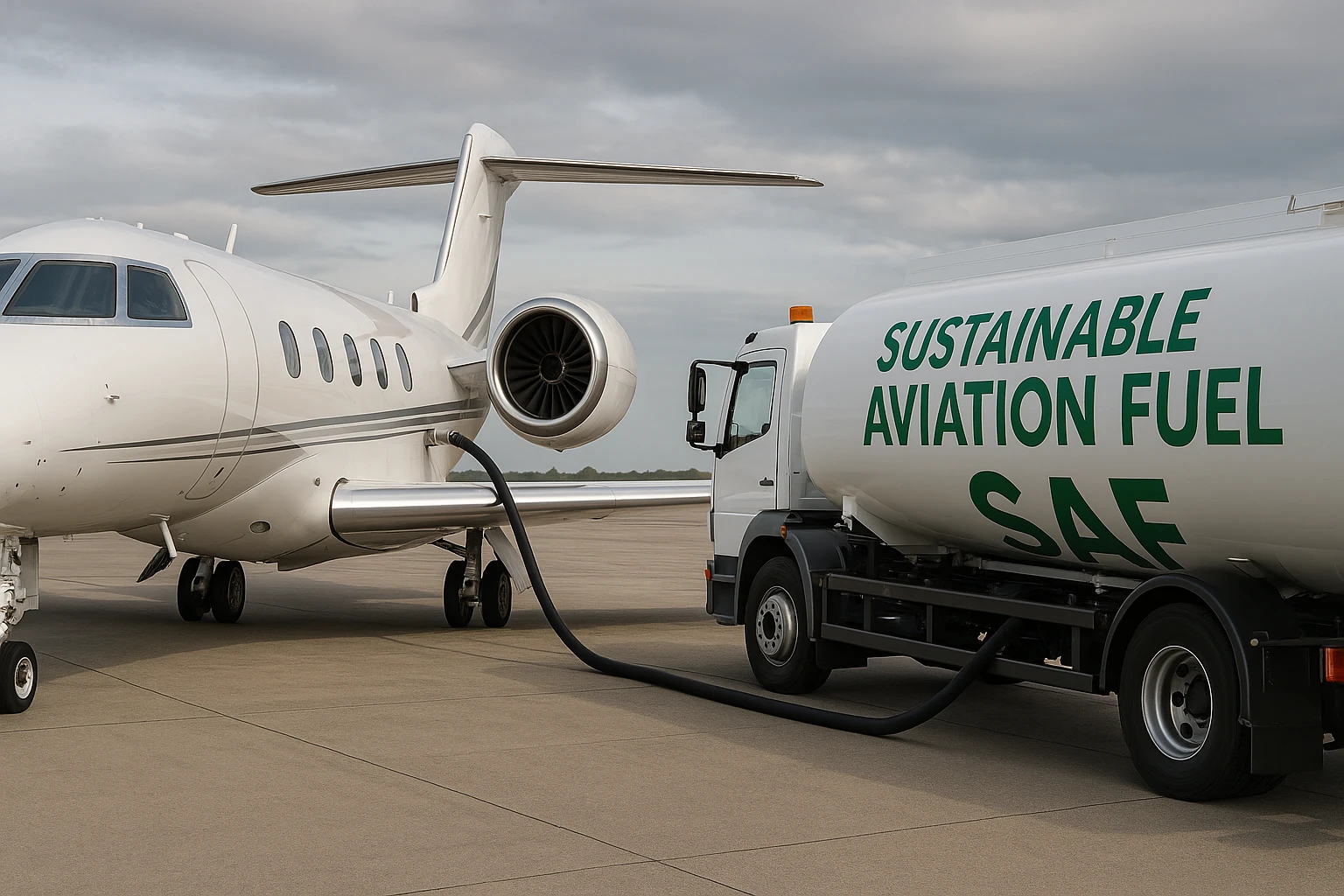
How Much Fuel Does the 10% Target Represent?
Canada's 10 percent goal equals roughly one billion litres of SAF used every year by 2030 (Transport Canada, 2026). Total Canadian jet fuel demand is projected to reach approximately 10.6 billion litres that same year, according to Canadian Energy Regulator estimates.
Canada's refineries already produced 6.4 billion litres of conventional jet fuel in 2024 (Statistics Canada, 2024). Much of that fuel serves the domestic market. Some is exported to the United States and China. The refining base already exists. What is missing is dedicated SAF production layered on top of it.
Global SAF output is growing fast, even from a small base. Production doubled year over year for three straight years (International Air Transport Association, 2024).
| Year | Global SAF Production (million litres) |
|---|---|
| 2021 | 99.9 |
| 2022 | 300 |
| 2023 | 600 |
| 2024 | 1,300 |
| 2025 (projected) | 2,700 |
Source: International Air Transport Association, 2024
Is British Columbia Proof That SAF Policy Works?
British Columbia's results suggest yes. Low carbon jet fuel reached 3.9 percent of the province's total jet fuel supply in 2025 (Government of British Columbia, 2026). That figure beat B.C.'s own volumetric requirement of 3 percent by 2030. The province hit the mark five years early. B.C.'s Low Carbon Fuel Standard has required lower carbon intensity in aviation fuel since 2026. A separate renewable content mandate is set to start at 1 percent in 2028, then rise to 3 percent by 2030.
"British Columbia has shown that low-carbon fuel policy works in the real economy."
Fred Ghatala, President, Advanced Biofuels Canada
Across all fuel categories, B.C.'s clean fuel rules avoided more than 5 million metric tons of greenhouse gas emissions in 2025 (Government of British Columbia, 2026). Cumulatively since 2010, the province has avoided over 32.7 million tons. Similar public-private coordination already underpins Canada's direct air capture protocol, one of the country's other major carbon management frameworks.
How Does Canada's Target Compare to the U.S. and U.K.?
Canada's 10 percent by 2030 goal sits in the middle of the pack globally. The United States is chasing 11.3 billion litres of domestic SAF production by 2030 under its SAF Grand Challenge. That target is backed by an estimated 44 billion U.S. dollars in announced investment.
The United Kingdom takes a different approach. Instead of an aspirational goal, it uses a binding supplier mandate. The mandate started at 2 percent in 2025. It rises on a straight line to 10 percent by 2030, then 22 percent by 2040.
| Jurisdiction | 2030 SAF Target | Policy Type |
|---|---|---|
| Canada | 10% (about 1 billion litres) | Aspirational goal |
| United States | 11.3 billion litres | Incentive-driven target |
| United Kingdom | 10%, rising to 22% by 2040 | Binding supplier mandate |
| European Union | 6%, rising to 70% by 2050 | Binding blending mandate |
What Projects Are Already Building Toward the Goal?
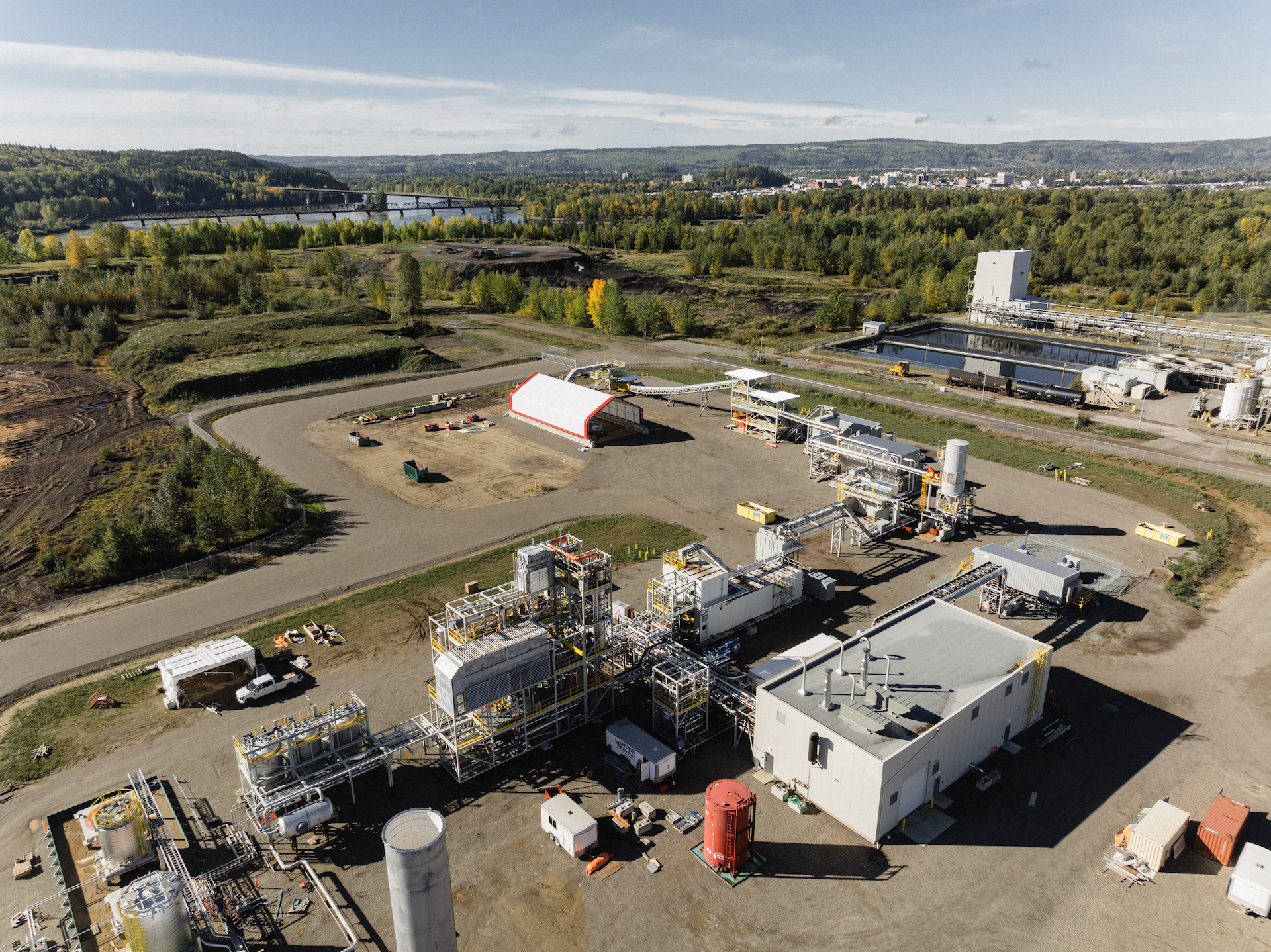
Several Canadian projects are moving ahead of the Blueprint's release. In Québec, Boeing is putting 10 million Canadian dollars into Project Avance, a sawmill-residue SAF facility. Production there is expected to start in 2027.
Ontario is backing a different feedstock path. The province committed 5.5 million Canadian dollars to a wood-based SAF demonstration plant in Thunder Bay. The project will use mill byproducts and underused wood fibre.
These regional projects sit under the national framework the Blueprint just formalized. Similar coordination has already scaled hydrogen hub development on the U.S. Gulf Coast. Canada's Blueprint draws on comparable public-private structures.
Carbon removal projects show the same government-industry model working nearby. Deep Sky's direct air capture deployment in Montreal is one example.
Momentum is building across North America too. Record U.S. SAF production volumes and on-airport SAF production in Pittsburgh both point the same direction. Even the recent retention of U.S. federal funding for hydrogen and carbon storage hubs signals durable policy support region-wide.
Official C-SAF video featuring Executive Director Geoff Tauvette explaining how sustainable aviation fuel (SAF) can cut aviation lifecycle emissions by up to 80% as a practical, drop-in solution to help Canada advance cleaner aviation.
The Runway Ahead
Canada's Blueprint does not pretend the path is easy. SAF still costs 2 to 8 times more than jet fuel. No Canadian facility has reached a final investment decision yet.
But the document gives industry something it lacked before. It offers a coordinated federal framework built with input from over 90 stakeholders across the aviation and fuels value chain. Combined with B.C.'s early results, Canada now has both a plan and proof that the plan can work.
Frequently Asked Questions
Is Canada's 10 percent SAF target mandatory?
No. It remains an aspirational goal under the Aviation Climate Action Plan, not a binding federal mandate. British Columbia does have its own binding volumetric requirement at the provincial level.
Does Canada currently produce SAF commercially?
Not yet. As of 2025, there was no sustained commercial SAF production in Canada, though announced projects total more than one billion litres of potential annual capacity.
What feedstocks will Canadian SAF likely use?
Canola, forestry residues, used cooking oil, and agricultural waste are the leading candidates, given Canada's existing feedstock base and refining expertise.
For ongoing coverage of carbon removal, BECCS, and corporate CDR procurement, subscribe to Decarbonfuse.com.
Subscribe to the newsletter
Daily decarbonization data and news delivered to your inbox
Follow the money flow of climate, technology, and energy investments to uncover new opportunities and jobs.
Latest issues
-
Colorado Joins the 7-State CCS Permit Fast Lane
Inside This Issue ⚖️ Colorado Takes Over Class VI Permits: What Changes for CCS? 🏭 Hebei Shoulang Facility Using LanzaTech Technology Achieves World’s First ISCC EU RCF Certification for Ethanol P...
-
The US Hasn't Made Heavy Water Since 1982
Inside This Issue ⚛️ Aternium Completes FEED Studies for US Hydrogen, Heavy Water Project 🐄 Google, McKinsey Strike Brazil Carbon Removal Deal With Silvopasture Project 🔧 Cummins Selects Stargate ...
-
Why Colorado’s Koloma Has Japan’s Largest Utility Hooked
Inside This Issue ⚡ JERA Invests in Koloma to Explore Natural Hydrogen as a Future Low-Carbon Energy 🔬 New CATF Tool Provides Framework for Self-Assessment and Strengthening of Biomass Carbon Remo...
Company Announcements
-
Citi Closes $72 Million Carbon Removal-Linked Note to Support Applied Carbon Biochar Project
HIGHLIGHTS Citi structured an innovative $72 million carbon removal-linked note to provide upfront capital for Applied Carbon's biochar project, marking a first-of-its-kind "outcome bond" for ver...
-
New platform opens access to the same rigorous project evaluations trusted by the world's leading carbon removal procurement programs Today, Relae (formerly Carbon Direct) launched The Diligence C...
-
Inside BLM's 650,000-Acre Bet on Wyoming Carbon Storage
The Bureau of Land Management has offered right-of-way grants covering about 649,438 acres of federal pore space in southwest Wyoming. The September 21, 2026 offers went to Moxa Carbon Storage LLC ...
-
NEW YORK, BUSINESS WIRE, SWITCH Maritime (Switch), a leading developer of zero-emission vessels, secured a Design Basis Agreement (DBA) with the United States Coast Guard (USCG) for the SWITCH-150,...