
Montana Renewables has not found a way to build the original $1.2 billion MaxSAF Phase 2 project for $137 million. Calumet has redesigned the expansion around existing refinery equipment, smaller project scopes, and a long-term lease of selected assets from the adjacent Calumet Montana Refining operation. The distinction explains much of the dramatic capital reduction.
Montana Renewables is targeting an approximately 200-million-gallon annual sustainable aviation fuel production run rate by year-end 2028. Calumet reported a current SAF run rate of 60 million gallons per year on September 1, 2026, following constraint removal during its spring turnaround.

Existing processing equipment and shared infrastructure are central to the economics of brownfield refinery conversions.
Great Falls facility
The Great Falls strategy provides a useful counterpoint to broader growth in U.S. sustainable aviation fuel capacity. Its strongest lesson is not that SAF facilities suddenly cost almost 90% less. It is that existing refinery infrastructure can radically change the incremental economics of SAF expansion.
Key Facts
- Remaining expansion capital: approximately $137 million
- Capital contemplated for the original Phase 2 plan: approximately $1.2 billion
- Current SAF production run rate reported by Calumet: 60 million gallons per year
- Target SAF production run rate: approximately 200 million gallons per year by year-end 2028
- Target total renewable-product sales: 17,000 barrels per day
- Final expected DOE loan draw: $34 million, subject to specified conditions
- Expanded annual feedstock consumption: approximately 2 billion pounds
>> In Other News: MAX Power Drills into Highest Natural Hydrogen Readings to Date in Third and Fourth Wells at Lawson as Discovery Expands
What disappeared from the $1.2 billion project?
The revised MaxSAF plan replaces a large new-build project with a series of smaller scopes primarily based on repurposing existing equipment. The amended federal loan agreement confirms that the original Phase 2 encompassed renewable-fuel expansion plus wastewater-treatment upgrades and infrastructure updates, including rail and tankage. Source: August 2026 amended Loan Guarantee Agreement.
The centerpiece of the redesign is a hydrotreater, hydrogen plant, and naphtha splitter from Calumet Montana Refining. Calumet says those selected assets will be redeployed to Montana Renewables under a long-term lease. Several additional modular components are also planned, including a third renewable-fuels reactor that Calumet says is currently offsite.
This means the $137 million figure is remaining project capital for the revised expansion. It should not be interpreted as the replacement cost of every asset required to support 200 million gallons of annual SAF production. Calumet's September 1 announcement does not disclose the economic value of the leased equipment or the associated lease payments.
| Original Phase 2 | Revised MaxSAF plan |
|---|---|
| Large new-build expansion | Six smaller defined projects |
| Approximately $1.2 billion contemplated capital | Approximately $137 million remaining capital |
| Up to $658 million of additional DOE funding | Final expected $34 million draw, subject to conditions |
| Full project equity commitment required before Phase 2 construction | No third-party equity planned for the revised expansion |
The approach extends a brownfield strategy already used at Great Falls. DecarbonFuse previously covered how Topsoe's HydroFlex technology was used to revamp existing Great Falls refinery equipment for renewable-fuel production.
Why can Calumet reuse refinery equipment?
Calumet can pursue the brownfield strategy because Montana Renewables and Calumet Montana Refining operate at the same Great Falls site. CMR is not being presented as an idle refinery that simply contributes surplus equipment. Calumet says CMR will remain in service producing retail asphalt, retain employees, and continue providing shared-site cost efficiencies.
Calumet also expects CMR to capture approximately $50 million of EBITDA at what the company described as elevated refining margins before the planned fourth-quarter 2026 transition. That figure is a company forecast, not a realized result. It indicates that the reconfiguration involves assets within an economically active operation rather than equipment with no alternative use.

"Our amended agreement with the DOE facilitates innovative technology and domestic energy security at a fraction of the original cost."
Todd Borgmann, CEO, Calumet
The hydrotreater is particularly important. Calumet says tying it to Montana Renewables' existing equipment creates a dual-reactor configuration in which the added reactor performs a "polishing" service rather than conventional cracking. The company says this configuration lowers byproduct production and yield loss. Calumet has not publicly quantified the SAF yield improvement in percentage points in the September 1 announcement, so no numerical yield gain should be assumed.
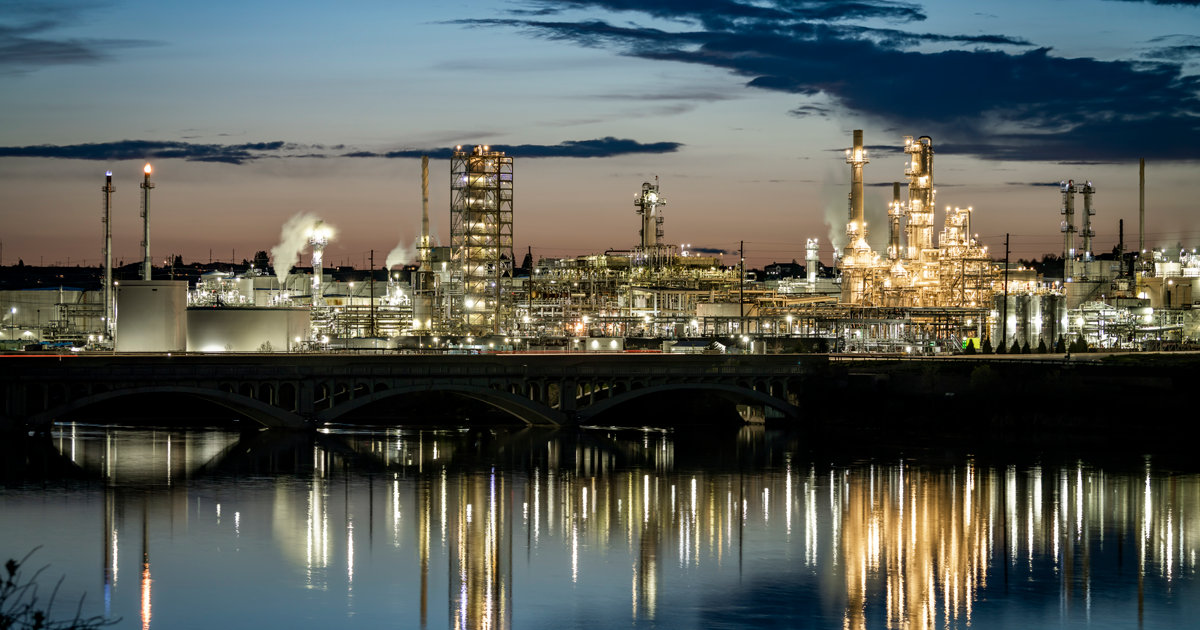
Hydrotreating and associated refinery infrastructure can provide valuable brownfield equipment for renewable-fuel conversions.
>> RELATED: Montana's $1.44B Bet on Aviation Fuel Enters Final Stretch
Is the 200-million-gallon target really SAF?
Calumet explicitly describes approximately 200 million gallons per year as the targeted SAF production run rate, rather than simply total renewable-products capacity. Separately, the company expects total renewable-product sales to increase 40% to 17,000 barrels per day by year-end 2028.
The announced sequence starts from a 60-million-gallon annual SAF run rate. Calumet expects to exceed 80 million gallons by year-end 2026, surpass 120 million gallons by spring 2027, and reach approximately 200 million gallons by year-end 2028. These are company targets and remain forward-looking.
Montana Renewables also produces renewable diesel and renewable naphtha. The revised program is expected to recover approximately 20 million gallons per year of renewable propane and butane that Calumet says was previously burned as fuel gas, converting those streams into saleable product.
Calumet says the redesigned project captures approximately 70% of the originally expected benefit while spending 15% of the originally expected Phase 2 capital. Those percentages are management estimates. They reinforce why the old and new projects should not be treated as identical scopes with radically different price tags.

Calumet's revised MaxSAF plan combines staged production targets with repurposed Great Falls refinery infrastructure.
Breaking the expansion into six smaller projects can reduce the amount of capital and construction scope exposed at one time. Calumet specifically describes the projects as controllable and quick-payback scopes designed to reduce construction risk. Actual execution remains subject to equipment performance, turnaround timing, cost, and other risks identified by the company.
Can Montana secure enough feedstock?
Feedstock requirements will rise with throughput. Calumet says the expansion would increase Montana Renewables' total feedstock consumption to approximately 2 billion pounds annually, with those inputs converted into renewable jet fuel, diesel, and gasoline.
Montana Renewables identifies tallow, distillers corn oil, canola oil, used cooking oil, and camelina oil among feedstocks supplied through Pacific Northwest farm and ranch operations. Calumet also identifies feedstock availability and pricing as risks that could affect the expansion.
That makes agricultural supply increasingly important as processing capacity expands. Camelina, for example, is receiving wider industry attention, including the Bayer and bp alliance to scale camelina for renewable fuels. Other brownfield renewable-fuel projects are also using diversified feedstocks, including Par Pacific's operating Kapolei biorefinery in Hawaii.
Demand is supported by contracted volumes as well. In February 2026, Montana Renewables and World Energy announced an agreement covering more than 70 million gallons of SAF over three years. DecarbonFuse covered the 70-million-gallon SAF agreement when it was announced.
"Contracting with MRL for SAF production enables us to better support our growing aviation decarbonization business."
Gene Gebolys, CEO, World Energy
Montana Renewables has also supplied MaxSAF for Gulfstream's 2026 high-altitude emissions testing, providing another operating example of the Great Falls fuel reaching aviation applications.
What changed in the DOE loan?
The U.S. Department of Energy and Montana Renewables changed more than the project's headline construction budget. Their August 28, 2026 amendment formally changed the expansion from a large new-build project to smaller scopes primarily involving repurposed equipment.
The maximum principal amount under the guaranteed loan was reduced from $1.44 billion to $815.8 million. Maximum capitalized interest was reduced slightly from $233 million at the original closing to $232.8 million under the amendment. The original DOE package therefore should not be described as $1.2 billion of Phase 2 construction spending.
The original DOE loan guarantee, closed in January 2025, totaled $1.67 billion, consisting of $1.44 billion of principal and $233 million of capitalized interest. DOE described it as financing the expansion of the Great Falls renewable-fuels facility, which included SAF, renewable diesel, and renewable naphtha production.
The first $782 million loan tranche was funded in February 2025 and used to recapitalize Montana Renewables, alongside an additional $150 million Calumet equity investment made with cash on hand. Under the revised agreement, additional availability falls from as much as $658 million to a final expected $34 million draw. Calumet says receipt of that draw remains subject to commercial, technical, and legal conditions.
The loan retains its 15-year tenor and an annual interest rate equal to the U.S. Treasury rate plus three-eighths of a percentage point. The March 2029 first servicing date and December 2039 maturity remain unchanged. The revised structure also calls for Montana Renewables' retained earnings to supplement DOE funds so that debt remains below 55% of eligible spending.
Montana Renewables commissioned onsite blending and shipping at Great Falls in October 2025 and began distributing MaxSAF, a certified 50/50 renewable–fossil jet blend, to regional airports.
The operating economics will also depend on policy and lifecycle carbon intensity. DecarbonFuse's coverage of the updated 45ZCF-GREET model explains how lifecycle emissions calculations connect clean-fuel production to federal tax-credit values.
Brownfield infrastructure is the real MaxSAF lesson
Montana Renewables' $137 million plan does not establish that a new 200-million-gallon SAF facility can be constructed for $137 million. The figure represents remaining capital for a redesigned expansion that relies heavily on equipment and infrastructure already present at the Great Falls site.
That distinction also limits how directly the model can be copied. A greenfield SAF developer without an adjacent hydrotreater, hydrogen plant, naphtha splitter, utilities, logistics, tanks, experienced workforce, and other compatible infrastructure would need a different capital plan.
The transferable principle is stronger and more useful: refinery owners can evaluate existing processing assets before assuming that additional SAF capacity requires a fully new facility. Great Falls demonstrates how brownfield integration, equipment reuse, staged construction, and existing operating infrastructure can potentially lower incremental expansion capital when the site is technically suitable.
Frequently Asked Questions
Does MaxSAF really cost only $137 million?
No. The $137 million figure is Calumet's estimate of remaining project capital for the revised expansion. The plan also relies on existing refinery equipment that will be made available to Montana Renewables under a long-term lease.
Is 200 million gallons the SAF target or total renewable-fuel capacity?
Calumet specifically targets an approximately 200-million-gallon annual SAF production run rate by year-end 2028. It separately targets 17,000 barrels per day of total renewable-product sales.
Can other SAF developers copy the Great Falls strategy?
The brownfield principle can be applied elsewhere, but the economics depend on having compatible existing assets. The disclosed MaxSAF capital figure should not be used as a general benchmark for greenfield SAF construction.
The MaxSAF story is therefore less about a universal 89% reduction in SAF construction costs than about the value locked inside existing industrial sites. If Calumet delivers its announced approximately 200-million-gallon annual SAF run-rate target, Great Falls could provide an important case study in how brownfield refinery infrastructure can support capital-efficient SAF expansion.
For ongoing coverage of carbon removal, BECCS, and corporate CDR procurement, subscribe to Decarbonfuse.com.
Subscribe to the newsletter
Daily decarbonization data and news delivered to your inbox
Follow the money flow of climate, technology, and energy investments to uncover new opportunities and jobs.
Latest issues
-
Colorado Joins the 7-State CCS Permit Fast Lane
Inside This Issue ⚖️ Colorado Takes Over Class VI Permits: What Changes for CCS? 🏭 Hebei Shoulang Facility Using LanzaTech Technology Achieves World’s First ISCC EU RCF Certification for Ethanol P...
-
The US Hasn't Made Heavy Water Since 1982
Inside This Issue ⚛️ Aternium Completes FEED Studies for US Hydrogen, Heavy Water Project 🐄 Google, McKinsey Strike Brazil Carbon Removal Deal With Silvopasture Project 🔧 Cummins Selects Stargate ...
-
Why Colorado’s Koloma Has Japan’s Largest Utility Hooked
Inside This Issue ⚡ JERA Invests in Koloma to Explore Natural Hydrogen as a Future Low-Carbon Energy 🔬 New CATF Tool Provides Framework for Self-Assessment and Strengthening of Biomass Carbon Remo...
Company Announcements
-
Citi Closes $72 Million Carbon Removal-Linked Note to Support Applied Carbon Biochar Project
HIGHLIGHTS Citi structured an innovative $72 million carbon removal-linked note to provide upfront capital for Applied Carbon's biochar project, marking a first-of-its-kind "outcome bond" for ver...
-
New platform opens access to the same rigorous project evaluations trusted by the world's leading carbon removal procurement programs Today, Relae (formerly Carbon Direct) launched The Diligence C...
-
Inside BLM's 650,000-Acre Bet on Wyoming Carbon Storage
The Bureau of Land Management has offered right-of-way grants covering about 649,438 acres of federal pore space in southwest Wyoming. The September 21, 2026 offers went to Moxa Carbon Storage LLC ...
-
NEW YORK, BUSINESS WIRE, SWITCH Maritime (Switch), a leading developer of zero-emission vessels, secured a Design Basis Agreement (DBA) with the United States Coast Guard (USCG) for the SWITCH-150,...