
U.S. clean-fuel producers have new information for modeling 2026 credit values, feedstock procurement and agricultural carbon intensity. IRS Notice 2026-53 connects regenerative farming practices to 45Z calculations, establishes distinct treatment for dairy and swine manure, and reinforces the North American feedstock restriction for fuel produced after 2025.
The Internal Revenue Service issued Notice 2026-53 on September 8, 2026. It provides the 2026 emissions rate table and supplements the 45ZCF-GREET framework updated in June. The credit applies to qualifying clean transportation fuel produced domestically after December 31, 2024 and sold by December 31, 2029.
For transportation fuel produced and sold during 2026, IRS Notice 2026-41 sets the inflation-adjusted 45Z base amount at 22 cents per gallon or gallon equivalent. The alternative amount is $1.09 for production at qualified facilities satisfying applicable prevailing-wage and apprenticeship requirements. Actual credit value also depends on the fuel's emissions factor.
Key Facts
- Notice 2026-53 became effective September 8, 2026 and includes the calendar-year 2026 emissions rate table.
- Fuel produced after December 31, 2025 must be exclusively derived from feedstock produced or grown in the United States, Mexico or Canada.
- The 2026 emissions rate table includes dairy manure and swine manure as distinct primary feedstocks.
- Negative emissions rates are prohibited for transportation fuel produced after December 31, 2025, except fuel derived from animal manure.
- For transportation fuel produced and sold in 2026, the inflation-adjusted base and alternative amounts are $0.22 and $1.09 per gallon or gallon equivalent, respectively.
>> In Other News: [x](x)
How Can Regenerative Agriculture Change 45Z Value?
Qualifying agricultural practices can now change the feedstock emissions intensity entered into 45ZCF-GREET. That gives producers a more concrete way to evaluate whether differentiated agricultural sourcing could improve the emissions factor, and therefore the potential credit value, of qualifying fuel.
The U.S. Department of Agriculture finalized its Technical Guidelines for the Production of Regenerative Agricultural Biofuel Feedstocks in June 2026. The September 2026 45ZCF-GREET update incorporates the 45Z-specific Feedstock Carbon Intensity Calculator. DOE identifies cover crops, tillage practices, nitrification inhibitors and manure application among the agricultural practices included in the calculator.
DecarbonFuse previously examined how the USDA feedstock carbon-intensity framework connects farm practices with biofuel economics. For fuel produced in 2025 and 2026, Notice 2026-53 also deems the pre-application nutrient-budget requirement satisfied, while retaining substantiation and recordkeeping requirements for nutrient inputs and removals.

"Today's guidance helps America’s farmers, ranchers, and fuel producers access growing opportunities in the domestic biofuels market."
Frank J. Bisignano
The financial connection is already visible in operating markets. Aemetis reported selling $18 million of 45Z credits in July 2026, including credits associated with ethanol and renewable natural gas production.
>> RELATED: The Overlooked Step To Max Out Your 45Z Credit

LanzaJet's Freedom Pines Fuels facility in Georgia produces sustainable aviation fuel from ethanol, illustrating the domestic clean-fuel production infrastructure affected by Section 45Z guidance.
Why Are Manure Pathways Different?
Animal-manure pathways occupy an unusual position under the revised 45Z rules because they can retain negative emissions rates. Other transportation fuels produced after December 31, 2025 cannot have an emissions rate below zero.
Notice 2026-53 includes dairy and swine manure as separate primary feedstocks in the 2026 emissions rate table. The September Department of Energy model subsequently added RNG pathways for dairy manure and swine manure. The model can account for qualifying farm-specific prior manure-management practices when calculating avoided emissions.
| Manure Feedstock | Current 2026 Treatment | Commercial Modeling Position |
|---|---|---|
| Dairy manure | Distinct primary feedstock and RNG pathway | Farm-specific prior practices may affect avoided emissions |
| Swine manure | Distinct primary feedstock and RNG pathway | Farm-specific prior practices may affect avoided emissions |
| Poultry manure | Not yet included as a primary feedstock | Treasury and IRS anticipate a later 2026 model update |
| Beef manure | Not yet included as a primary feedstock | Treasury and IRS anticipate a later 2026 model update |
The IRS specifically encourages poultry- and beef-manure fuel producers to await that subsequent model update before potentially submitting a provisional emissions rate petition. For RNG developers, the remaining model update is therefore a concrete item to watch rather than a finalized pathway.
North American Sourcing Changes Procurement
Feedstock origin is now directly tied to 45Z eligibility for post-2025 production. Transportation fuel produced after December 31, 2025 must be exclusively derived from feedstock produced or grown in the United States, Mexico or Canada.

"We thank USDA, DOE, and the Treasury Department for decisively tying qualifying farm practices to 45Z and providing important clarification on ILUC."
Emily Skor
The rule can affect producers that previously relied on oils, fats or other feedstocks sourced outside North America. Notice 2026-53 confirms, for example, that Canadian and Mexican used cooking oil can qualify under the geographic restriction, while non-Canadian and non-Mexican imported UCO cannot support a 45Z claim for fuel produced after 2025.
This requirement could increase competition for qualifying North American feedstocks, although the guidance does not quantify that market effect. Projects developing additional regional supply may become more relevant. The Corteva and bp Etlas joint venture, for example, plans to develop oil from crops including canola, mustard and sunflower for SAF and renewable diesel markets.
Growth Energy welcomed the guidance because it connects qualifying agricultural practices with 45Z calculations. That connection matters for ethanol producers evaluating farm-level data, procurement contracts and the carbon intensity of incoming feedstocks.
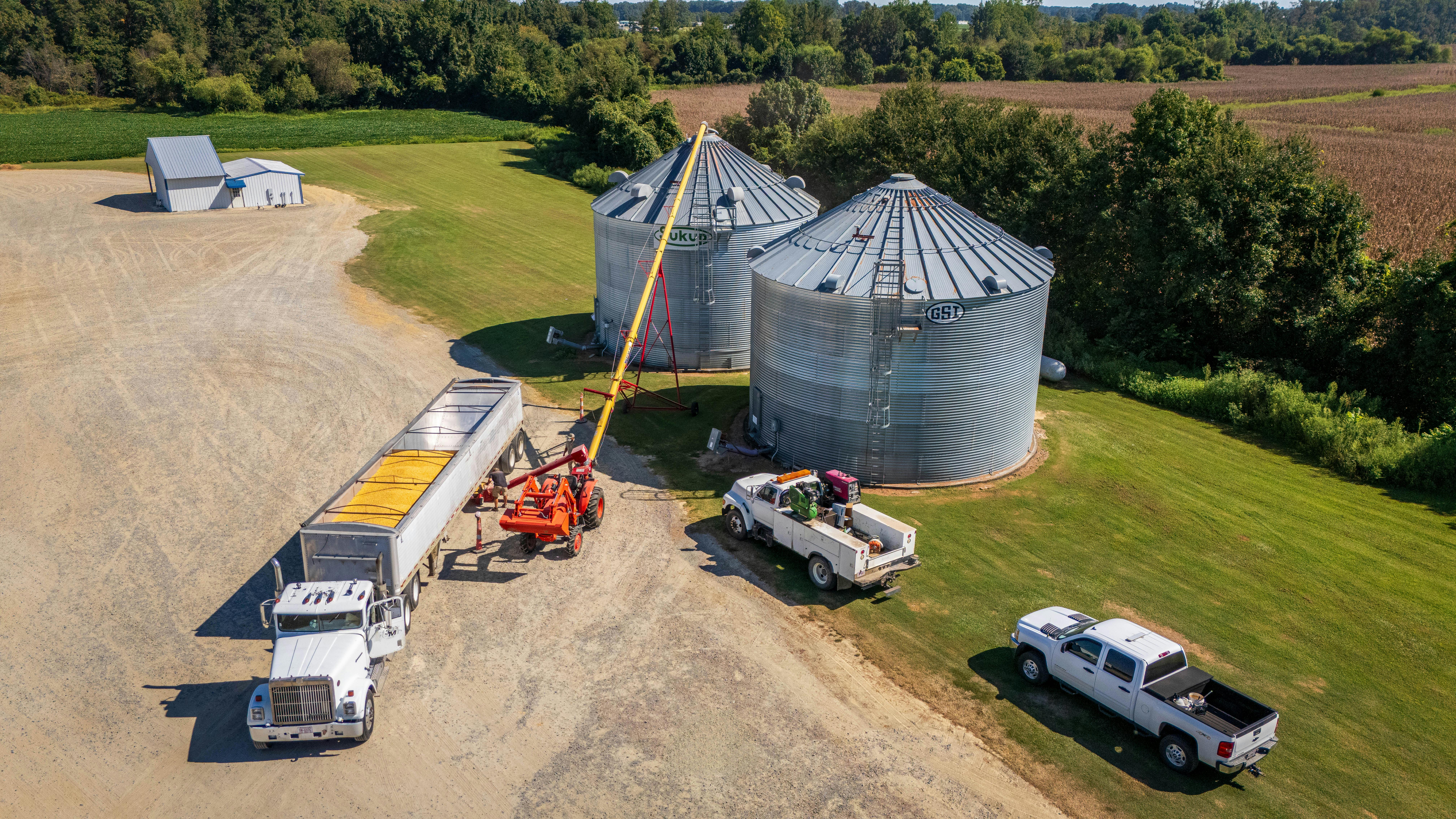
Aerial photograph capturing grain silos, trucks, and agricultural machinery on a North Carolina farm.
What Changes For SAF Investment Decisions?
SAF producers can use the 2026 table to identify eligible pathways and the allowed emissions methodology for each pathway. The table includes alcohol-to-jet, HEFA and gasification plus Fischer-Tropsch pathways using specified feedstocks.
For 2026 production, SAF also uses the same statutory applicable amounts as other transportation fuel. IRS Notice 2026-41 sets the inflation-adjusted 2026 amounts at 22 cents and $1.09, depending on whether the facility qualifies for the alternative amount. The final credit still varies with the emissions factor.
That makes feedstock CI and procurement relevant alongside conversion technology. DecarbonFuse has tracked the expansion of North American SAF supply, the Kapolei biorefinery's SAF production and the New Rise Reno SAF project. For these markets, clearer carbon accounting can improve the quality of project and feedstock scenarios without guaranteeing project economics.
LanzaJet official video on first commercial-scale ethanol-to-jet SAF production at Freedom Pines Fuels in Georgia.
What Should Producers Watch Next?
Notice 2026-53 is not the final word on 45Z. Treasury and IRS state that the proposed regulations issued February 4, 2026 remain under final consideration. As of September 12, 2026, the IRS has not announced a specific publication date for final regulations.
Four commercial issues now merit attention: final rulemaking, the anticipated poultry- and beef-manure model update, producer responses to North American sourcing requirements, and adoption of regenerative-agriculture accounting. The September guidance gives companies more inputs they can use today, while preserving several decisions that could still affect future credit calculations.
The broader investment question is whether that additional modeling certainty translates into new ethanol, renewable diesel, RNG and SAF commitments. Existing projects have already linked lower carbon intensity with 45Z economics, including ethanol facilities using carbon capture. The latest guidance makes feedstock production and sourcing another increasingly important part of that calculation.
For ongoing coverage of carbon removal, BECCS, and corporate CDR procurement, subscribe to Decarbonfuse.com.
Subscribe to the newsletter
Daily decarbonization data and news delivered to your inbox
Follow the money flow of climate, technology, and energy investments to uncover new opportunities and jobs.
Latest issues
-
Europe's First Full-Scale CO2 Storage Is Now Live
Inside This Issue 🌊 EU's First Full-Scale Carbon Storage Site Goes Live as INEOS Greensand Begins Operations ⚡ IRS 45Z Guidance Reshapes U.S. Biofuel Economics 🏭 Avnos Introduces the Avnos HDAC Mo...
-
Mammoth DAC Plant in Iceland Hits 5x Carbon Removal Output
Inside This Issue 🌱 Climeworks Cuts Mammoth DAC Operating Costs by Over 50% 💰 ExxonMobil Wins Texas Approval for $5bn Carbon Capture Project 🌐 Open Coalition Approves Work Plan and Defines Secreta...
-
Origins Hub Will Store 1.5 Million Tonnes of CO2 in Alberta
Inside This Issue 🍁 Enhance Energy's Origins Hub Reshapes Alberta Carbon Storage 🤝 Carbon Unbound Merges East and West Coast Summits Into One Flagship North American CDR Event 🧭 Vortex Energy Enga...
Company Announcements
-
MAX Power Engages Global Technology Leader Kyndryl to Build Commercialization Strategy for MAXX LEMI
Kyndryl Canada has been engaged to deliver a commercialization strategy and go-to-market plan for MAX Power’s proprietary AI-assisted MAXX LEMI platform, built on Canada’s first confirmed subsurfac...
-
Perdue Farms and Arva Intelligence will serve as the first adopters of the Registry as part of a new pioneering organization each is helping to co-found – an environmental board of trade (EBOT) - ...
-
Exomad Green and Carbonfuture Expand Long-Term Supply as Buyers Prioritize Proven Delivery
The world’s largest supplier of delivered durable carbon removal deepens its commercial collaboration with Carbonfuture as buyers prioritize execution, traceability and reliable delivery SANTA CRU...
-
Avnos Introduces the Avnos HDAC™ Module, Its First Factory-Built Product Line
Avnos enters commercial manufacturing with its first standardized HDAC™ module built, tested and ready for deployment. LOS ANGELES -- BUSINESS WIRE--Avnos, developer of infrastructure-scale Hybrid...