
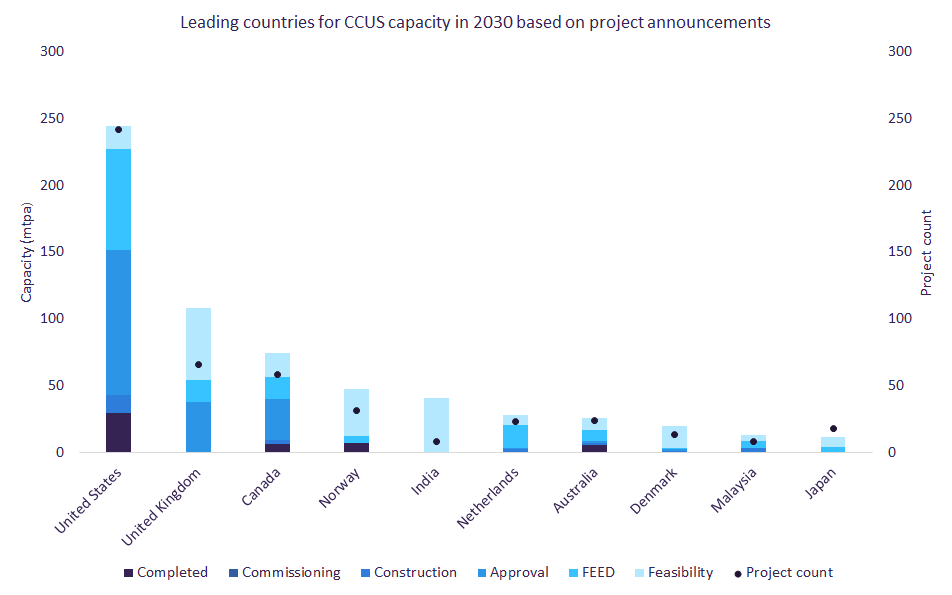
Carbon Capture, Utilization, and Storage (CCUS) is rapidly emerging as a pivotal technology in the global effort to combat climate change. According to GlobalData's CCUS Market Outlook and Trends H1 2025 report, global CCUS capacity is projected to reach 735 million tonnes per annum (mtpa) by 2030.
This ambitious growth is spearheaded by key players across various countries. Let's delve into the top companies propelling CCUS initiatives worldwide.
>> RELATED: Pioneering the Future: Companies Leading the Charge in BECCS Technology
1. United States: Pioneering CCUS Innovations
The United States stands at the forefront with an anticipated 244.77mtpa of CCUS capacity across 266 projects by 2030. This impressive figure is largely attributed to industry giants such as:
- ExxonMobil: Leading significant projects like the Baytown Refinery CCS Project in Texas.
- Prairie State Generating Company: Driving the Prairie State Energy Power Plant CCS Project in Illinois.
These companies are leveraging robust policy frameworks and financial incentives, including the Inflation Reduction Act and the Infrastructure Investment and Jobs Act, to advance their CCUS endeavors.
2. United Kingdom: Ambitious Climate Strategies
The United Kingdom is making substantial strides with a projected 107.93mtpa of CCUS capacity across 75 projects by 2030. Notable contributors include:
- Drax Group: Spearheading the Drax BECCS (Bioenergy with Carbon Capture and Storage) power plant in North Yorkshire.
- Sumitomo Corporation: Developing the Bacton Hydrogen Hub CCS project in Norfolk.
These initiatives align with the UK's commitment to integrating CCUS into its industrial decarbonization and broader climate strategies.
3. Canada: Early Adoption and Continued Growth
Canada has been a proactive adopter of CCUS technologies, with an expected 74.49mtpa of capacity from 62 projects by 2030. Key players driving this growth are:
- Shell Canada: Engaged in multiple CCUS projects across the country.
- Petro-Canada: Investing in carbon capture solutions to reduce emissions.
Canada's leadership in carbon pricing and substantial financial commitments underscore its dedication to CCUS development.

>> In Other News: Air Products, Air Liquide Signal Cooling of Hydrogen Enthusiasm
4. Norway: European CCUS Leader
Norway is set to achieve 47.74mtpa of CCUS capacity from 39 projects by 2030. A standout initiative is the Northern Lights CO₂ Storage Project, a collaboration between:
- Equinor: A major force in the energy sector.
- Shell: Bringing extensive experience in carbon capture.
- TotalEnergies: Contributing to the project's development.
This project represents the world's first cross-border CO₂ transport and storage facility, highlighting Norway's leadership in European CCUS efforts.
5. India: Emerging CCUS Market
India is rapidly emerging in the CCUS landscape, with a planned capacity of 40.71mtpa across ten projects by 2030. A significant contributor is:
- Synergia Energy: Leading the Cambay storage project, poised to be a major player in India's carbon capture initiatives.
The Indian government's proposed CCUS policies aim to foster industry clusters and provide financial incentives to achieve ambitious capacity targets.
6. The Netherlands: Comprehensive CCUS Policies
The Netherlands is projected to reach 27.69mtpa in CCUS capacity across 26 projects by 2030. Companies at the forefront include:
- Royal Dutch Shell: Actively involved in various CCUS projects.
- Equinor: Partnering in initiatives to enhance carbon capture capabilities.
The Dutch government's supportive policies and funding opportunities have been instrumental in advancing CCUS projects.
7. Australia: Incentivizing CCUS Development
Australia anticipates a total CCUS capacity of 25.37mtpa from 30 projects by 2030. Leading entities include:
- Santos Limited: Investing in carbon capture projects to mitigate emissions.
- Chevron Australia: Operating significant CCUS initiatives in the region.
Government incentives and funding have played a crucial role in promoting CCUS technologies across the country.
8. Denmark: Steady Progress in CCUS
Denmark is forecasted to have 19.54mtpa in CCUS capacity from 13 projects by 2030. Key participants are:
- Ørsted: Engaging in projects aimed at reducing carbon emissions.
- TotalEnergies: Collaborating on CCUS developments within the country.
Both domestic and EU-level support have facilitated Denmark's steady progress in CCUS initiatives.
9. Malaysia: Strategic CCUS Hubs
Malaysia is expected to achieve 13.3mtpa in CCUS capacity across nine projects by 2030. Notable companies include:
- Petronas: Leading efforts in developing CCUS hubs and infrastructure.
- Mubadala Petroleum: Partnering in projects to enhance carbon capture capabilities.
The Malaysian government's strategic roadmap and incentives are pivotal in advancing CCUS projects.
10. Japan: Laying the Groundwork for CCUS
Japan rounds out the list with a projected 11.52mtpa of CCUS capacity from 21 projects by 2030. Prominent contributors are:
- Mitsubishi Heavy Industries: Developing advanced carbon capture technologies.
- JGC Holdings Corporation: Participating in various CCUS projects to reduce emissions.
Japan's forward-looking policies and significant investments are establishing a strong foundation for CCUS development.
In summary, these companies are at the vanguard of the global CCUS movement, each playing a crucial role in their respective countries to combat climate change through innovative carbon capture solutions.
Subscribe to the newsletter
Daily decarbonization data and news delivered to your inbox
Follow the money flow of climate, technology, and energy investments to uncover new opportunities and jobs.
Companies


Latest issues
-
The US Hasn't Made Heavy Water Since 1982
Inside This Issue ⚛️ Aternium Completes FEED Studies for US Hydrogen, Heavy Water Project 🐄 Google, McKinsey Strike Brazil Carbon Removal Deal With Silvopasture Project 🔧 Cummins Selects Stargate ...
-
Why Colorado’s Koloma Has Japan’s Largest Utility Hooked
Inside This Issue ⚡ JERA Invests in Koloma to Explore Natural Hydrogen as a Future Low-Carbon Energy 🔬 New CATF Tool Provides Framework for Self-Assessment and Strengthening of Biomass Carbon Remo...
-
LNK Energies Targets $6.50 Hydrogen With No Federal Subsidies
Inside This Issue 🚛 MIT Startup Says It Can Turn Diesel Trucks Into Cheaper Hydrogen Haulers, See It at Disrupt 🏭 Baytown City Council Briefs: ExxonMobil Blue Hydrogen Agreement Approved 🌎 Colorad...
Company Announcements
-
A new interactive tool from Clean Air Task Force (CATF) provides a practical framework for the self-assessment and strengthening of biomass carbon removal (BiCRS) protocols to help ensure that carb...
-
LanzaJet Secures Financing to Scale SAF Production and Supply Global Customers
CHICAGO, Oct. 15, 2026 (GLOBE NEWSWIRE) -- LanzaJet, Inc., a leading next-gen fuels technology company and fuels producer, today announced fully committed new financing of at least $20 million to s...
-
44.01 and Frontier Advance Permanent CO₂ Storage Through In-Situ Mineralization
44.01's in-situ mineralization (ISM) process turns CO₂ into solid rock underground in a few years, after which the risk of reversal is functionally zero. >> In Other News: JERA Invests in ...
-
JERA Invests in Koloma to Explore Natural Hydrogen as a Future Low-Carbon Energy
JERA Co., Inc. (JERA), through its corporate venture capital arm JERA Ventures, has invested in Koloma, Inc. (Koloma), a U.S.-based natural hydrogen exploration and development company. The invest...