
Texas regulators have cleared ExxonMobil's Rose carbon storage project in Jefferson County. On September 15, 2026, the Railroad Commission of Texas voted 2-1 to allow up to 53 million metric tons of CO₂ storage. The decision clears the way for dedicated permanent storage on a Gulf Coast pipeline network that already exists.
ExxonMobil is a Spring, Texas-based energy major whose Low Carbon Solutions unit runs its carbon capture and storage (CCS) business. The commission regulates oil, gas, pipelines, and CO₂ storage wells.
What Did Texas Approve for ExxonMobil's Rose Project?
The Railroad Commission of Texas approved Rose's Class VI permit, No. 57803, in a 2-1 vote on September 15, 2026. That vote supplied the state authorization ExxonMobil needed on top of its federal permits.
The U.S. Environmental Protection Agency (EPA) issued three final Class VI permits for Rose on October 21, 2025. Class VI permits cover wells that inject CO₂ deep underground for long-term storage.
EPA approved Texas's Class VI primacy on November 12, 2025. The rule took effect on December 15, 2025. That handoff is now putting Gulf Coast CCS projects in the fast lane.
Rose's application was protested and went to a hearing in March 2026. Commissioner Wayne Christian cast the only vote against the permit.
Energy Intelligence described the Rose decision as the first major test of Texas's newly granted Class VI authority.
>> In Other News: CHAR Tech Nears Final Mechanical Installation at Thorold Facility
Key Facts
- State approval: Railroad Commission of Texas, 2-1 vote, September 15, 2026
- Federal permits: three EPA Class VI permits issued October 21, 2025
- Storage limit: up to 53 million metric tons of CO₂ over 13 years, or about 4 million metric tons per year
- Wells: three injection wells in the Fleming and Upper Frio formations, Jefferson County
- Pipeline: a new 18-mile line from Mid-County industrial sources
- Network: more than 1,300 miles of ExxonMobil CO₂ pipeline and about 9 million metric tons per year under contract
How Much CO₂ Can Rose Store?
Rose can store up to 53 million metric tons of CO₂ over a 13-year injection period, according to EPA. That averages roughly 4 million metric tons per year, based on the commission's project summary.
EPA's permits cap combined injection at 5 million metric tons per year. Each well may average between 1.1 million and 1.67 million metric tons annually.
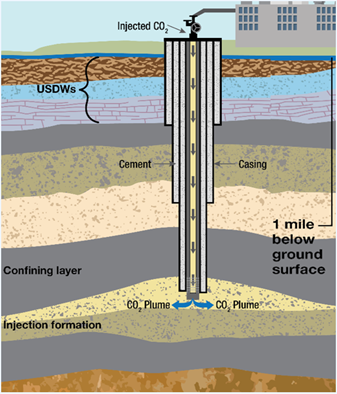
The CO₂ will go into the Fleming and Upper Frio sands. Injection intervals start between roughly 3,400 and 7,525 feet below ground, according to the commission.
Thick shale layers seal those zones. The deepest Upper Frio reservoirs sit beneath about 400 feet of Anahuac Shale.
- Site footprint: more than 13,000 acres of privately owned land, per ExxonMobil
- Monitoring network: three water monitoring wells, one in-zone well, and one above-zone well
- Post-injection care: monitoring for 50 years after injection ends, or until the commission approves a non-endangerment demonstration
An 18-mile pipeline will carry CO₂ from industrial facilities in Mid-County to the storage site near the Cheek community.

"We've worked diligently to meet or exceed the rigorous standards set. Carbon capture and storage projects will create growth, jobs and economic opportunity, and we're pleased to play a leading role in advancing their deployment."
Barry Engle, President, ExxonMobil Low Carbon Solutions
Barry Engle made those comments when EPA issued the federal permits in October 2025.
How Does Rose Fit into ExxonMobil's Shared CCS Network?
Rose adds dedicated storage to pipelines ExxonMobil already operates. The company's 2023 Denbury acquisition brought more than 1,300 miles of CO₂ pipeline, including nearly 925 miles in Louisiana, Texas, and Mississippi.
ExxonMobil has about 9 million metric tons per year of CO₂ under contract with third-party customers, per its Low Carbon Solutions website. In August 2026, the company described the system as a "carbon superhighway" linking multiple emitters to multiple storage sites.
That setup changes the equation for emitters. A fertilizer plant or power station can hand off captured CO₂ without developing its own storage site. ExxonMobil pitches this as faster deployment with one point of accountability.
CF Industries, the Illinois-based ammonia producer, was the network's first customer. Its Donaldsonville Complex CCS start-up in Louisiana sends up to 2 million metric tons of CO₂ per year into the system.
ExxonMobil has been storing that CO₂ through enhanced oil recovery at permanent geologic sites. CF says ExxonMobil plans to shift to dedicated permanent storage, starting with Rose.
Other customers are already lined up across the network:
- NG3 gas treating, Gillis, Louisiana: up to 1.2 million metric tons per year, now operating as the second active CCS project in Louisiana
- Linde clean hydrogen, Texas: up to 2.2 million metric tons per year under contract from its Beaumont blue hydrogen facility
- Calpine Baytown Energy Center, Texas: up to 2 million metric tons per year from a natural gas cogeneration plant near Houston
Louisiana, home to the Donaldsonville and NG3 projects, has also moved to keep its CCS rules consistent statewide.
>> RELATED: ExxonMobil Signs Carbon Capture Agreement With CF Industries in Mississippi
Captured CO₂ on the system can move to dedicated storage, enhanced oil recovery, or industrial use, according to ExxonMobil. Rose is the newest dedicated storage destination.

The infographic traces how captured CO₂ from network customers can move through ExxonMobil's pipelines to permanent storage at Rose.
Rose averages roughly 4 million metric tons per year. The whole network has about 9 million metric tons per year under contract.
Which Texas Storage Projects Are Next in Line?
Rose is one of several Texas storage sites moving through the commission. A March 2026 legal review of the agency's tracker counted 17 active Class VI applications.
The table below shows the latest public status for five of them.
| Project | Operator | County | Wells | Latest Status |
|---|---|---|---|---|
| Rose | ExxonMobil | Jefferson | 3 | Approved, September 15, 2026 |
| Brown Pelican | Oxy Low Carbon Ventures | Ector | 3 | Approved, amended permit posted August 2026 |
| Bluebonnet | Bluebonnet Sequestration Hub (Oxy) | Chambers and Liberty | 6 | Draft permit notice, July 2026 |
| Bayou Bend East Phase 1 | Chevron, TotalEnergies, Equinor | Jefferson | 6 | Pending data response (April 2026 tracker) |
| Sunflower | ExxonMobil | Jefferson and Liberty | 3 | Under review (April 2026 tracker) |
Bluebonnet has reached the draft permit stage. The Occidental hub plans to store 157.2 million metric tons over 20 years, according to the commission's draft permit notice.
Brown Pelican will store CO₂ from 1PointFive's STRATOS direct air capture plant in Ector County. The commission's project summary lists 9.11 million metric tons over 12 years.
Bayou Bend brings together Chevron, TotalEnergies, and Equinor. ExxonMobil's own Sunflower site would cover about 25,000 acres in eastern Liberty and western Jefferson counties.

"Texas has successfully managed underground injection wells for decades while protecting drinking water, and I'm confident they'll continue this success with Class VI wells."
Scott Mason, Regional Administrator, EPA Region 6
Scott Mason said that when EPA issued Rose's federal permits in October 2025. Before primacy, 64 of the 239 Class VI well permits under review at EPA were for Texas wells, according to the Bipartisan Policy Center.
Moving that backlog to state review is part of a national carbon storage map that is being redrawn.
The Road from Permit to First Injection
No first-injection date for Rose has been announced publicly. The commission says Class VI permits that received public comments become effective 45 days after issuance.
The next steps follow a set order. ExxonMobil must finish well construction and meet the permit's pre-injection requirements. It then needs a separate authorization to inject from the commission.
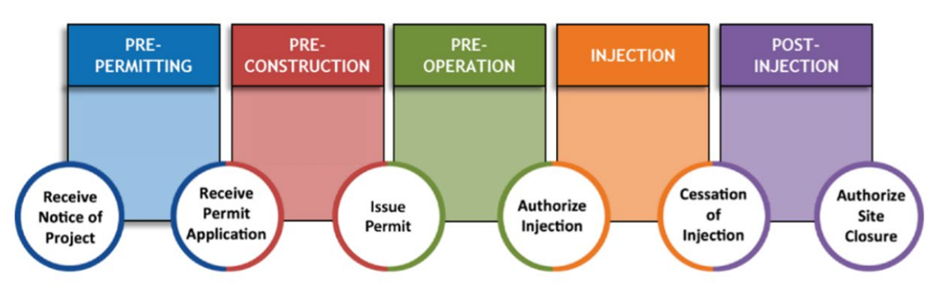
EPA's Class VI lifecycle graphic shows the pre-operation and injection phases Rose moves into after its permit approval. Courtesy of the U.S. EPA.
Customer tie-ins along the 18-mile Rose pipeline are the next milestone to watch. CF has already said its Donaldsonville volumes will shift to dedicated storage starting with Rose.
Official Yara International overview of carbon capture and storage in action at the Sluiskil plant in the Netherlands, which can capture and liquefy up to 800,000 tons of CO₂ per year from ammonia production for transport and permanent storage beneath the North Sea.
Other markers include Sunflower's review and a final decision on Bluebonnet.
Frequently Asked Questions
When will ExxonMobil start injecting CO₂ at Rose?
No start date has been announced publicly. ExxonMobil must finish well construction and meet pre-injection requirements. It then needs a separate authorization to inject from the Railroad Commission of Texas.
Where will Rose's CO₂ come from?
Rose will take CO₂ from several industrial emitters through ExxonMobil's Gulf Coast pipeline network. A new 18-mile pipeline links Mid-County industrial sources to the Jefferson County storage site.
How much CO₂ does ExxonMobil have under contract?
ExxonMobil reports about 9 million metric tons per year of CO₂ under contract with third-party customers. Rose alone can accept up to 53 million metric tons over 13 years.
Rose gives Gulf Coast emitters a permanent home for up to 53 million metric tons of CO₂. The pipes are already in the ground. Now the storage has its green light.
For ongoing coverage of carbon removal, BECCS, and corporate CDR procurement, subscribe to Decarbonfuse.com.
Subscribe to the newsletter
Daily decarbonization data and news delivered to your inbox
Follow the money flow of climate, technology, and energy investments to uncover new opportunities and jobs.
Latest issues
-
North America's RNG Food Waste Giant Just Got Bigger
Inside This Issue ♻️ Vanguard Renewables and Generate Upcycle Unite to Create North America's Largest Food Waste-to-RNG Platform 🌍 Google Is Buying Climate Impact on Two Clocks at Once ✈️ Infinium...
-
Europe's First Full-Scale CO2 Storage Is Now Live
Inside This Issue 🌊 EU's First Full-Scale Carbon Storage Site Goes Live as INEOS Greensand Begins Operations ⚡ IRS 45Z Guidance Reshapes U.S. Biofuel Economics 🏭 Avnos Introduces the Avnos HDAC Mo...
-
Mammoth DAC Plant in Iceland Hits 5x Carbon Removal Output
Inside This Issue 🌱 Climeworks Cuts Mammoth DAC Operating Costs by Over 50% 💰 ExxonMobil Wins Texas Approval for $5bn Carbon Capture Project 🌐 Open Coalition Approves Work Plan and Defines Secreta...
Company Announcements
-
CHAR Tech Nears Final Mechanical Installation at Thorold Facility
Company Update Installation of the pyrogas piping at the Thorold Facility begins this week, the final major construction step ahead of end-to-end commissioning Commercial ramp up and operations r...
-
Agreements span the Rockies, Midwest, and U.S. Gulf Coast and could support recovery of more than 70 million incremental barrels of oil LOS ALAMOS, N.M.--(BUSINESS WIRE)--Today, Spiritus, an energ...
-
Germany's Uniper Signs Offtake Deal for Synthetic Green Jet Fuels
FRANKFURT, Sept 23 (Reuters) - German state-owned utility Uniper signed a deal to procure synthetic sustainable jet fuel (eSAF) from US-based Arcadia eFuels, the companies said on Wednesday. Unipe...
-
The 2026 edition adds delivery risk to credit quality for the first time, giving CDR developers, investors, and buyers a single benchmark for whether a project is both high-quality and positioned t...