
Second UK CO2 Storage Licensing Round Yields Interest for Over 2 Million North Sea Acres
Published by Todd Bush on March 25, 2026
The North Sea Transition Authority (NSTA) has received bids from carbon storage developers for more than 2 million acres of North Sea seabed as part of its second carbon storage licensing round.
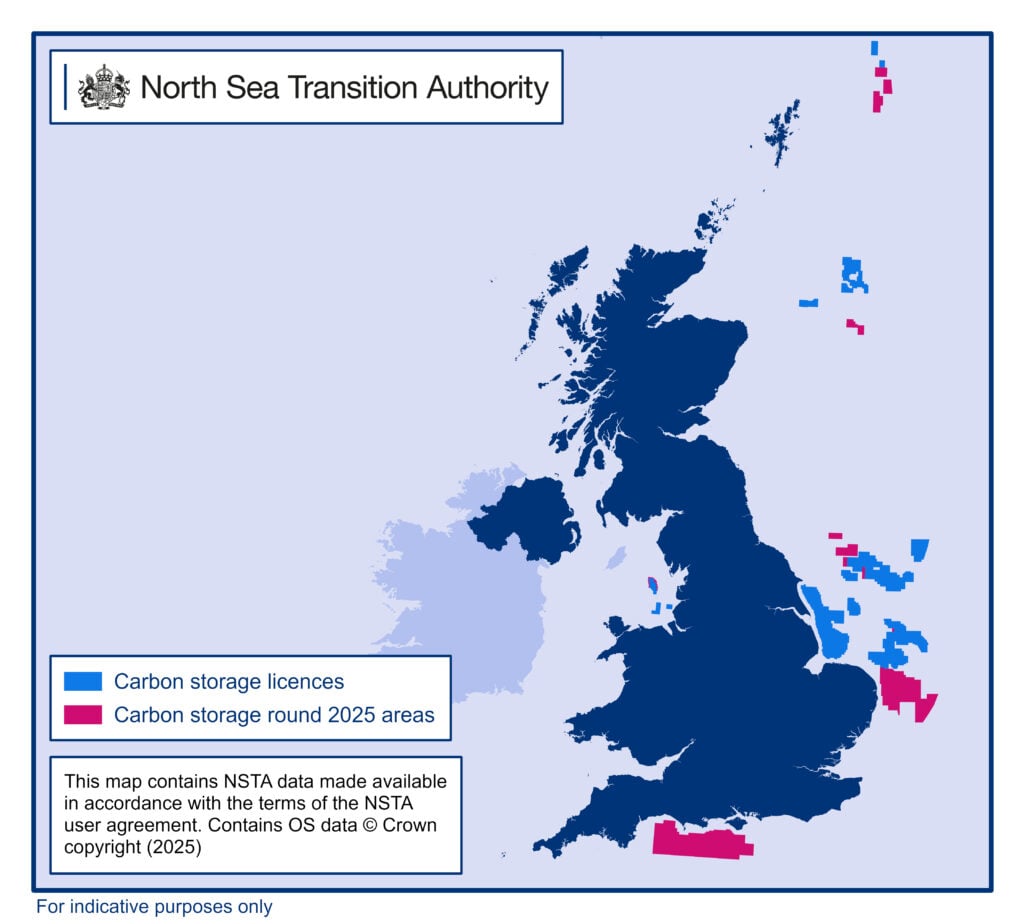
The licensing round was opened in December 2025, offering five locations offshore Scotland and nine offshore England for exploration and appraisal, with the stores offering up to 2 gigatons of additional CO2 storage capacity.
>> In Other News: AirCapture and Almanac Beer Co. Launch World’s First Commercial Beer Carbonated With Co2 Captured From the Atmosphere With Direct Air Capture
The areas fall into two broad categories, including depleted hydrocarbon fields selected by the NSTA, and saline aquifer sites identified following a Call for Nominations, which enabled industry partners to indicate sites of interest that offered a greater chance of successful project delivery.
Following the closure of the carbon storage licensing round today, March 24, the NSTA reported that it had received bids for more than 2 million acres of seabed.
The applications will now be reviewed, with the NSTA to work with the applicants and other stakeholders before deciding on whether or not to award licenses. This will include further consultation and discussions with bodies such as The Crown Estate and Crown Estate Scotland to ensure any awarded areas are spatially planned and coordinated alongside other marine sectors.
“The growth of the carbon storage sector is great news for UK jobs, growth, skills and the supply chain. The UK holds a unique position in developing offshore energy in general, including carbon storage. As we transition, we benefit from decades of experience in the North Sea, commercial know-how, optimal geological conditions, and spatial co-ordination,” said Andy Brooks, NSTA Director of New Ventures.
The UK’s first carbon storage licensing round in September 2023 saw the award of 21 carbon storage licenses. The NSTA subsequently awarded the first storage permits to two projects – Endurance and HyNet – allowing them to proceed towards first injection.
The Endurance site, off the coast of Teesside, which could store up to 100 million tons of CO2, received a permit in December 2024, and Liverpool Bay-based HyNet, which could also store up to 100 million tons of CO2 over 25 years, received three permits in April 2025.
Endurance recently started drilling an appraisal well, which follows the one spudded in the Hewett field in the Southern North Sea by the Bacton CCS project.
The first injection from both projects is possible in 2028.
Subscribe to the newsletter
Daily decarbonization data and news delivered to your inbox
Follow the money flow of climate, technology, and energy investments to uncover new opportunities and jobs.
Latest issues
-
Verra Landed CCP Approval. What Changes for DAC?
Inside This Issue ✅ Verra's CCS Credits Just Got the Integrity Seal Buyers Want 💰 South Korea Unveils $747 Billion Energy Transition Plan Through 2035 💧 Hydrogen and Carbon Capture and Storage in ...
-
Quebec Wood Waste Just Became Jet Fuel
Inside This Issue 🌲 ARC Bio Tests a Refinery Shortcut to Forest-Based SAF 💧 Scientists Just Found a New Way to Make Hydrogen from Water 🤝 How Channel Partnerships Are Helping More Organizations Ta...
-
How Vaulted Deep Turned Offtakes Into $35M Debt
Inside This Issue 🏦 How Carbon Removal Offtakes Are Starting to Unlock Commercial Debt 🌉 California Opens the Door to a Three-Way Carbon Market 🧪 New Material Developed at Oregon State Provides Bo...
Company Announcements
-
Gevo and ClimeFi Complete Carbon Removal Transaction, Advancing Gevo's Growing Carbon Business
Transaction supports Gevo's path toward a carbon business exceeding $30 million in annual revenue from existing operations ENGLEWOOD, Colo., Oct. 08, 2026 (GLOBE NEWSWIRE) -- Gevo, Inc. (NASDAQ: G...
-
ZeroMe Launches OffsetC App to Bring Transparency and Personal Agency to Carbon Offsetting
NEW YORK, Oct. 07, 2026 (GLOBE NEWSWIRE) -- ZeroMe, Inc. today announced the launch of the OffsetC carbon offset app, designed to make buying carbon credits more transparent, more accessible, and e...
-
CALGARY, AB, Oct. 8, 2026 /CNW/ - Gas Liquids Engineering Ltd. (GLE) is pleased to announce the successful completion of its detailed engineering scope for Enhance Energy Inc.'s Origins Carbon Capt...
-
Ballard Secures 4.8MW Order From Siemens Mobility to Power Hydrogen Trains in Romania
24 FCrail™ fuel cell modules will power 12 Mireo Plus H trains, Romania’s first hydrogen fleet and the platform’s largest deployment to date. VANCOUVER, CANADA and MUNICH, GERMANY – Ballard Power ...